
New Construction Water Softener in Raleigh, NC
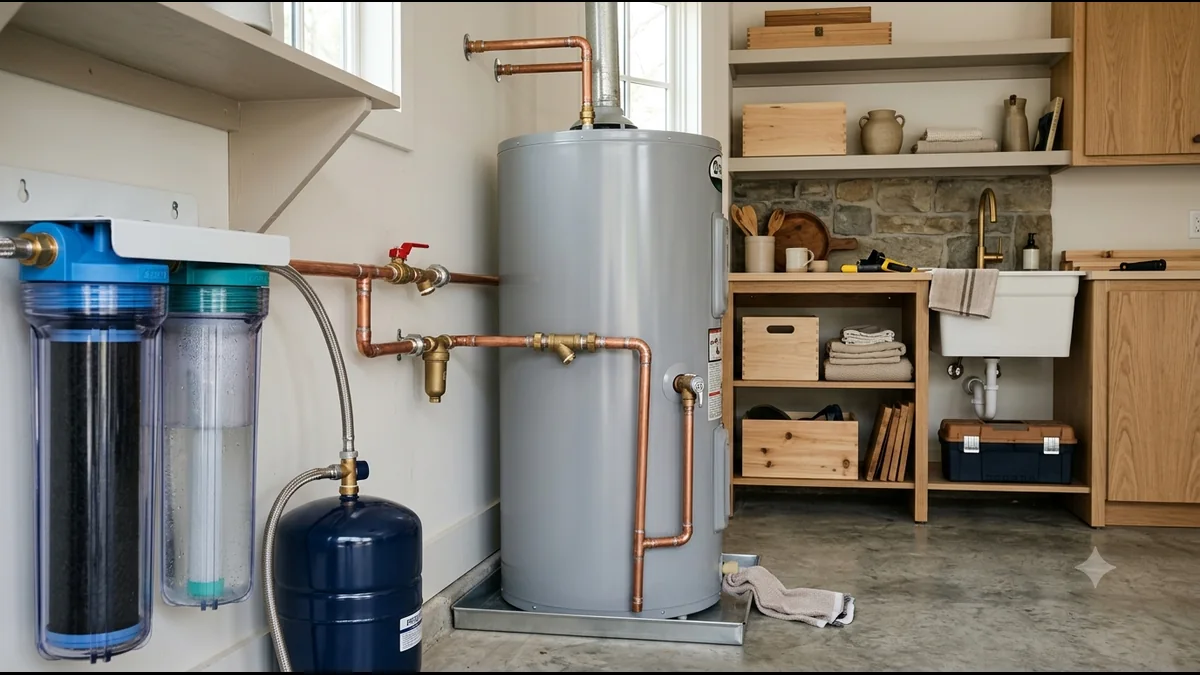
Direct answer: A newly built Raleigh home is the best moment to install whole-home water treatment, because every appliance it protects still has its full service life ahead of it and the plumbing has never been easier to reach. Raleigh Water runs about 1.6 grains per gallon — slightly hard on the WQA scale, but not mineral-free — and mineral deposits accumulate from the first day the water is on. An all-in-one softening plus carbon system protects the house from year one.
Why put a water softener in a brand-new Raleigh house?
Because the clock on every appliance starts the day the water is turned on, and it never resets. A new build hands you a factory-fresh water heater, an unscaled dishwasher, a washing machine with zero cycles, clean glass shower enclosures and unmarked fixtures. What eventually degrades all of those is not a single event but the slow arithmetic of mineral deposits, one gallon at a time, across ten or fifteen years of ownership.
Raleigh Water's hardness is about 1.6 grains per gallon, which sits in the slightly-hard tier of the WQA scale — the same one the Hach Total Hardness Test Kit (Model 5-B) uses. That is genuinely good news, and it is not the same as mineral-free. Calcium and magnesium are dissolved in that water, and they come out of solution wherever water evaporates or heats — on glassware, on aerators, on shower glass, and on the heating surfaces inside a water heater. Our own testing across the wider service area measures 1.6 to 3.7 grains per gallon depending on ZIP code, so a new Raleigh-area address can also land higher than the system average suggests.
What's the advantage of installing during construction instead of later?
Access, cost, and the amount of accumulated deposit you never have to deal with.
| Install timing | Condition of the house | Job complexity | What gets protected |
|---|---|---|---|
| During the build or right after closing | Everything new; garage empty; plumbing exposed or accessible | Simplest and cleanest | The full service life of every appliance and fixture |
| Two to five years in | Early film on glass, first deposits on aerators | Standard retrofit | Most of the remaining service life |
| Ten years in | Years of accumulation inside the water heater | Standard retrofit | What's left, plus the next water heater |
| After a water heater failure | Scale already contributed to the failure | Retrofit plus a heater replacement | The replacement unit onward |
There's also a scheduling advantage people underestimate: an empty house is the easiest house to work in. No stored boxes in the garage, no furniture to move, no household to work around.
Does a builder's softener loop mean I already have a softener?
No — a loop is pre-plumbed pipework and nothing more. Many Raleigh-area builders rough in a softener loop, and it's worth asking whether yours did, because it makes the eventual installation tidier and faster. But until equipment is connected to it, water flows straight past and arrives at your fixtures exactly as the utility delivered it. A loop is a head start on the install, not a substitute for one.
It's also worth knowing that a loop is sized and placed by the builder's standard plan, not by your water. Where the loop sits determines convenience; what goes into it should be determined by an actual hardness reading at your address.
What about chlorine taste in a new Raleigh home?
That's the half of the problem softening doesn't touch, and it applies to new construction exactly as much as to a 1970s ranch. Raleigh Water normally disinfects with chloramine, which holds a residual with very little taste or odor. Once a year — historically from about the last week of February through the first week of April, with the 2026 period running February 26 to April 2 — it converts to free chlorine only and flushes the distribution system, on the N.C. Department of Environmental Quality's recommendation. That's when a lot of households first notice a pool-water taste. The dates shift, so watch for the City's own announcement.
Beyond taste, disinfection byproducts form when disinfectant reacts with organic matter in source water. The EWG Tap Water Database lists HAA9 at 19.9 ppb and TTHM at 21.7 ppb for Raleigh's system — compliant with EPA limits, and measured against EWG's stricter non-regulatory guidelines. Activated carbon removes disinfection byproducts effectively, and it's the same stage that removes the seasonal chlorine taste.
That's why the system we install is an all-in-one: softening resin plus an activated carbon stage in a single whole-home unit. The softening half protects the equipment; the carbon half handles what you taste and smell. Buying them as one unit, at the moment the house is new, is the cleanest version of this decision you'll ever get.
What does a new construction water softener cost in Raleigh?
Locally installed all-in-one systems are sized and priced after a free water analysis, well under what national big-brand installers commonly quote ($6,000 to $12,000) for comparable whole-home coverage. What you're quoted depends on household water usage and what the test at your address finds — which is why the analysis comes first and the number comes second.
Operating cost is where Raleigh new builds do particularly well. Starting from roughly 1.6 grains per gallon, a softener regenerates infrequently and consumes very little salt, so the running cost is modest for the life of the system. Low hardness makes protection inexpensive here — it is a reason to install early, not a reason to wait. Our Raleigh water softener cost page breaks the pricing down further.
Protect the new house from day one
Take our 60-second water quiz to see which all-in-one system fits your new Raleigh build, or book a free water analysis and find out what your specific address is delivering before the first appliance runs a thousand cycles.
Frequently Asked Questions
I'm closing on a new build in Raleigh next month — should I install before or after I move in? Before, if scheduling allows. The house is empty, the garage is clear, and the plumbing is easy to reach, which makes it the simplest install you'll ever get. It starts with the free water analysis at the address, which can generally be done once the water service is on.
My builder told me Raleigh water is soft — do I still benefit from a softener? Yes, and both things can be true depending on the scale. Builders often go by an older, USGS-style scale where 1.6 grains per gallon reads as soft; we classify on the Water Quality Association (WQA) scale — the same one the Hach Total Hardness Test Kit uses — where 1.6 gpg is slightly hard. Either way, that water still carries dissolved calcium and magnesium that deposit on fixtures and inside the water heater over years — plus the carbon half of the system handles the chloramine taste and disinfection byproducts that softening never touches.
Will installing a system void my new home warranty? Warranty terms vary by builder, so read your own documents and ask before scheduling. What matters practically is that the work is done with licensed plumbing and documented properly, which is standard for a whole-home install.
Does new plumbing resist scale better than old plumbing? New pipe starts clean, which is an advantage, but it doesn't change the water running through it. Deposits begin accumulating from the first day regardless of pipe age — new construction simply gives you the option of never letting them start.
Is it worth doing this before the appliances are even installed? The timing that matters is before the appliances start running cycles, not before they're physically in place. Once the water heater has been heating untreated water for a few years, some of the protection you were buying has already been spent.
Related reading: Water Softener Installation in Raleigh | Water Heater Scale Buildup Prevention | Does Soft Water Make Appliances Last Longer? | New Construction Water Softener in Cary, NC
Answer nine practical questions, then request a written quote or well-water analysis.
Start My Water Analysis