
New Construction Water Treatment in Durham, NC
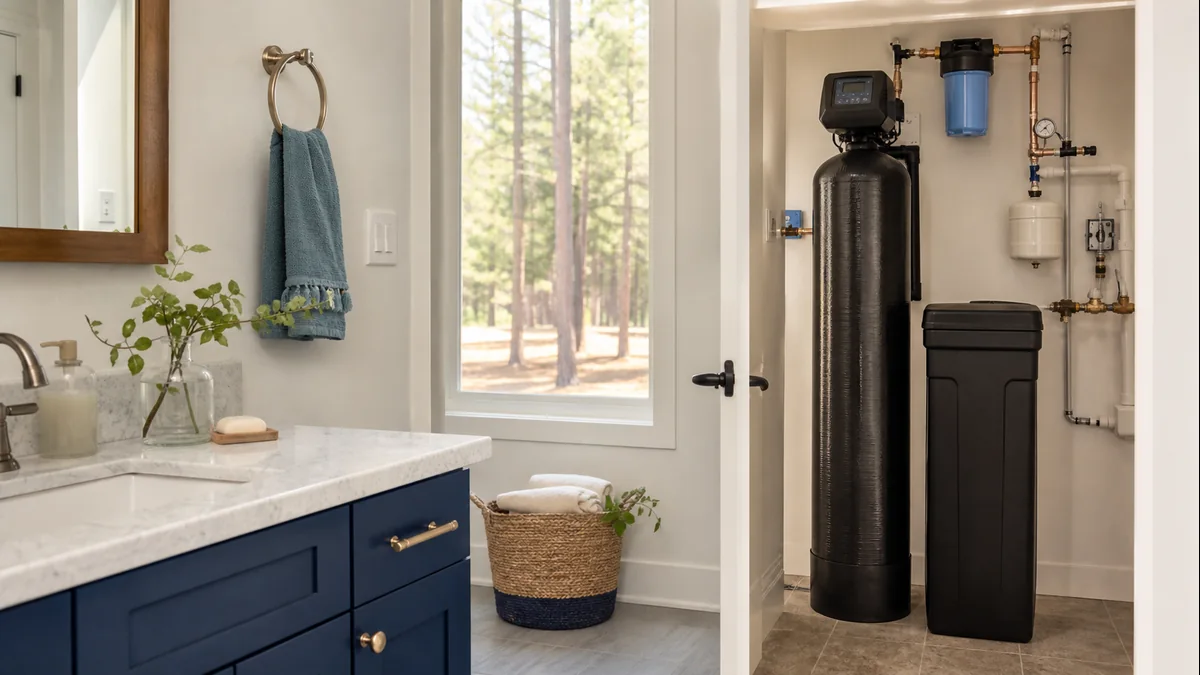
Direct answer: Durham runs its own utility and publishes no townwide hardness number — unlike Cary or Apex, there's no figure to check before you close. Durham's 2025 water quality report does confirm chlorine-and-chloramine disinfection with compliant TTHM and HAA5 levels. For a new Durham build, a free water test is the only number that actually describes your tap, and an all-in-one softening-and-carbon system covers whatever that test finds.
Why doesn't Durham publish a townwide hardness number?
Durham operates its own water utility rather than buying finished water from a neighboring town, and its Department of Water Management simply doesn't include hardness on its published reports. Cary's FAQ states one figure; Apex's annual report states another. Durham's 2025 Annual Drinking Water Quality Report — the current one, read in full for this article — tracks more than 150 contaminants and never mentions hardness once.
That's not an oversight to worry about. Hardness isn't a federally regulated contaminant, so a utility reports it only if it chooses to, and Durham hasn't. For a new-build buyer, that leaves a real gap: a Cary buyer can at least anchor expectations to a published range before testing. A Durham buyer starts from nothing published, which makes a free water test the actual starting point rather than a nice-to-have.
Where does Durham's water come from, and how is it treated?
Durham draws raw water from two surface reservoirs it owns and operates — Lake Michie and the Little River Reservoir — and treats it at two plants, the Williams Water Treatment Plant and the Brown Water Treatment Plant. That's a different setup from Raleigh Water and from the shared Cary/Apex Water Treatment Facility on Jordan Lake; Durham's supply, sources, and treatment train are entirely its own.
Both plants disinfect with chlorine and chloramines together, the same two-stage approach used across the Triangle. Durham's 2025 report lists a running annual average chlorine residual of 0.63 ppm and chloramines at 1.5 ppm, both well under the 4.0 ppm federal limit for each. That residual is what keeps the water safe between the plant and a new home's meter, and it's also where taste and disinfection byproducts come from.
What does Durham's own 2025 report confirm, and what does it leave out?
Here's what a careful read of the current report actually tells a new-build buyer, and where the trail runs out:
| Category | What the 2025 report confirms | What it does not tell you |
|---|---|---|
| Source & treatment | Lake Michie and Little River Reservoir, treated at Williams and Brown plants | — |
| Disinfectant residual | Chlorine 0.63 ppm and chloramines 1.5 ppm running annual average, both compliant | Residual at a specific address on a given day |
| TTHM | Highest locational average 56 ppb, compliant with the 80 ppb limit | Level at your new build's exact tap |
| HAA5 | Highest locational average 49 ppb, compliant with the 60 ppb limit | Level at your new build's exact tap |
| PFOA / PFOS | Tracked as unregulated contaminants; readings ran as high as 5.7 ppt and 7.2 ppt | Whether those readings apply to your street |
| Hardness | Not reported anywhere in the document | Everything — there is no figure to start from |
What does the missing hardness number mean for a new Durham build?
It means the softening side of a system has to be sized from an actual test, not a published starting point. That's true everywhere, but in Durham it's the only option — there's no townwide figure to sanity-check a test result against, high or low.
A free analysis at your new address is what tells you whether your water lands slightly hard, moderately hard, or somewhere else entirely on the Water Quality Association scale, the same one the Hach Total Hardness Test Kit, Model 5-B, reads out in.
The carbon side doesn't wait on that number at all. Durham's own 2025 data already shows compliant but real TTHM and HAA5 levels, plus PFOA and PFOS readings that reach into the range EPA's national PFAS rule addresses with a 4.0 parts-per-trillion limit for each. Those figures apply to a new Durham build the same day water service turns on, whatever the hardness test eventually shows.
EPA's own National Primary Drinking Water Regulations table lists TTHM's potential effect from long-term exposure above the MCL as "liver, kidney or central nervous system problems; increased risk of cancer," and HAA5's as "increased risk of cancer." Durham's 2025 numbers stay under both limits — legally compliant is a ceiling EPA itself set, not a promise of zero exposure, and it's exactly the ceiling a carbon stage is built to sit under with room to spare.
Does a Durham builder's softener loop matter if there's no town figure to size it against?
Not by itself. Many new Durham subdivisions rough in a softener loop the same way Wake County builders do, and it's worth asking whether yours has one, since it makes the eventual install tidier. But a loop is empty pipework — water runs straight through it until equipment is connected, and the loop's placement tells you nothing about what's actually in your water.
Because Durham publishes no hardness figure, a loop here carries even less information than a loop in a town with a published number. The loop tells you where a system will connect. Only a test at your address tells you what to put in it.
How do you find your new Durham home's actual hardness without a town figure?
Two ways, and they answer different questions. A free water analysis from a local installer tests your specific tap for hardness, chlorine and chloramine, and gives you a sizing number the same visit.
For a DIY read between now and then, the Hach Total Hardness Test Kit, Model 5-B, is a drop-count titration kit that reports directly in grains per gallon on the Water Quality Association scale — the same scale that classifies 1.0 to 3.5 gpg as slightly hard and 3.5 to 7.0 gpg as moderately hard.
Neither test requires a townwide figure to interpret. Both stand on their own, which is exactly what a Durham new build needs when the utility's own report is silent on the question.
Get your new Durham build tested
There's no townwide hardness number to compare against in Durham, which means the free water test at your own address is doing work a published figure would normally do elsewhere. Take our 60-second water quiz to see which all-in-one system fits your new build, or book the free analysis directly and get an actual reading before your water heater runs its first thousand cycles.
FAQ
I just closed on a new build in Durham and searched for the town's hardness number — why can't I find one? Because Durham doesn't publish one. Its 2025 Annual Drinking Water Quality Report covers more than 150 monitored contaminants and never lists hardness, since it's not a federally regulated figure and Durham hasn't chosen to report it separately. A free water test at your address is the number that fills that gap.
Is Durham's water unsafe if there's no hardness figure published? No — hardness and safety are separate questions. Durham's 2025 report shows 100% compliance on every regulated contaminant it does track, including TTHM and HAA5, both under their federal limits. The missing hardness figure just means there's nothing published to size a softener against, not a safety concern.
My new home is in Durham but my sister's is in Cary — why does her city publish a number and mine doesn't? Durham and Cary are separate utilities that make separate reporting choices; hardness isn't required by EPA, so each town decides on its own whether to publish it. Cary's figure describes Cary's plant average, and it wouldn't apply to your Durham address even if Durham did publish one — a test at your own tap is the only number that actually does.
Does the missing hardness figure mean Durham's water might be harder than Cary's or Apex's? There's no way to know from published numbers, and guessing in either direction isn't useful. What's known is that Durham's own reservoirs and treatment train are different from the Cary/Apex system, so borrowing a neighboring town's figure for a Durham address would just be a different kind of guess than not having one at all.
What's actually in Durham's water besides possible hardness? A chlorine-and-chloramine disinfectant residual, plus compliant but measurable TTHM and HAA5 from Durham's 2025 report, and PFOA/PFOS readings tracked as unregulated contaminants that reach into the range EPA's national PFAS rule addresses. An activated carbon stage handles all of that regardless of what the hardness test eventually shows.
How soon after closing can I get my new Durham home tested? As soon as water service is active at the address, which for most new builds is at or before closing. Scheduling the free analysis early means you have an actual number, not a guess, before appliances and fixtures start accumulating whatever the test finds.
Sources
- City of Durham — 2025 Annual Drinking Water Quality Report
- City of Durham — Water Treatment Process
- City of Durham — Water Quality & Treatment
- City of Durham — PFAS Treatment Upgrade Project
- EPA — National Primary Drinking Water Regulations
Related reading: Water Softener Installation in Durham, NC | New Construction Homes in Triangle NC: When Should Water Treatment Go In? | How to Test Water Hardness at Home in Durham, NC | PFAS & Forever Chemicals in Durham, NC | Water Softener Cost in Durham, NC
Answer nine practical questions, then request a written quote or well-water analysis.
Start My Water Analysis