
New Construction Water Treatment in Fuquay-Varina, NC — Timing on a Blended Supply
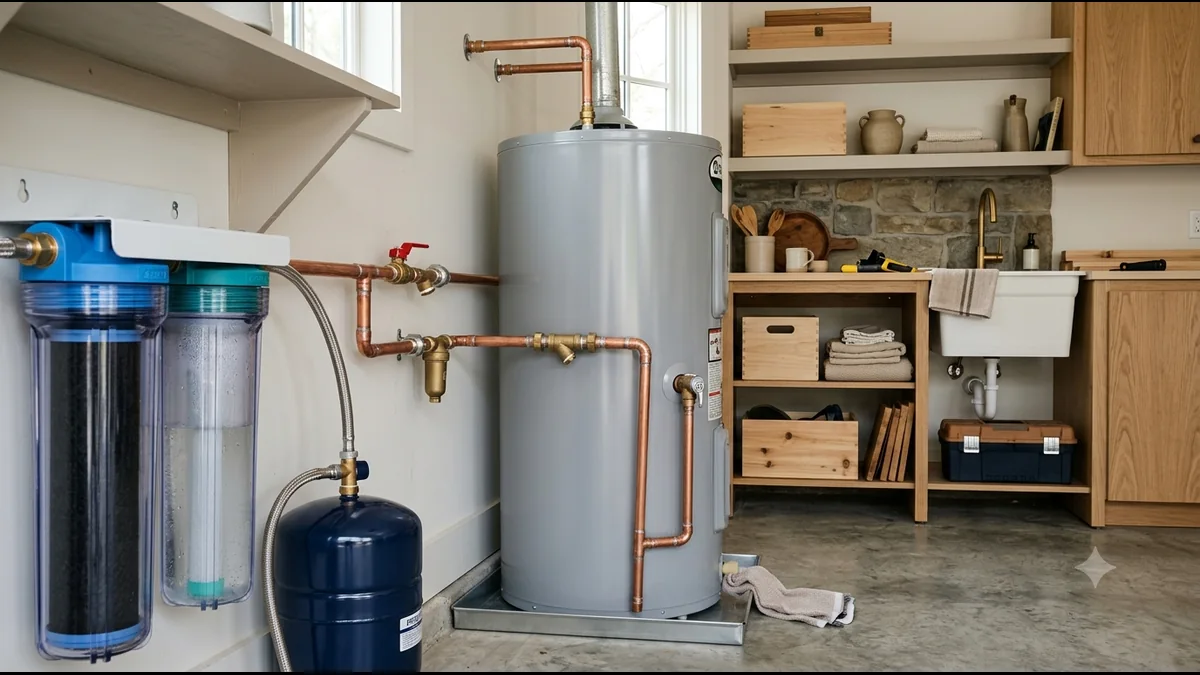
Direct answer: Fuquay-Varina buys water wholesale from three separate systems, so the blend reaching a given new build depends on where in town it sits — a townwide average can't describe your address. The town's own figure is 40 ppm hardness, but a test at your new home is the number that actually matters. Acting at move-in, before appliances accumulate any buildup, is the cheapest point to install treatment.
Why does Fuquay-Varina's water supply change depending on where you live?
Because the town doesn't run one treatment plant on one source — it buys finished water wholesale and blends it across the distribution network. The Town of Fuquay-Varina's own Public Utilities page states plainly: "The Town of Fuquay-Varina purchases water for consumption from the City of Raleigh, Harnett County, and Johnston County." Raleigh draws from Falls Lake, Harnett County draws from the Cape Fear River, and Johnston County draws from the Neuse River — three different source rivers feeding into one town's pipes.
For a new-construction buyer, that matters more than it sounds like it should. A subdivision going up on one side of Fuquay-Varina could be drawing mostly from one blend, while a subdivision a few miles away draws from another, and the mix at either address can shift depending on how the town is balancing supply that week. There's no single "Fuquay-Varina water" the way there's a single "Raleigh Water" — there's whatever combination happens to reach your specific meter.
Does the town publish a hardness number, and does it apply to my house?
Yes, and it's worth using honestly rather than ignoring. Fuquay-Varina's own utilities FAQ lists "Town of Fuquay-Varina drinking water hardness - 40 ppm" on a published scale that classifies 17.1–60 ppm as "slightly hard" — the same 40 ppm figure works out to roughly 2.3 grains per gallon, which lands in the same slightly hard band on the WQA/Hach scale the Hach Total Hardness Test Kit, Model 5-B, reads out in.
That figure is a townwide number, though, built from a blend of three different sources feeding different parts of town at different times. A new-construction address on a distribution line drawing more heavily from one source than another could read meaningfully higher or lower than 40 ppm. The published average is a real, useful starting point — it just isn't a substitute for testing the water actually arriving at your new home.
When during construction should I plan for a water treatment system?
As soon as the plumbing rough-in is being planned, not after drywall goes up. A whole-home system needs a spot on the main line — typically a garage, utility closet, or mechanical room — with room to access it and a nearby drain. Deciding that location while the space is still open framing costs nothing extra in most cases; deciding it after finishes, tile, and flooring are already in usually means retrofitting around them.
Some Fuquay-Varina builders rough in a bypass loop for a future softener; some don't. A loop by itself is empty pipe — water runs straight through until equipment is actually connected to it — so ask your builder directly whether one is included rather than assuming either way.
Is it better to install at closing or wait until after move-in?
At closing, if the schedule allows it, and within the first few weeks after move-in at the latest. The mechanical space is at its emptiest and most accessible before you've moved boxes and furniture into the garage or utility area, which makes installation simpler on both ends.
More importantly, every appliance in the home — the water heater, the dishwasher, the washing machine — starts running on treated water from its very first cycle instead of picking up scale for however many months pass before a system finally goes in.
There's no penalty for testing before your blend is fully known, either. A free water analysis measures what's actually coming through your tap on move-in day, regardless of which of the three source systems happens to be dominant that season.
What happens if I wait years to add treatment?
Buildup accumulates the entire time, and it doesn't reverse itself once treatment finally arrives. Calcium and magnesium deposit gradually inside a water heater tank and on its heating elements, on glass shower doors, inside dishwasher and washing machine components, and on fixtures — a process that runs on its own schedule regardless of whether anyone's paying attention to it.
Chlorine and chloramine taste, along with disinfection byproducts, are also present the entire time a system isn't installed, since all three of Fuquay-Varina's source rivers are surface water requiring disinfection to stay safe in transit.
EPA's National Primary Drinking Water Regulations table lists the potential health effect from long-term exposure above the legal limit for total trihalomethanes (TTHM) as "liver, kidney or central nervous system problems; increased risk of cancer," and for haloacetic acids (HAA5) as "increased risk of cancer."
Legally compliant water means staying under a limit EPA itself set as a ceiling, not proof of zero exposure — which is exactly why a carbon filtration stage removes these compounds directly instead of relying on compliance alone. Waiting doesn't make any of this go away; it just delays when the carbon stage starts doing that work.
Why is move-in the cheapest point in the home's life to act?
Because prevention and remediation aren't the same cost, and they're not interchangeable. A Pacific Northwest National Laboratory report prepared for the U.S. Department of Energy found that scale and sediment buildup in a gas storage water heater can act as an insulator between the tank burner and the water, decreasing efficiency — and that cleaning the tank afterward doesn't restore full efficiency, since the burner surface at the bottom of the tank can't be completely cleaned once sediment has built up there.
A brand-new water heater installed the same week as the rest of the house is the one moment prevention costs less than the cleanup it's preventing.
Every month a new build sits without treatment is a month closer to needing that cleanup instead of just the prevention.
Acting during construction vs. at move-in vs. years later
| During construction | At move-in | Years later | |
|---|---|---|---|
| Equipment location | Planned into open framing, easiest and cheapest | Confirmed and installed before boxes fill the space | Often requires retrofitting around finished walls |
| Water heater condition | N/A — nothing installed yet | Protected from the very first heating cycle | Already carrying however many years of scale and sediment |
| Hardness/DBP exposure | N/A | Addressed immediately | Accumulates the entire time, does not reverse |
| Blend-specific testing | Confirm rough-in plans with builder | Free water analysis measures your actual move-in blend | Same test, just delayed — buildup already underway |
| Relative cost | Lowest — built into the plan | Low — prevention, not remediation | Highest — remediation on top of ongoing scale |
Ready to get your Fuquay-Varina address tested?
A townwide average of 40 ppm doesn't tell you what's coming out of your specific new build's tap, and every month without treatment is a month your water heater and fixtures spend accumulating scale you'll otherwise pay to prevent. Take our 60-second water quiz to see which all-in-one system fits your new home, or book a free water analysis now, while move-in is still the cheapest point to act.
FAQ
I'm building in Fuquay-Varina right now — how early should I bring up water treatment with my contractor? As soon as the plumbing rough-in is being planned. Confirming a location for the equipment near the main line, with a nearby drain and room for access, is far simpler while the space is still open framing than after walls and flooring are finished.
I just closed on a new build in Fuquay-Varina — is 40 ppm hardness even worth treating? Yes. On the WQA/Hach scale, 40 ppm (about 2.3 grains per gallon) falls in the slightly hard band, and that's a townwide average — your specific blend could run higher. Buildup from even modest hardness is cumulative, and hardness aside, the chlorine/chloramine taste and disinfection byproducts in all three of the town's source waters are addressed separately by a carbon stage.
Does it matter which of the three source systems is feeding my house right now? Not for deciding whether to treat the water — every blend combination still carries hardness minerals and disinfection byproducts that an all-in-one system is built to handle. It matters for sizing, which is exactly why a free water analysis at your address, not a guess about which source is dominant, is the right first step.
What's the actual cost difference between treating at move-in versus waiting five years? There's no fixed dollar figure to quote, since remediation costs depend on how much buildup has occurred and what it's affected. What's documented is that flushing a water heater after sediment has settled doesn't fully restore its original efficiency — prevention at move-in avoids that gap entirely, while waiting only adds a cleanup cost on top of the same system you'd eventually install anyway.
My builder didn't include a softener rough-in loop — does that mean I don't need treatment? No, it just means a licensed plumbing contractor will tie the system into your main line without a pre-existing loop rather than through one. A missing loop is a plumbing detail, not a signal about your water quality.
How is timing different for a whole-home system versus just adding a softener later? Both benefit from starting at move-in, but a whole-home all-in-one system also needs its carbon stage sized against your address's actual chlorine/chloramine and disinfection-byproduct readings, not hardness alone. A free water analysis captures both at once, so there's no reason to split the decision into two separate purchases.
Sources
- Town of Fuquay-Varina — Public Utilities
- EPA — National Primary Drinking Water Regulations
- Pacific Northwest National Laboratory (prepared for U.S. DOE) — Impacts of Water Quality on Residential Water Heating Equipment, PNNL-22921
Related reading: Water Treatment in Fuquay-Varina, NC | New Construction Homes in Wake County: Water Treatment Guide | Water Softener Cost in Fuquay-Varina, NC | Water Softener and Home Resale Value in Fuquay-Varina, NC | Water Softener Installer Company in Fuquay-Varina, NC
Answer nine practical questions, then request a written quote or well-water analysis.
Start My Water Analysis