
New Construction Water Treatment in Garner, NC
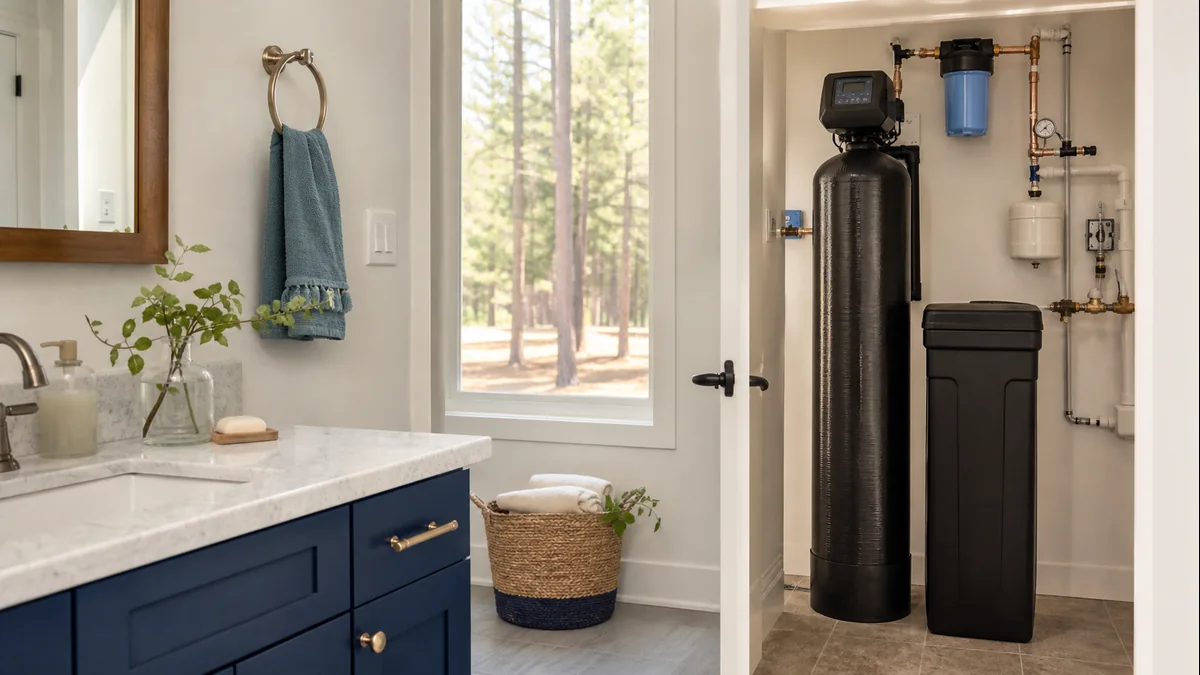
Direct answer: A brand-new Garner home starts collecting mineral scale in its water heater, dishwasher, and washer from the very first fill — Raleigh Water's roughly 1.6 gpg is genuinely slightly hard, not maintenance-free. Treating at move-in protects appliances with their full service life still ahead, not after deposits have already formed. The carbon stage also strips the annual chlorine taste that shows up on this same supply.
Why does a brand-new water heater in Garner need protection starting day one?
Because the clock on every appliance in the house starts the moment the builder turns the water on, not the day you notice a problem. A new water heater has zero hours of scale exposure at the walkthrough. Every gallon it heats afterward carries a small amount of dissolved calcium and magnesium, and that mineral load doesn't flush back out — it deposits on the tank wall or heating surface and stays there, adding a little more with every cycle.
None of that shows up as a single event. It shows up ten years later as a water heater that runs hotter than it should for the same setting, or fails earlier than a properly protected one would have. Treating the water before the appliance has logged a single cycle is the only way to make sure that entire service life runs on protected water instead of part of it.
Which new-build appliances in a Garner home are most exposed to scale?
Every appliance that heats, holds, or repeatedly rinses water is exposed the same way — starting from zero the day it's installed:
- Water heater — tank or tankless, the heating surface is where scale first accumulates
- Dishwasher — the spray arm and internal plumbing run hundreds of cycles a year, each one carrying mineral-laden water
- Washing machine — heating elements and valves are exposed to the same mineral load, cycle after cycle
- Faucet aerators and showerheads — small openings narrow visibly once deposits start forming
- Glass shower enclosures — soap reacting with calcium and magnesium is what leaves the etched film that's hard to strip back off once it sets in
A new build doesn't skip this list. It just starts everyone on it at zero instead of partway through.
Does Raleigh Water's "slightly hard" rating mean a new Garner home is already protected?
No — slightly hard describes the mineral level, not the outcome over time. On the WQA/Hach scale, the same one the Hach Total Hardness Test Kit (Model 5-B) reads out in, Garner's roughly 1.6 grains per gallon from Raleigh Water sits in the 1.0–3.5 gpg slightly hard band, well short of the 7 gpg where "hard" actually starts. That's a genuinely favorable starting point.
It is not the same as mineral-free. Calcium and magnesium are still dissolved in that water, and our own testing across the service area finds hardness running 1.6 to 3.7 grains per gallon depending on ZIP — the top of that range crosses into moderately hard on the same scale. A new Garner appliance sitting on the higher end of that range accumulates deposits faster than the townwide figure suggests, which is exactly what a free water analysis at your specific address settles.
What does Raleigh Water's annual chlorine conversion mean for a new home's carbon stage?
It means the carbon half of the system has real, documented work to do beyond just taste. Raleigh Water treats with chloramine most of the year, then converts to free chlorine only for several weeks — historically late February through early April — and flushes the distribution system while it does, on the N.C. Department of Environmental Quality's recommendation.
Chlorine residual runs higher system-wide during that window, and a new Garner household's first spring in the house is often the first time anyone in it notices a pool-water taste at the tap.
Disinfection byproducts form year-round as a normal part of that disinfection process. Raleigh's system measures TTHM at 21.7 ppb, per the EWG Tap Water Database — legally compliant, under EPA's 80 ppb limit. The same database lists HAA9 at 19.9 ppb, a nine-compound composite that carries no EPA maximum contaminant level at all; only the five-compound HAA5 measure is federally regulated, at 60 ppb.
EPA's own National Primary Drinking Water Regulations table lists TTHM's potential health effect from long-term exposure above the MCL as "liver, kidney or central nervous system problems; increased risk of cancer," and HAA5's as "increased risk of cancer." Legally compliant means the water stays under a ceiling EPA itself set — not a guarantee of zero exposure to the compounds EPA had in mind when it set that ceiling. A carbon stage removes them at the tap rather than relying on staying under a limit.
Does it matter whether a new Garner home has a tankless or tank water heater?
It changes where scale collects, not whether it happens. A tank water heater has a large reservoir, so scale settles as sediment on the tank floor and coats the heating element or lower surfaces gradually over years. A tankless unit heats water on demand through a much narrower heat exchanger, which means the same dissolved minerals are moving through tighter passages every time hot water runs — a setup that's generally less forgiving of scale buildup than a large tank has room to be.
Either type starts at zero the day it's installed in a new Garner home, and either type benefits from the same fix: softened water removes the calcium and magnesium before it ever reaches the heating surface, tank or tankless.
What does treating a new Garner home protect over each appliance's full lifespan?
| Appliance | Age at move-in | What scale does over years | What softening prevents |
|---|---|---|---|
| Water heater (tank or tankless) | Zero hours of use | Insulating scale layer on tank surfaces, or narrowed passages in a tankless heat exchanger | Calcium and magnesium removed before either type is ever exposed |
| Dishwasher | Zero cycles run | Deposits narrow spray-arm holes over hundreds of cycles, leaving film on glassware | Full spray pressure and a cleaner rinse maintained cycle after cycle |
| Washing machine | Zero loads washed | Scale collects on heating elements and valves; detergent lathers less | Less internal buildup, better detergent performance with less product |
| Faucet aerators, showerheads | Brand-new, unblocked | Mineral deposits narrow openings and distort spray | Openings stay clear for years longer |
| Glass shower enclosures | Spotless at final walkthrough | Soap scum bonds with minerals into an etched film | Softened water lathers cleaner, leaving far less residue to begin with |
The pattern across every row is the same: nothing in a new house has accumulated anything yet, and treating the water before it does is the only way to keep that column empty instead of catching up on it later.
Protect the new Garner house from the first gallon
Every appliance in a new Garner build has its entire service life still ahead of it right now — that's the moment to lock in protection, not the moment to plan on revisiting later. Take our 60-second water quiz to see which all-in-one system fits your new home, or book a free water analysis to get your address's exact hardness reading before the water heater logs its first thousand cycles.
FAQ
I just closed on new construction in Garner — is it too soon for me to think about a water softener? It's the ideal time, not too soon. Every appliance in the house currently has zero hours of scale exposure, and installing before or right at move-in means that entire service life runs on protected water instead of starting the clock on untreated water first.
My builder told me Garner's water is fine — do I still need to do anything? "Fine" usually refers to hardness, and it's true that 1.6 gpg is genuinely slightly hard rather than hard. But that still means calcium and magnesium are present and accumulating, and it says nothing about the chlorine taste and disinfection byproducts on the same supply — a softener alone doesn't touch either of those.
Is a tankless water heater more at risk from scale than a regular tank in a new Garner home? The heat exchanger in a tankless unit runs water through narrower passages than a tank's reservoir, which generally makes it less tolerant of mineral buildup. Both types start with zero exposure at installation, and softened water protects either one the same way — by removing the minerals before they reach the heating surface.
Why does the water suddenly taste different some springs after we moved in? That's Raleigh Water's annual conversion from chloramine to free chlorine, done on the state's recommendation to flush the distribution system — it runs for several weeks, historically late February through early April, and often produces a stronger chlorine taste than the rest of the year. A carbon filtration stage removes that taste along with the disinfection byproducts present the rest of the year.
Does a builder's softener loop mean the house already has a system? No — a loop is rough-in pipework only. Water runs straight through an empty loop until equipment is actually connected to it, so a new Garner home with a loop still needs a system sized to an actual water test before it's protecting anything.
How fast do new appliances actually start showing wear from scale? There's no single date — it's cumulative from the first cycle, and it typically takes years before it's visible as reduced water heater efficiency, spotty glassware, or narrowed fixture openings. That gradual timeline is exactly why treating from day one protects more of an appliance's working life than waiting to see a problem first.
Sources
- EPA — National Primary Drinking Water Regulations
- Raleigh Water — Where Does My Drinking Water Come From?
- EWG Tap Water Database — City of Raleigh
Related reading: Water Treatment in Garner, NC | New Construction Homes in Wake County: Water Treatment Guide | Water Heater Scale Buildup in Raleigh, NC | Water Softener Installation in Garner, NC | Does Soft Water Protect Appliances in Raleigh, NC?
Answer nine practical questions, then request a written quote or well-water analysis.
Start My Water Analysis