
New Construction Water Treatment in Knightdale, NC
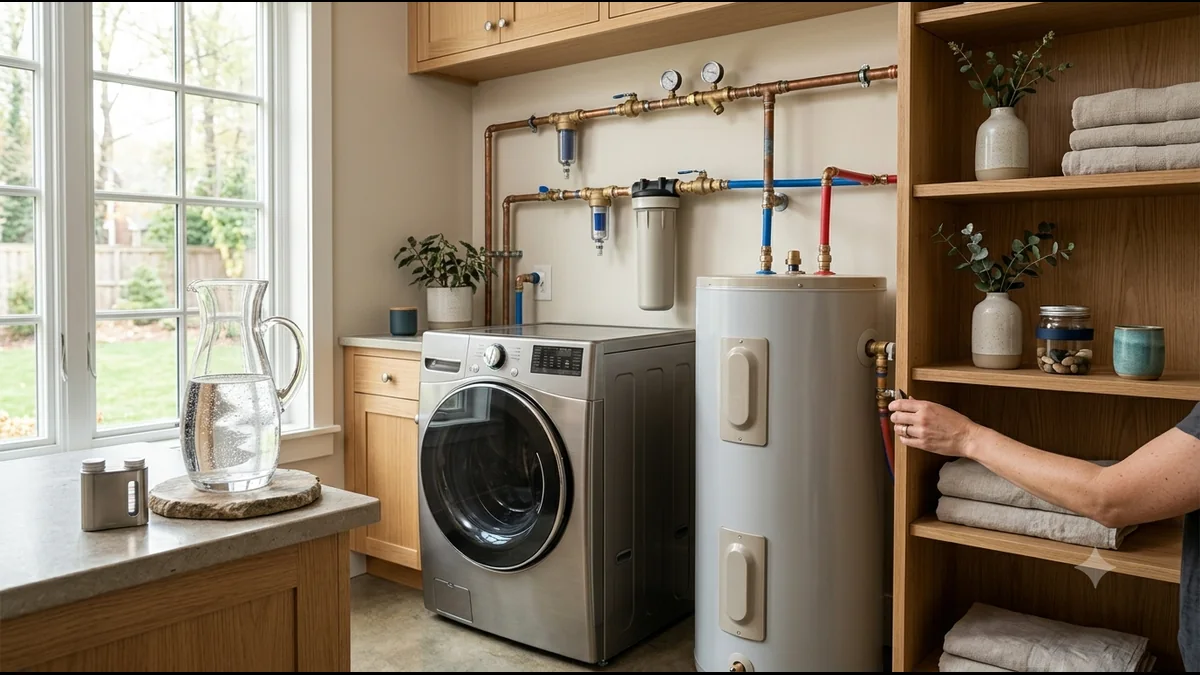
Direct answer: For a new Knightdale build, water treatment is a closing-process question as much as a plumbing one: ask the builder whether a softener loop is roughed in, and confirm it at the pre-drywall and final walkthroughs. Knightdale runs on Raleigh Water — slightly hard at roughly 1.6 gpg — so the free analysis fits naturally into the weeks around closing, before appliances start running cycles.
What should I ask my builder about water treatment before closing on a Knightdale home?
Ask three things, ideally at your first walkthrough with the builder's rep. Is a softener loop already roughed into the plumbing plan, and where does it sit — garage, crawlspace, or utility closet? Does the builder offer to install a treatment system as part of the build, or is that left to the homeowner afterward? If the builder does offer one, what exactly is included, since "water treatment" can mean anything from a full whole-home system to a single inline filter under the kitchen sink.
None of these questions commit you to anything — they just make sure you know what's already built into the house before you're standing in it with boxes to unpack.
What is a softener loop, and does having one mean I don't need to do anything else?
A softener loop is rough-in pipework — a bypass built into the main line specifically so a system can be connected later without cutting into finished walls. It is not equipment. Water runs straight through an empty loop exactly as it arrives from Raleigh Water until something is actually installed on it.
Having a loop is a genuine convenience: it means whoever eventually installs your system does a cleaner, faster job than they would cutting into your plumbing from scratch. It tells you nothing about your actual water hardness, which varies by ZIP even within Knightdale, or what the treatment should be sized to handle.
What should I check at the pre-drywall walkthrough?
The pre-drywall walkthrough is your one chance to see the plumbing before it disappears behind finished walls, and it's the right moment to physically confirm the softener loop question you already asked. Look for the loop yourself, or ask the site supervisor to point to it, in whatever space is designated for mechanical equipment.
Confirm its location makes sense — a loop tucked behind future storage shelving is harder to service later than one left clearly accessible. This is also the point to ask whether the main line's stub-out and the loop are both roughed in per the builder's standard plan, since that's what a future installer will be connecting to.
What should I check at the final walkthrough before closing?
The final walkthrough is about confirmation, not discovery — you're verifying that what was promised at pre-drywall actually got built. Walk to the mechanical space and confirm the loop is there, accessible, and undamaged.
If the builder included any treatment equipment, confirm it's actually connected and not sitting in a box, and ask for any documentation that came with it. If you're bringing in your own installer after closing, this is also the point to ask whether the final plumbing inspection affects when that work can start.
Should the builder install my water treatment system, or should I bring in my own installer afterward?
Either path can work. A builder-installed system is convenient — one less task after closing — but it's typically sized to a standard plan rather than a test of your address, and it may not pair softening with the carbon filtration that handles chlorine, chloramine, and disinfection byproducts.
Bringing in your own installer after closing means the system gets sized to an actual water test instead, and lets you choose an all-in-one system rather than the builder's standard package — at the cost of one more scheduled visit, though an empty, newly closed house is about as easy as it gets for a plumber to work in.
Either way, whoever does the work needs to be a licensed North Carolina plumbing contractor — tying a system into your main water line is defined as plumbing contracting work under N.C. Gen. Stat. § 87-21.
Where does water treatment fit in the weeks around closing?
Closer than most buyers think. The permit that gets your new Knightdale home its water meter is a separate step from anything on the treatment side, and it usually happens before you get keys — Raleigh Water's own connection process requires a Utility Connection Permit to set the meter, applied for during the residential building plan review. Ask your builder who is handling that application on your job, so nobody assumes the other party has it.
What's left for you is the water quality itself, not the water supply. That's where the free water analysis fits: it can happen any time after the meter is active, which for most closings is the same week you get keys. Scheduling it alongside utility transfers, rekeying locks, and the inspection follow-up keeps it from becoming its own separate errand months later.
What does a new Knightdale home's water actually need treatment for?
Two things, and only one of them is what most buyers think to ask about. Knightdale runs on Raleigh Water at roughly 1.6 grains per gallon — slightly hard on the WQA/Hach scale, the one the Hach Total Hardness Test Kit (Model 5-B) reads out in — with our own testing across the service area measuring 1.6 to 3.7 gpg depending on ZIP.
That's the mineral side: calcium and magnesium a softener removes before they can deposit in a new water heater or on fixtures.
The other side is disinfection. Raleigh Water disinfects with chloramine most of the year, per the utility's own description of its treatment process, and converts to free chlorine for several weeks annually — historically late February through early April — to flush the distribution system on the N.C. Department of Environmental Quality's recommendation.
Disinfection byproducts follow: Raleigh's system measures TTHM at 21.7 ppb, under EPA's 80 ppb limit, and HAA9 at 19.9 ppb, an unregulated nine-compound composite EWG tracks (only the five-compound HAA5 measure carries an EPA limit, at 60 ppb).
EPA's National Primary Drinking Water Regulations table lists TTHM's potential health effect from long-term exposure above the MCL as "liver, kidney or central nervous system problems; increased risk of cancer," and HAA5's as "increased risk of cancer." Compliance means Raleigh Water stays under a ceiling EPA itself set — it isn't a promise of zero exposure to the compounds that ceiling exists for. A carbon filtration stage is what removes them, which a softener alone never touches.
What should happen at each stage of buying a new Knightdale home?
| Stage of the build | What to do about water treatment |
|---|---|
| First walkthrough / contract | Ask whether a softener loop is roughed in and whether the builder offers a treatment package |
| Pre-drywall walkthrough | Physically confirm the loop's location and accessibility before walls close it in |
| Final walkthrough | Verify the loop is intact, or that any builder-installed equipment is actually connected |
| Closing / keys handed over | The utility's meter permit is already done — this is when the water is live at your tap |
| First weeks in the house | Schedule the free water analysis alongside other move-in tasks, before appliances run their first full season of cycles |
Book your free water analysis before move-in gets busy
The window between closing and a fully unpacked house is the easiest one you'll get to schedule a water analysis and, if needed, an installation — clear access, no furniture in the way, and every appliance in the home still at zero hours of exposure. Take our 60-second water quiz to see which all-in-one system fits your new Knightdale home, or book the free analysis directly and get it done while the house is still easy to work in.
FAQ
I'm under contract on new construction in Knightdale — is it too early for me to ask about water treatment? No — the earlier you ask, the more useful the answer is. Before drywall goes up is the best time to confirm whether a softener loop is roughed in and where, since that location becomes much harder to change once walls close around it.
My builder says a water softener is included — how do I know if that's enough? Ask exactly what's included: a full whole-home system, a bare softener with no carbon stage, or something smaller. A builder's standard package is generally sized to a typical plan rather than a test of your specific address, so it's worth confirming with a free water analysis after closing regardless of what came with the house.
Is it better to have the builder install our system or hire our own installer after closing? It's a trade-off between convenience and sizing. A builder-installed system is one less task but typically a standard-plan unit; your own installer after closing sizes an all-in-one system to your specific address, at the cost of one more scheduled visit.
What if there's no softener loop at all in our new Knightdale home? Not a dealbreaker — a system can still be installed at the main line without a pre-existing loop, it just takes a bit more plumbing work to tie in. Worth knowing before closing so you're not surprised by the difference in install scope.
When can we actually schedule the water analysis — does it have to wait until we've fully moved in? No — it can happen as soon as your water service is active, usually the same week you get keys. Scheduling it early, before furniture fills the mechanical space, keeps the eventual install simpler too.
Does it matter that Knightdale is mostly new construction with little older housing to compare our water to? Not for what's in the water — Knightdale runs on the same Raleigh Water supply regardless of a house's age. What's different for new construction is the opportunity: every fixture and appliance starts at zero, so treating early protects the whole service life instead of part of it.
Sources
- EPA — National Primary Drinking Water Regulations
- Raleigh Water — Where Does My Drinking Water Come From?
- City of Raleigh — Connecting to Water and Sewer Services
- North Carolina General Assembly — General Statute § 87-21, Definitions; contractors licensed by Board
- EWG Tap Water Database — City of Raleigh
Related reading: Water Treatment in Knightdale, NC | New Construction Homes in Triangle NC: When Should Water Treatment Go In? | When Should I Install a Water Softener After Buying a House in Raleigh? | Raleigh New Homeowner Water Softener Checklist | What Drives Water Softener Cost in Knightdale, NC
Answer nine practical questions, then request a written quote or well-water analysis.
Start My Water Analysis