
Does My Rolesville HOA Need to Approve a New Whole-Home Water System?
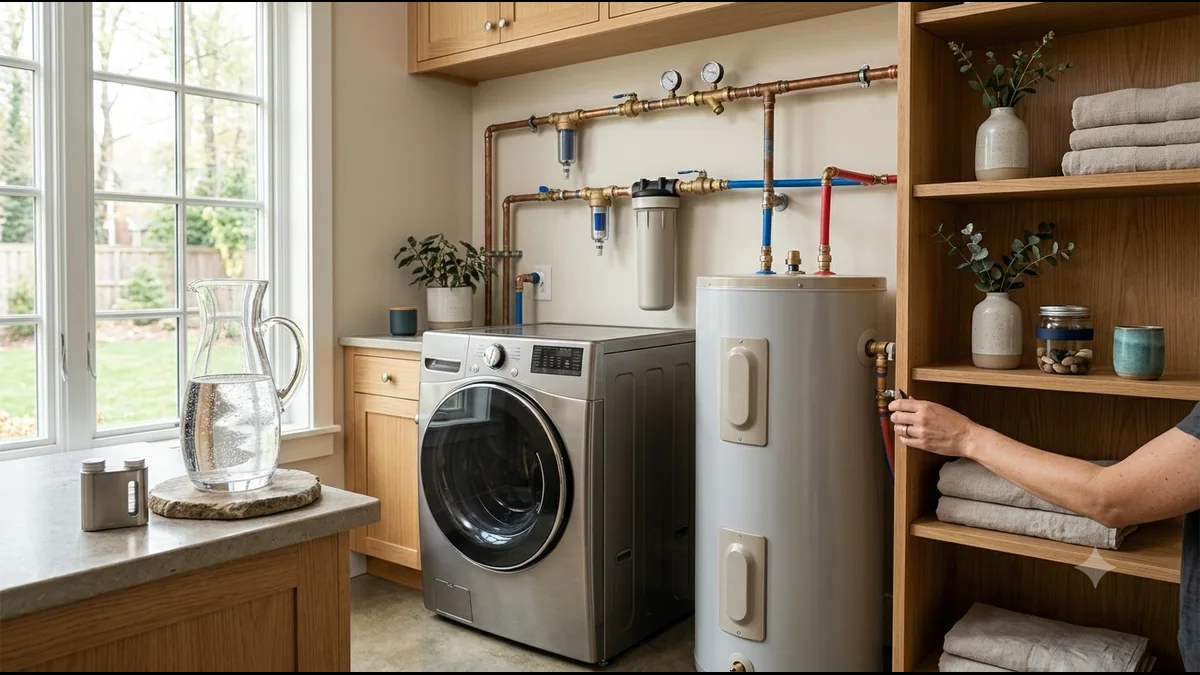
Direct answer: In most new Rolesville subdivisions, a whole-home softening-and-carbon system doesn't need HOA sign-off at all — it installs indoors, on the main line, with nothing visible from the street. Read your own covenants to confirm, since HOA rules vary community to community. The real decision is siting: garage wall, utility closet, or crawl space, each needing main-line access, a drain, and power.
Does My Rolesville HOA Need to Approve a Whole-Home Water System in a New Build?
In the large majority of cases, no — but the only way to know for certain is to open your own declaration, not to take that as a blanket promise.
New single-family sections around Rolesville are typically HOA-governed, and every buyer in a covenant-restricted community asks the same thing at closing: does adding equipment to the house require a form? For a system that ties into the main line inside the house, architectural review provisions exist to catch a different category of change — one visible from outside the home — and this equipment isn't in that category.
What Can an HOA Actually Govern Inside My Home Versus Outside It?
Architectural review clauses are written to control what a neighbor driving down the street can see: siding and paint colors, roofing material, fencing, driveway changes, exterior lighting, satellite dishes bolted to a facade. A system plumbed into the main line inside a garage, utility room, or crawl space touches none of that — no footprint change, no roofline change, nothing a passerby would notice. That's the practical reason this rarely turns into an actual approval fight.
North Carolina HOAs formed since 1999 generally operate under the Planned Community Act, N.C.G.S. Chapter 47F, which sets the statutory framework for how a declaration and bylaws function. One detail worth knowing: the Act doesn't automatically apply to a section with 20 lots or fewer unless the declaration says otherwise — worth checking if your Rolesville build sits in a smaller phase of a larger development.
Either way, Chapter 47F doesn't hand down a list of approved or banned equipment; your own recorded declaration is what actually controls your lot.
How Do I Find Out for Sure — What Should I Actually Read?
Pull your declaration and any separate architectural guidelines before assuming either answer. These typically come from your closing packet, your builder, or your HOA management company; if you can't locate a copy, the Wake County Register of Deeds holds the recorded version. Read specifically for whether the document requires review for interior plumbing work, or only for changes visible from outside.
If it requires notice for any home improvement regardless of visibility, a short written description covers it — something like: "Installing an interior whole-home water treatment system on the main line, in the [garage/utility closet/crawl space]. No exterior work, no change to appearance." That one sentence answers the only question a review board actually cares about.
This is general information, not legal advice specific to your community. If a question comes up that this doesn't resolve, your architectural committee is the authority on your own declaration.
Where Does a Whole-Home System Go in a New Rolesville Single-Family Home?
Unlike a townhome sharing walls with its neighbors, a new single-family build in Rolesville usually gives an installer more room to work with — a full garage, a standalone utility room, or crawl space access, rather than a tight shared mechanical closet.
The system ties in wherever the main line enters the house, before it splits toward individual fixtures, so every tap, shower, and appliance runs through it. Which spot is right depends on how your specific home was plumbed, not on a single rule that applies to every house the same way.
What Does Each Spot Actually Need to Work?
| Location | Main-line access | Drain needed | Power needed | Visible from street or shared sightlines |
|---|---|---|---|---|
| Garage wall | Usually straightforward, near the water service entry | Often present or easy to add | Usually already present | No |
| Interior utility closet | Depends on how the home was plumbed | Often present | Usually already present | No |
| Crawl space access point | Frequently direct, near where the line enters the house | Varies by home | Varies by home | No |
None of these three locations puts anything outside the house or changes what the home looks like from the sidewalk — which is exactly why, regardless of which one an installer picks during your free water analysis, the HOA question tends to be a non-issue.
How Is This Different From the HOA Question for a Rolesville Townhome?
The underlying answer — interior installation, no exterior change, check your own declaration — is the same. What's different is the physical situation: a townhome shares walls and often a tighter mechanical space with its neighbors, which is the specific scenario covered in HOA approval for a water softener in a Rolesville townhome.
A new single-family build usually has a standalone garage or a crawl space that isn't shared with anyone, which gives an installer more siting options and removes any question about a shared wall. If you're buying a townhome instead of a detached home, that page walks through the shared-wall specifics this one doesn't need to cover.
What's Actually in Rolesville's Water That Makes This Worth Doing at Move-In?
Raleigh Water supplies Rolesville along with Raleigh, Garner, Knightdale, Wake Forest, Wendell, and Zebulon — one utility, one shared source, feeding all seven communities from the same treatment process. Address-by-address testing we've run across that footprint reads 1.6 to 3.7 grains per gallon, slightly hard toward the low end and moderately hard toward the top, on the Water Quality Association scale the Hach Total Hardness Test Kit, Model 5-B, uses.
That range works in a new homeowner's favor: a softener sized correctly to it regenerates infrequently and runs on relatively little salt. The catch is that minerals keep accumulating on fixtures and inside a water heater the entire time the house goes untreated, so the favorable range doesn't offset waiting.
Hardness is only one side of what's in a new Rolesville home's pipes. Two disinfection byproducts show up in Raleigh Water's own numbers: TTHM measured at 21.7 ppb, comfortably inside the EPA's 80 ppb ceiling, and HAA9 — a broader nine-compound haloacetic acid measure — at 19.9 ppb. HAA9 itself carries no federal limit; the EPA only regulates the narrower five-compound HAA5 figure, capped at 60 ppb.
EPA's National Primary Drinking Water Regulations table lists TTHM's potential effect from long-term exposure above its limit as "liver, kidney or central nervous system problems; increased risk of cancer," and HAA5's as "increased risk of cancer." Legally compliant water is a ceiling EPA itself set, not a guarantee of zero exposure — a carbon stage removes these compounds directly rather than relying on staying under a limit.
Raleigh Water also disinfects with chloramine most of the year and briefly converts to free chlorine annually on the state's recommendation, which is why softening resin alone — ion exchange for calcium and magnesium only — never covers the whole picture.
Under N.C. Gen. Stat. § 87-21, connecting a whole-house water treatment system to the main line is licensed plumbing contracting work in North Carolina — worth knowing if a board ever asks who's doing the install, since a professionally installed system is generally exactly what a review board wants to see.
Settle Both Questions Before Move-In
Take the 60-second water quiz to see which all-in-one system fits your new Rolesville home, or book a free water analysis — a specialist walks the property, identifies the indoor spot that keeps the HOA question simple, and measures your actual tap water before recommending a system.
FAQ
I'm closing on a new build in a Rolesville HOA next month — do I need to submit anything before the installer comes out? Read your declaration first. Most interior plumbing work, including a whole-home system tied into the main line, doesn't require architectural review because it's invisible from outside the unit. If your declaration calls for notice on any home improvement, a short written description of the interior install is normally all it takes.
I can't find my HOA's declaration for my new Rolesville section — where do I even start looking? Check your closing documents first, then your HOA management company if your community has assigned one. If neither turns it up, the Wake County Register of Deeds holds the recorded version of every declaration filed in the county.
Will my HOA make me put the system in a specific spot, like the garage instead of the crawl space? Most declarations don't specify an interior location at all, since architectural review is written around what's visible from outside. The spot that actually gets chosen comes down to where your home's main line, drain access, and power line up — something your installer determines during the free water analysis, not something a board typically weighs in on.
My new Rolesville section is still developer-controlled and doesn't have a full HOA board yet — does that change anything? No. The declaration recorded for your community controls your lot regardless of who's currently running the board, so the same read-your-declaration step applies whether you're dealing with a developer or an elected board.
Is this actually different for me than it would be for a friend buying a Rolesville townhome? The HOA logic is identical — interior installation, no exterior change — but your situation is physically easier. A single-family home usually has a standalone garage or crawl space rather than a shared mechanical space, which gives an installer more room to choose from and removes any shared-wall question entirely.
Should I wait until after we've moved in and settled to deal with any of this? There's no reason to. The HOA check is a same-day read of your own declaration, and it runs in parallel with scheduling your free water analysis — neither one requires waiting until boxes are unpacked, and an empty, move-in-ready house is actually the easiest one to install in.
Sources
- EPA — National Primary Drinking Water Regulations
- North Carolina General Assembly — General Statute § 87-21, Definitions; contractors licensed by Board
- North Carolina General Assembly — Chapter 47F, North Carolina Planned Community Act
Related reading: HOA Approval for a Water Softener in a Rolesville, NC Townhome | Who Installs Water Softeners in Rolesville, NC | Water Softener Cost in Rolesville, NC | Wake County New Construction Water Treatment | New Construction Water Softener in Wake Forest, NC
Answer nine practical questions, then request a written quote or well-water analysis.
Start My Water Analysis