
Protecting a New Zebulon Home's Finishes: Water Treatment Before Move-In
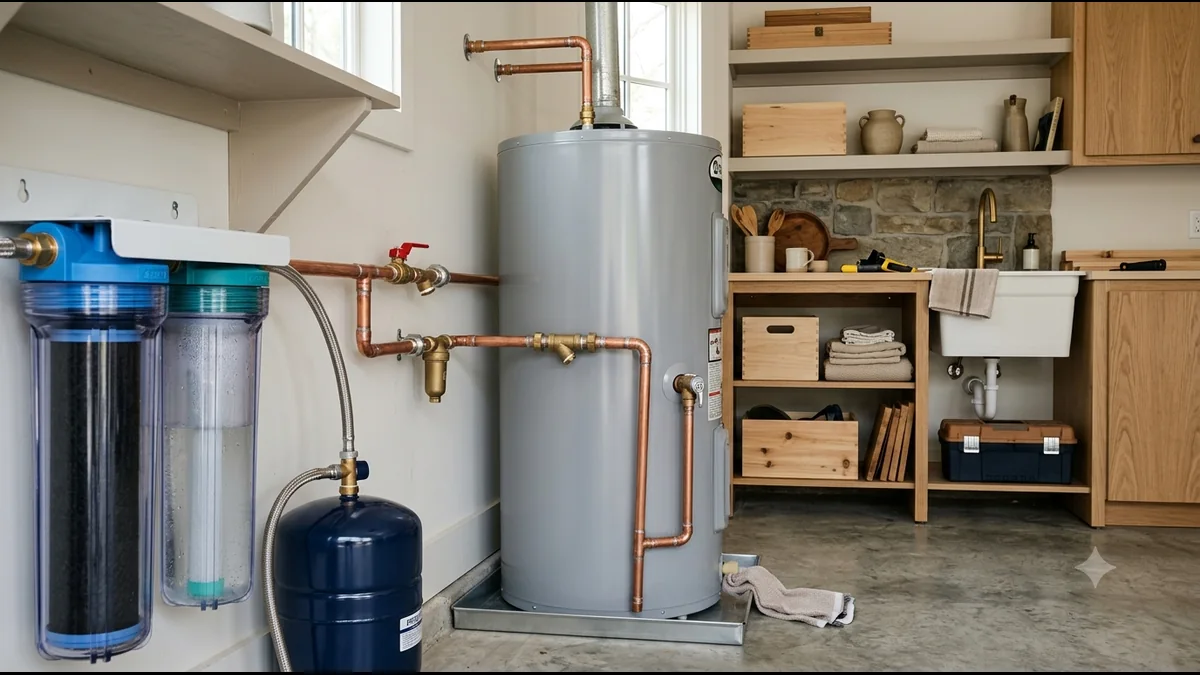
Direct answer: A brand-new Zebulon home's glass shower doors, tile grout, stainless fixtures, and chrome faucets start spotless — and mineral deposits are far easier to prevent than to remove once they've etched in. Zebulon runs on Raleigh Water, measuring 1.6 to 3.7 grains per gallon by ZIP in our own testing. Installing an all-in-one softening-and-carbon system before move-in keeps every finish looking the way it did on closing day.
Why Do a New Home's Finishes Need Protecting When Everything's Brand New Right Now?
Because "new" only describes today, and every finish in the house is about to start a years-long relationship with whatever is dissolved in Zebulon's water. A glass shower door that closes with a satisfying click at the final walkthrough is the same door absorbing mineral deposits by the third month of daily use if nothing changes about the water reaching it.
Nothing about brand-new construction changes what's flowing through the pipes — the finishes are new, the water isn't. Every rinse, every drying cycle, every load of dishes is either building deposits on a surface starting from zero, or it isn't, depending on whether the water was treated before move-in.
What Does Mineral Buildup Actually Do to Glass Shower Doors Over the First Few Years?
It starts as an almost invisible haze and progresses to a permanent etch if it's never addressed. Calcium and magnesium ride along in the water that beads and dries on glass after every shower; as that moisture evaporates, the minerals it carried are left behind on the surface.
Early on, that residue wipes off easily. Left long enough, repeated cycles of the same deposit forming and partially resisting cleaning start to dull the glass permanently — a change in the surface itself, not just a film sitting on top of it, and one that's difficult to reverse once it sets in.
What Happens to Tile and Grout in a New Zebulon Bathroom Without Treatment?
Grout takes it hardest of any bathroom surface, because unlike glazed tile or glass, grout is porous and absorbs water rather than shedding it. Every shower soaks into fresh grout and, as it evaporates from inside that porous material, leaves calcium, magnesium, and soap residue embedded rather than sitting on the surface where a wipe would remove it.
In a brand-new bathroom, that process starts with the very first shower. Grout that looks bright white at the final walkthrough is the same grout absorbing that first round of deposits before the first month is out — a process that compounds with every shower after.
How Does Buildup Affect a Stainless Sink and New Kitchen Appliances?
The same way it affects glass, just on a surface that shows it differently. A kitchen sink air-dries more times a day than almost any other surface in a new home, and every drying cycle leaves behind whatever calcium and magnesium the water was carrying.
On stainless steel, that shows up as a chalky film that breaks up the reflective finish, most visibly around the drain and faucet base. New stainless appliances — a dishwasher's interior, a refrigerator's water dispenser, a range hood near steam — face the same slow accumulation on a longer timeline, plus scale building inside the dishwasher's internal components with every cycle it runs.
What Happens to Chrome Fixtures and Faucets Specifically?
Chrome shows spotting fast because it's a bright, reflective surface where even light mineral residue is visible, and every faucet in a new Zebulon home handles water dozens of times a day. Deposits build at the base where water lingers longest and around the aerator, where mineral particles can accumulate inside the fixture itself and gradually reduce or distort the spray pattern — a mechanical effect on top of the cosmetic one.
A fixture that looks flawless in a builder's showroom photo is running exactly the same water as everything else in the house from day one.
New Zebulon Home: Surface, What Buildup Does, What Prevents It
| Surface | What buildup does over the first few years | What prevents it |
|---|---|---|
| Glass shower doors/enclosures | Haze that thickens with each cycle, eventually etching the surface permanently | Softening resin removes the minerals before they reach the glass |
| Tile & grout | Porous grout absorbs and holds deposits below the surface, not just on top | Softened water leaves nothing behind to absorb into the grout |
| Stainless sink & appliances | Chalky film at drains and faucet bases; internal scale inside dishwashers over repeated cycles | Softening prevents the film and protects internal appliance components |
| Chrome fixtures & faucets | Visible spotting plus aerator buildup that distorts spray pattern | Softening keeps deposits from forming in and on the fixture |
Is Prevention Actually Easier Than Removing Stains Later?
Yes, and the difference is what each surface actually loses. A chalky film wipes off relatively easily while it's still new; the same deposit, given years to compound, can etch glass, discolor grout permanently, and leave chrome permanently dulled no matter how it's cleaned. Prevention means the mineral load never reaches the surface in the first place, so there's nothing accumulating for a future homeowner to fight. Treating the water once, at move-in, replaces years of recurring scrubbing with a single install.
What's in Zebulon's Water That Causes This in the First Place?
Zebulon is a Raleigh Water community, sharing its supply with Raleigh, Garner, Knightdale, Rolesville, Wake Forest, and Wendell.
The town-wide figure runs about 1.6 grains per gallon — slightly hard on the Water Quality Association scale the Hach Total Hardness Test Kit, Model 5-B, uses — but our own testing across the service area measures 1.6 to 3.7 grains per gallon depending on ZIP code, reaching moderately hard at the top of that range. Slightly hard is not mineral-free; it's a real, cumulative amount of calcium and magnesium, which is exactly what's arriving at every new fixture in the house.
Hardness explains the buildup on glass, tile, and fixtures, but it isn't the whole story for a new home's water. The disinfection side shows up in Raleigh Water's numbers too: 21.7 ppb for TTHM, well under the EPA's 80 ppb cap, and 19.9 ppb for the nine-compound HAA9 measure. HAA9 has no EPA limit of its own — the regulated five-compound HAA5 figure is the one that's capped, at 60 ppb.
Why does EPA regulate those two at all? Its National Primary Drinking Water Regulations table gives the reason: for TTHM, "liver, kidney or central nervous system problems; increased risk of cancer" from long-term exposure above the limit, and for HAA5, "increased risk of cancer." Staying under a limit is not the same as removing the compound the limit exists for, and a carbon stage does the latter.
There is a seasonal element too. Chloramine is the year-round disinfectant, with a short annual switch to free chlorine on the state's recommendation — a change in taste and odor most households notice in their first spring in the house. That is the carbon side's work, running alongside the softening resin that keeps deposits off every new finish.
Connecting a whole-home system to the main line is licensed plumbing contracting work under N.C. Gen. Stat. § 87-21, which is worth confirming with any installer working on a brand-new build.
Keep Your New Zebulon Home Looking the Way It Does Today
Take the 60-second water quiz to see which all-in-one system fits your new home, or book a free water analysis before move-in to find out exactly where your address falls in the 1.6–3.7 gpg range Triangle Waterworks measures across Zebulon.
FAQ
We're about to close on a new build in Zebulon and I don't want to end up scrubbing stains like at our last house — what should we actually do before we move in? Book a free water analysis before or right at move-in, while every fixture and appliance is still at zero cycles. That's the point where treating the water protects the full service life of every finish instead of catching up after a year or two of deposits.
I just picked out a glass shower enclosure for our new Zebulon bathroom — how long before hard water spots would show up if we don't treat the water? It varies by household usage, but the process starts with the very first shower, since evaporating water leaves mineral residue behind every time. Visible haze can appear within weeks to a few months of regular use; the earlier a system is in place, the less of that clock ever gets to run.
Does a whole-home system protect our new stainless appliances too, or just the kitchen sink? It covers both. Softening resin treats the water supplying every fixture and appliance in the house, so the same protection that keeps the sink spot-free also reduces scale accumulating inside a dishwasher or around a refrigerator's water dispenser over years of cycles.
Our tile and grout look perfect right now — is it really worth worrying about before we've even used the shower? Yes, specifically because grout is porous and starts absorbing mineral deposits from the first shower onward, unlike glass or glazed tile that sheds water quickly. Treating the water before the first use means the grout never has anything to absorb in the first place.
Is it actually cheaper to prevent this than to fix it later? In effort terms, yes — prevention is one install versus years of recurring scrubbing, resealing, or fixture replacement once deposits have set in permanently on glass or grout. A free water analysis is the way to find out what a system for your specific home involves.
How do I find out what our specific new Zebulon address's hardness actually is before we move in? A free water analysis reads your exact tap once water service is on, rather than relying on the town-wide average. For interim at-home testing, the Hach Total Hardness Test Kit, Model 5-B, reports results in grains per gallon on the same scale Triangle Waterworks uses.
Sources
- EPA — National Primary Drinking Water Regulations
- North Carolina General Assembly — General Statute § 87-21, Definitions; contractors licensed by Board
Related reading: Why Does My Stainless Steel Sink Keep Getting Hard Water Spots in Zebulon, NC? | How to Remove Hard Water Stains From Shower Tile Grout in Zebulon, NC | Who Installs Water Softeners in Zebulon, NC | Water Softener Cost in Zebulon, NC | Wake County New Construction Water Treatment
Answer nine practical questions, then request a written quote or well-water analysis.
Start My Water Analysis