
Can You Install a Water Softener With Galvanized Pipes in Zebulon, NC?
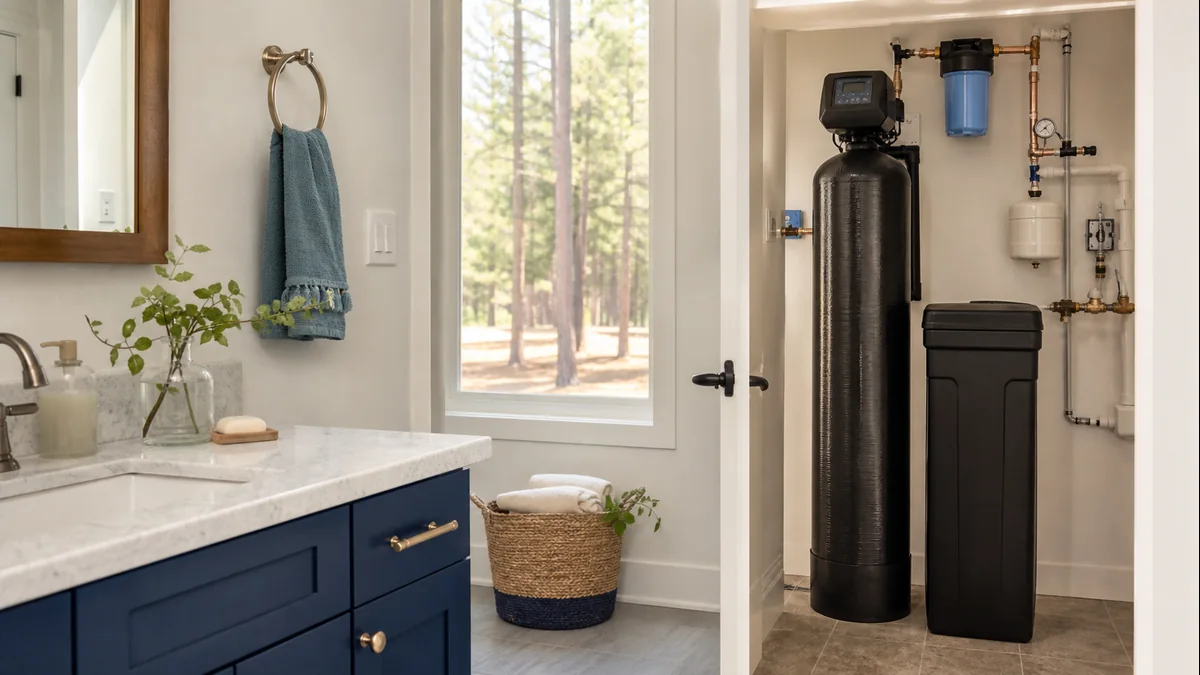
Direct answer: Yes. A whole-home softening and carbon system installs at the point where water enters your Zebulon home, so it ties into your existing plumbing regardless of whether the pipes carrying water to your fixtures are galvanized steel, copper, or PEX. Softening removes the calcium and magnesium that keep adding to decades of interior buildup inside galvanized pipe, and a carbon stage handles chlorine, chloramine taste, and disinfection byproducts. An assessment confirms the exact tie-in point for your home.
Can I Install a Whole-Home Water Softener If My Zebulon Home Has Galvanized Pipes?
Yes. A whole-home system doesn't install inside your walls or replace any of your existing supply lines — it installs at a single point, typically where the main water line enters the house, before water branches out to every fixture. From that point of entry, treated water travels through whatever piping your home already has, the same way untreated water does today. Whether that piping is galvanized steel, copper, or PEX doesn't change where or how the system ties in. An installer confirms the exact tie-in location and any fittings needed during a free assessment, which is standard practice for any whole-home installation, old plumbing or new.
What Exactly Is Galvanized Pipe, and Why Do Some Older Zebulon Homes Have It?
Galvanized pipe is steel plumbing coated with a layer of zinc, which was applied to slow corrosion on the steel underneath. It was a common choice for residential supply lines in homes built before the mid-20th century, before copper became the standard replacement and, more recently, PEX became common in new construction and repiping projects. If your Zebulon home dates back far enough, some or all of its original supply lines may still be galvanized — either throughout the house or in sections that haven't been updated. That's simply a function of when the home was built and what plumbing materials were standard at the time.
Why Do Older Homes With Galvanized Pipe Often Show Reduced Water Pressure?
Over years of use, the interior surface of galvanized pipe tends to roughen, and mineral and corrosion deposits gradually accumulate along that roughened surface. As those deposits build up on the inside walls of the pipe, the usable diameter narrows, which is a common reason older homes with galvanized plumbing experience reduced flow at fixtures compared to when the pipe was new. This is a gradual, cumulative process rather than something that happens suddenly, and it's a well-documented characteristic of aging steel pipe generally — not a defect specific to any one home. It's also a separate issue from whether a whole-home system can be installed; it describes what's happening inside pipe that already exists, not a condition on adding treatment at the point of entry.
Does Treating the Water Help Galvanized Pipe, or Make Things Worse?
Treating the water helps, and here's the mechanism: a softener removes calcium and magnesium from the water before it ever reaches your galvanized pipe, so those minerals are no longer available to keep adding to the deposits already accumulating on the interior surface. That doesn't reverse decades of prior buildup, but it does stop feeding the process going forward, in the same pipe you already have. A carbon stage works alongside softening to reduce chlorine and chloramine taste and disinfection byproducts, which softening alone doesn't touch. Installing a whole-home system is something you do with your existing galvanized plumbing, not instead of it — there's no requirement to update your pipes first, and doing so isn't a prerequisite for treating the water that runs through them.
How Does Zebulon's Water Factor Into This?
Zebulon is served by Raleigh Water, the same utility supplying Raleigh, Garner, Knightdale, Rolesville, Wake Forest, and Wendell, drawn from Falls Lake. On the Water Quality Association scale the Hach test kit uses, Raleigh Water measures roughly 1.6 grains per gallon (gpg) — slightly hard, not the higher bands people tend to picture. Our own testing across the service area measures 1.6 to 3.7 gpg depending on the exact address, so the number that matters most is the one from your own tap.
That's a genuinely low reading, but low hardness isn't the same as mineral-free, and calcium and magnesium are present in every gallon that passes through your pipes. Buildup is cumulative — a small amount left behind with each use adds up over years, in galvanized pipe just as it does in copper, PEX, appliances, and fixtures. A softener addresses that mineral load directly, and low local hardness works in your favor here: a correctly sized system doesn't need to regenerate often and uses relatively little salt to run.
What About Chlorine, Chloramine, and Disinfection Byproducts in Zebulon's Water?
Softening only addresses calcium and magnesium, which is why it's typically paired with a carbon stage rather than installed on its own. Raleigh Water's documented figures show HAA9 at 19.9 ppb and TTHM at 21.7 ppb — both legally compliant with EPA limits, though above the stricter, non-regulatory EWG guideline — and none of that is affected by softening resin, since disinfection byproducts aren't hardness minerals. Raleigh Water also normally disinfects with chloramine and converts to free chlorine only once a year, on the North Carolina Department of Environmental Quality's recommendation, flushing the distribution system during the changeover; the timing shifts year to year, so check the City's own announcement rather than a fixed date. An all-in-one system pairs both stages in one installed footprint: softening resin for the minerals adding to pipe buildup, and a carbon stage for what softening alone never touches.
How Does Installation Actually Work With My Existing Plumbing?
An installer starts with an assessment, looking at where the main line enters your house, what the existing plumbing looks like at that point, and how to tie the system in cleanly — the same process regardless of whether the rest of your home's supply lines are galvanized, copper, or PEX. In North Carolina, installing or replacing a whole-house water treatment system falls under plumbing contracting: N.C. Gen. Stat. § 87-21 defines plumbing contracting to include installing or replacing "whole-house water purification or treatment systems." That's a large part of why the visit matters for a home with older piping — a professional installer has seen galvanized tie-ins before and can confirm the right approach for your specific setup rather than guessing from a generic install.
Galvanized Pipe vs. Copper vs. PEX in Older Zebulon Homes
| Material | When it was common | What to know |
|---|---|---|
| Galvanized steel | Homes built before the mid-20th century | Zinc-coated steel; interior surface roughens and accumulates deposits over decades, which can reduce flow |
| Copper | Common replacement for galvanized starting mid-20th century | Widely used in re-piping and remodels of older homes |
| PEX | Common in new construction and modern repiping | Flexible plastic tubing, increasingly standard today |
| Any of the above | — | A whole-home softening and carbon system installs at the point of entry and works with all three |
Frequently Asked Questions
I own an older home in Zebulon with galvanized pipes — can I still get a whole-home softener installed? Yes. The system ties in at the point where water enters your house, not inside your existing plumbing, so it works with galvanized supply lines the same way it would with copper or PEX. An assessment confirms the exact tie-in for your home before installation.
Do I need to replace my galvanized pipes before adding a water softener? No — a whole-home system installs at the point of entry and works with whatever plumbing your home currently has. Some owners eventually update older piping for other reasons, like age or a remodel, but that's a separate decision from treating the water, not something that has to happen first.
My water pressure has dropped over the years in my older Zebulon home — is that from the pipes or the water? It's most likely the pipe itself: over time, the interior surface of galvanized pipe can roughen and accumulate deposits that narrow the usable diameter and reduce flow. Treating the water going forward stops adding more mineral buildup to that process, though a plumber is the right person to evaluate the pipe itself if pressure loss is significant.
Will treating my water make my galvanized pipes leak or fail sooner? No — softening and carbon treatment don't add anything corrosive to the water; softening removes calcium and magnesium through ion exchange, and a carbon stage reduces chlorine and disinfection byproducts. Neither process introduces anything to your existing pipes that isn't already accounted for in a standard point-of-entry installation.
I'm about to buy an older Zebulon home with galvanized plumbing — should that change my plan to add a water softener? Not in terms of whether you can install one — the system installs at the main line regardless of the home's pipe material. It's still worth having a licensed plumber assess the home's plumbing as part of a purchase, but that inspection and a water treatment installation are two separate, complementary steps, not a sequence where one has to wait on the other.
Does a water softener use materials that could react badly with galvanized steel? No — a softener's resin tank and the carbon stage connect to your plumbing the same way any point-of-entry fixture does, through standard fittings an installer selects for your specific pipe material. That's exactly what the assessment is for: confirming the right connection for your home's existing setup.
See What Your Zebulon Home Actually Needs
Galvanized pipe is a fact about your home's plumbing history, not a barrier to treating the water running through it today. Take our 60-second water quiz to see what an all-in-one softening and carbon system would look like for your specific Zebulon home, or book a free water analysis so an installer can confirm the right tie-in point for your existing plumbing.
Related reading: Older Home in Wake Forest's Historic District? What to Know About Your Water | How to Fix Low Water Pressure From Hard Water | Water Softener vs. All-in-One System | Template vs. Custom-Sized Water System | How to Test Water Hardness at Home
Answer nine practical questions, then request a written quote or well-water analysis.
Start My Water Analysis