
PFAS "Forever Chemicals" in Apex, NC Water — What's Actually in Your Tap
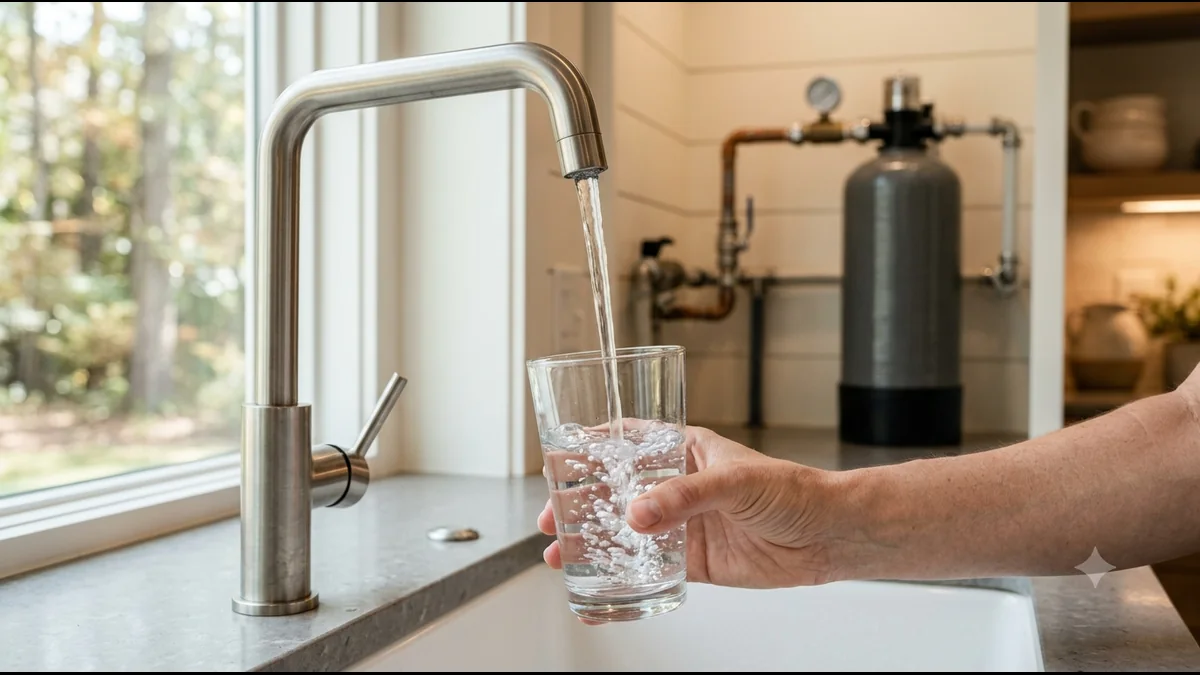
Direct answer: Apex's own 2024 water quality report shows the regulated PFAS compounds — PFOA, PFOS, PFHxS, PFNA, and PFBS — all non-detect. Two unregulated short-chain compounds, PFBA and PFHxA, did show up at low single-digit ppt levels, and the same report shows TTHM at 41 ppb, ranging to 53. An all-in-one system's carbon stage is built to remove exactly that — a free water analysis confirms your address.
Does Apex, NC tap water have PFAS "forever chemicals" in it?
Mostly not, according to Apex's own testing. The Town of Apex's 2024 Annual Drinking Water Quality Report tested for eleven PFAS compounds under the EPA's monitoring program, and the compounds now regulated with an enforceable limit — PFOA, PFOS, PFHxS, PFNA, and PFBS — all came back non-detect (ND). PFOA and PFOS carry the strictest limit, 4.0 parts per trillion (ppt), and Apex's water didn't register a measurable level of either one.
That's a genuinely good result, and it's worth stating plainly rather than burying it. Non-detect means the lab's equipment found no measurable trace of that specific compound at the sensitivity threshold it tested to — not that PFAS is a non-issue for the water supply as a whole, which the same report goes on to show.
Two other PFAS compounds, both currently unregulated, did register: PFBA averaged 3.8 ppt (range non-detect to 7.6 ppt) and PFHxA averaged 3.65 ppt (range 3.3 to 4.0 ppt). Neither has an EPA drinking-water limit yet, so neither counts as a violation — but "unregulated" and "absent" are two different things, and both are present in Apex's finished water right now.
What did Apex's 2024 water quality report actually find?
A mix of clean results on the regulated PFAS list and real, verified numbers on disinfection byproducts that a softener alone does nothing about. The table below pulls directly from Apex's 2024 report.
| Parameter | Apex 2024 result | Range | EPA limit |
|---|---|---|---|
| PFOA / PFOS / PFHxS / PFNA / PFBS | Non-detect | — | MCL 4.0 ppt (PFOA, PFOS) |
| PFBA | 3.8 ppt | ND – 7.6 ppt | Not yet regulated |
| PFHxA | 3.65 ppt | 3.3 – 4.0 ppt | Not yet regulated |
| TTHM | 41 ppb | 20 – 53 ppb | MCL 80 ppb |
| HAA5 | 19 ppb | 8 – 19 ppb | MCL 60 ppb |
| Chloramines (running annual avg.) | 3.23 ppm | 1.04 – 3.98 ppm | MRDL 4.0 ppm |
Every one of these figures is legally compliant — Apex had zero MCL violations in the 2024 reporting year. Compliant is a real, meaningful bar; it's also a ceiling set by EPA's own risk tolerance, not a guarantee of zero exposure to anything in the report.
EPA's own National Primary Drinking Water Regulations table lists TTHM's potential health effect from long-term exposure above the MCL as "Liver, kidney or central nervous system problems; increased risk of cancer," and HAA5's as "Increased risk of cancer." Apex's compliant result means those effects don't apply to what's coming out of your tap today — but they're exactly why a carbon stage removes TTHM and HAA5 outright rather than relying on staying under a legal limit.
Where does Apex's PFAS come from, and why does Jordan Lake matter?
From the raw source water itself, long before it reaches the treatment plant. Apex draws its drinking water from B. Everett Jordan Lake, part of the Cape Fear River Basin, treated at the jointly owned Cary/Apex Water Treatment Facility — Cary operates it, and it also supplies RDU and RTP South.
In 2017, Duke University researchers sampled raw Jordan Lake water and found the collection of related fluorinated compounds — short-chain and long-chain together — added up to 100 to 200 ppt, with short-chain compounds making up the majority. That same reporting found treated Cary drinking water at the time carrying PFOA at 5.6 ppt with PFOS undetectable — Cary's own water systems manager, Alexandra Jones, said treatment removed some of those compounds and not others.
It also explains the pattern in Apex's own 2024 results: the plant's activated-carbon and multi-barrier treatment process is effective enough to bring the long-chain, regulated compounds down to non-detect, while the smaller, harder-to-remove short-chain compounds — PFBA and PFHxA — are the ones still slipping through in trace amounts. That's a watershed story the plant is actively managing, not a plant failure.
Does boiling water remove PFAS from Apex tap water?
No — boiling does not remove PFAS, and it can make the concentration worse. PFAS molecules don't break down or evaporate at boiling temperature, so the water that evaporates leaves the PFAS behind, slightly concentrating whatever was already in the pot.
It's the opposite of what most people assume a stovetop "just boil it" fix does for anything in tap water. For the full mechanism, see Does Boiling Water Remove PFAS? No — Here's Why.
Reverse osmosis and a Brita-style pitcher aren't the same thing here either. Standard carbon pitcher filters are typically certified only for chlorine taste (NSF/ANSI 42), not PFAS — a filter has to be specifically certified to NSF/ANSI 53 or P473 for PFAS reduction, or the treatment has to be reverse osmosis under NSF/ANSI 58. How to Remove PFAS from Drinking Water walks through which certification does which job.
What removes PFAS, disinfection byproducts, and hardness from Apex water?
Two different technologies, working on two different halves of what's actually in the tap. Does Activated Carbon Remove PFAS from Water? covers the mechanism in detail — the short version is that carbon media certified to NSF/ANSI 53 or P473 adsorbs PFAS molecules as water passes through it, the same stage that also strips chlorine, chloramine taste, and the TTHM and HAA5 measured in Apex's own report.
Softening resin does none of that — it's ion exchange built specifically for calcium and magnesium, the minerals behind scale buildup, cloudy glassware, and shortened water heater life. Apex's own 2024 report puts average hardness at 33.3 ppm (about 1.9 gpg), which the town calls "moderately soft."
Our own testing across the wider service area measures 1.6 to 3.7 gpg depending on ZIP code — slightly hard to moderately hard on the WQA/Hach scale the Hach Model 5-B test kit uses. Either end of that range is still cumulative buildup over a home's plumbing lifespan.
An all-in-one whole-home system runs both stages in a single unit: the softening resin handles the mineral side, and the carbon stage handles PFAS, chlorine and chloramine taste, and the disinfection byproducts — the two halves of Apex's own report that a softener-only system would leave completely untouched. That's the "best of both worlds" case for one system over two separate fixes.
Why does Apex switch from chloramine to chlorine once a year, and does that matter for PFAS?
It doesn't change the PFAS picture, but it does change what's in the water for a few weeks. Like Raleigh and Cary, Apex normally disinfects with chloramine, then converts to free chlorine for a short period once a year on the N.C. Department of Environmental Quality's recommendation, flushing the distribution system while it does.
Chlorine residual runs higher system-wide during that window, and flushing can cause temporary discoloration. The exact dates shift year to year, so check the Town's own announcement rather than a fixed calendar — a carbon stage handles the taste and odor spike either way, chloramine or chlorine.
Get your own address tested, not just the townwide average
Apex's 2024 report is a plant-average snapshot, not a reading from your specific tap — and it's worth acting on now rather than filing away. A free water analysis gets you the actual hardness reading at your address alongside a plan for the carbon side of your water that a townwide report can't give you.
Take our 60-second water quiz to see which all-in-one system fits your home, or book the free analysis directly and get both halves of the picture — mineral and contaminant — before you decide on anything.
FAQ
I just moved to Apex and saw "forever chemicals" mentioned online — should I be worried about my tap water? Apex's 2024 report shows the regulated PFAS compounds (PFOA, PFOS, PFHxS, PFNA, PFBS) all non-detect, so there's no violation to worry about. Two unregulated short-chain compounds, PFBA and PFHxA, are present at low single-digit ppt levels, and the water also carries disinfection byproducts like TTHM at 41 ppb — a carbon-stage system addresses both.
Does Apex, NC actually test for PFAS in its drinking water? Yes — Apex tested for eleven PFAS compounds in 2024 under the EPA's monitoring program and published the results in its Annual Drinking Water Quality Report, which is publicly available on the Town's website.
What's the difference between PFBA/PFHxA and PFOA/PFOS? PFOA and PFOS are long-chain PFAS with an EPA-enforced limit of 4.0 ppt; PFBA and PFHxA are shorter-chain compounds that aren't yet regulated and are generally harder for a treatment plant to fully remove. Apex's own results show the long-chain compounds at non-detect and the two short-chain compounds present in trace amounts.
I filled my pitcher filter with Apex tap water — does that take care of the PFAS? Only if the filter is specifically certified to NSF/ANSI 53 or P473 for PFAS reduction; a standard carbon pitcher filter certified only for chlorine taste (NSF/ANSI 42) will not reliably remove PFAS. Check the filter's certification label rather than assuming any carbon filter does the same job.
I boil tap water before giving it to my baby — does that also take care of PFAS? No — boiling does not remove PFAS from water, and because some of the water evaporates while the PFAS stays behind, boiling can leave the remaining water slightly more concentrated. If PFAS reduction matters for your household, that calls for certified carbon or reverse osmosis, not a stovetop step.
How often does Apex re-test for PFAS, and will I know if something changes? Apex reports PFAS results annually in its Consumer Confidence Report as part of the EPA's ongoing Unregulated Contaminant Monitoring Rule program, and any MCL violation on a now-regulated compound would trigger a separate public notice. A free water analysis gives you a current reading for your own address any time you want one, rather than waiting for next year's report.
Sources
- EPA — PFAS National Primary Drinking Water Regulation
- EPA — National Primary Drinking Water Regulations
- Town of Apex — 2024 Annual Drinking Water Quality Report
- WRAL — Elevated levels of perfluorinated chemicals found in Jordan Lake, Cary drinking water
Related reading: Just Moved to Apex, NC? A New Resident's Water Guide | Who Installs Water Treatment Systems Across Raleigh, Cary, Apex, Morrisville, and Wake Forest?
Answer nine practical questions, then request a written quote or well-water analysis.
Start My Water Analysis