
Does Zebulon, NC Water Have PFAS? What Raleigh Water's Testing Shows
Direct answer: Yes, in trace amounts. Raleigh Water, which supplies Zebulon, found PFOS at 1.15–2.98 ppt and PFOA at 2.21–2.94 ppt in its 2025 testing, every quarter under the EPA's 4.0 ppt limit. That's a system-wide finished-water result, not a reading from your specific tap — a carbon stage in the all-in-one system removes PFAS no matter what the citywide number says.
Does Zebulon, NC water have PFAS?
Yes. Raleigh Water lists Zebulon among the seven towns it supplies — alongside Raleigh, Garner, Knightdale, Rolesville, Wake Forest, and Wendell — and its 2025 Perfluorinated Compounds Data Results show PFOS at 1.15–2.98 parts per trillion and PFOA at 2.21–2.94 ppt in finished water across all four quarters, every reading under the EPA's 4.0 ppt Maximum Contaminant Level. PFBS came in at 2.58–3.14 ppt, PFHxS ranged non-detect to 0.996 ppt, and PFNA and GenX were non-detect.
The utility's own data states the Hazard Index running annual average did not exceed 1, and no violation occurred. That is a real, compliant record. It does not mean PFAS was absent from the water.
Why doesn't Raleigh Water's system-wide PFAS number describe your specific tap?
Raleigh Water tests PFAS at its treatment plants and at monitoring points across the distribution network that serves Raleigh, Garner, Knightdale, Rolesville, Wake Forest, Wendell, and Zebulon together — not at every individual tap in that service area.
A system-wide report describes what left the plant, not what a specific household's plumbing adds or changes before the water reaches the glass. That's the reason an address-level test matters everywhere on the system, not something particular to where Zebulon sits.
What did Raleigh Water's 2025 testing find, compared to the EPA limit?
| PFAS compound | Raleigh Water's 2025 result | EPA MCL | Status |
|---|---|---|---|
| PFOS | 1.15–2.98 ppt | 4.0 ppt | Detected, under the limit every quarter |
| PFOA | 2.21–2.94 ppt | 4.0 ppt | Detected, under the limit every quarter |
| PFBS | 2.58–3.14 ppt | Not individually regulated | Detected |
| PFHxS | ND–0.996 ppt | Not individually regulated | Detected in some quarters |
| PFNA | Non-detect | Not individually regulated | Not detected |
| GenX | Non-detect | Not individually regulated | Not detected |
Is the system-wide result the same as what comes out of a Zebulon tap?
Not necessarily. Raleigh Water's figures are finished-water results reported for the system as a whole, not for any specific address. What an individual Zebulon tap actually shows also depends on the home's own plumbing — something no system-wide report can capture.
That's why "compliant" and "your number" aren't the same statement. A free water analysis at your address answers the second question; Raleigh Water's report only answers the first.
Why is "under the EPA limit" a ceiling, not proof of zero PFAS?
Because the 4.0 ppt MCL is EPA's own risk-tolerance line for the entire country, not a claim that anything below it is harmless. PFOS and PFOA were present in every one of the four 2025 quarters — just under that ceiling each time. Detectable and absent are different facts.
A system built to stay under a legal number is still leaving PFAS in your water. A system built to remove it — carbon certified to NSF/ANSI 53 or P473, or reverse osmosis to NSF/ANSI 58 — doesn't depend on where the ceiling gets drawn.
What about chloramine, the annual switch, and disinfection byproducts on Zebulon's side of the system?
Raleigh Water normally disinfects with chloramine, which the City describes as having little taste or odor. Once a year, on the N.C. Department of Environmental Quality's recommendation, the system switches to free chlorine only and flushes the distribution network to speed the changeover — the 2026 period ran February 26 through April 2. Chlorine residual runs higher system-wide during that window.
That process also generates trihalomethanes (TTHM) and haloacetic acids (HAA5). Raleigh's 2025 CCR reports TTHM averaging 34.2 ppb (up to 42.8) against an 80 ppb limit, and HAA5 averaging 22.0 ppb (up to 33.6) against a 60 ppb limit, both compliant.
EPA's National Primary Drinking Water Regulations table lists the potential health effects from long-term TTHM exposure above the MCL as "Liver, kidney or central nervous system problems; increased risk of cancer." For HAA5, the listed effect is "Increased risk of cancer." Those are EPA's own words for exposure above the legal limit over the long term, not a description of Zebulon's current, compliant water — it's the exact reason EPA set the ceiling where it did.
Does boiling or a pitcher filter handle PFAS in Zebulon's water?
No, for different reasons. Boiling doesn't remove PFAS — it evaporates water and leaves the compound behind, concentrating it in a smaller volume rather than reducing it. A basic pitcher filter isn't tested against NSF/ANSI 53, P473, or 58, so there's no verification it removes PFAS at all, even if the carbon inside happens to help with taste.
What actually removes PFAS from Zebulon's water?
Carbon certified for the job, or reverse osmosis. PFOA and PFOS need activated carbon rated to NSF/ANSI 53 or P473, or RO certified to NSF/ANSI 58. A water softener alone has no mechanism for either one — it's ion exchange built for calcium and magnesium.
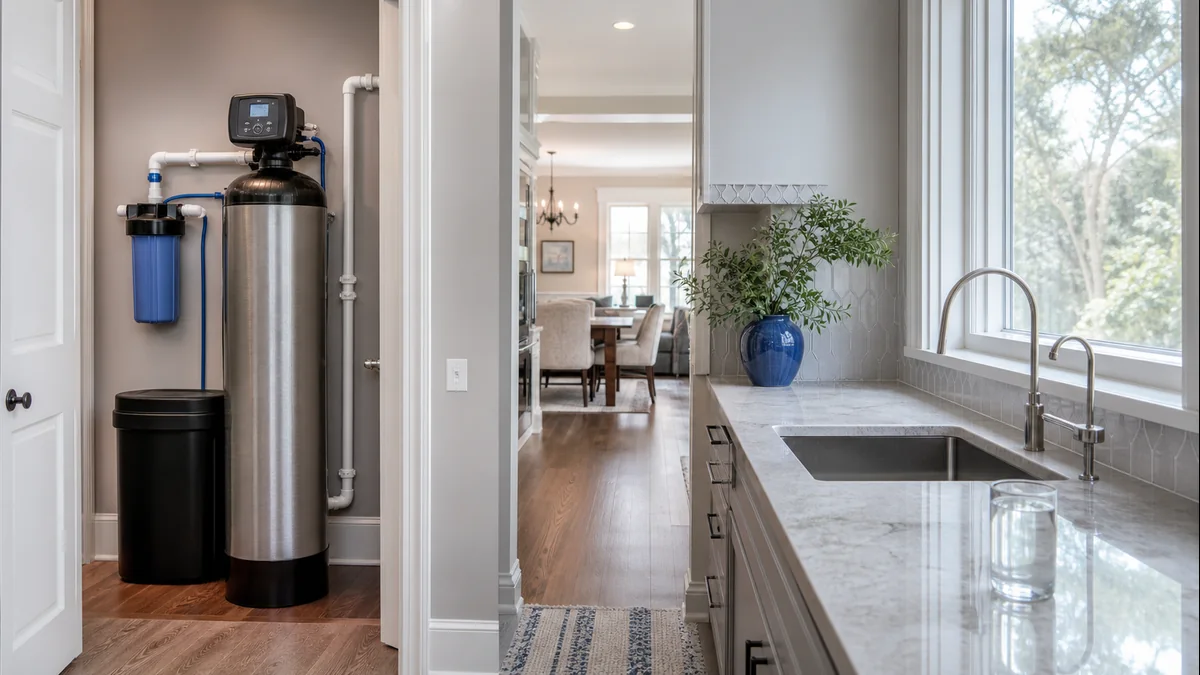
The all-in-one system pairs a PFAS-rated carbon stage with softening resin, so a single install handles the contaminants a softener can't touch and the mineral buildup carbon doesn't touch. See who installs water softeners in Zebulon, NC for what that installation looks like locally.
Get your Zebulon address tested, not just the system average
Raleigh Water's numbers describe the system; they don't describe your specific tap. Take the 60-second water quiz to see which all-in-one system fits your Zebulon home, or book a free water analysis for a number tied to your actual address. For local install pricing, see water softener cost in Zebulon, NC.
FAQ
Does Zebulon, NC tap water have PFAS in it? Yes. Raleigh Water's 2025 testing found PFOS at 1.15–2.98 ppt and PFOA at 2.21–2.94 ppt across all four quarters, both under the EPA's 4.0 ppt limit. PFBS and PFHxS were also detected; PFNA and GenX were not.
I'm on Raleigh Water in Zebulon — does my tap match the citywide average they publish? Not necessarily. The utility's figures are system-wide results, not a reading from any specific address. The reported PFAS and disinfection byproduct numbers are a starting point — a free water analysis gives you the number for your actual tap.
Is it fair to say Zebulon's water is worse than water elsewhere on Raleigh Water's system? There's no verified data showing that — the reported figures are system-wide, not broken out by location or address. What's accurate to say is that a system-wide average was never measured at any specific tap, anywhere on the system, which is a reason to test locally rather than a claim about worse water in any one town.
I moved to Zebulon from a well and I'm not sure how to think about municipal PFAS numbers — where do I start? Start with what's verified: Raleigh Water's 2025 data shows detectable PFAS under the EPA limit system-wide. A free water analysis at your new address tells you what that means specifically for your home, and an all-in-one system handles both PFAS and the hardness a well never had to deal with the same way municipal water does.
Does Zebulon go through the same annual chlorine switch as the rest of Raleigh Water's system? Yes. Zebulon is on the same system, so the once-a-year switch to free chlorine and the distribution flush applies here too, typically running from late February into early April with dates announced by the City each year.
Will a water softener take care of the PFAS Raleigh Water reported? No. A softener is ion exchange for calcium and magnesium — it has no mechanism for PFAS. Removing it requires carbon rated to NSF/ANSI 53 or P473, or RO certified to NSF/ANSI 58, which is why the all-in-one system pairs that carbon stage with softening resin.
Sources
- Raleigh Water — Perfluorinated Chemicals Data and Information
- City of Raleigh — 2025 Water Consumer Confidence Report
- EPA — National Primary Drinking Water Regulations
Related reading: Triangle NC PFAS & Forever Chemicals Explainer | Water Softener Cost in Zebulon, NC | Who Installs Water Softeners in Zebulon, NC? | New Construction Water Treatment in Zebulon, NC | How to Remove PFAS From Water
Answer nine practical questions, then request a written quote or well-water analysis.
Start My Water Analysis