
How to Test Your Morrisville, NC Water for PFAS
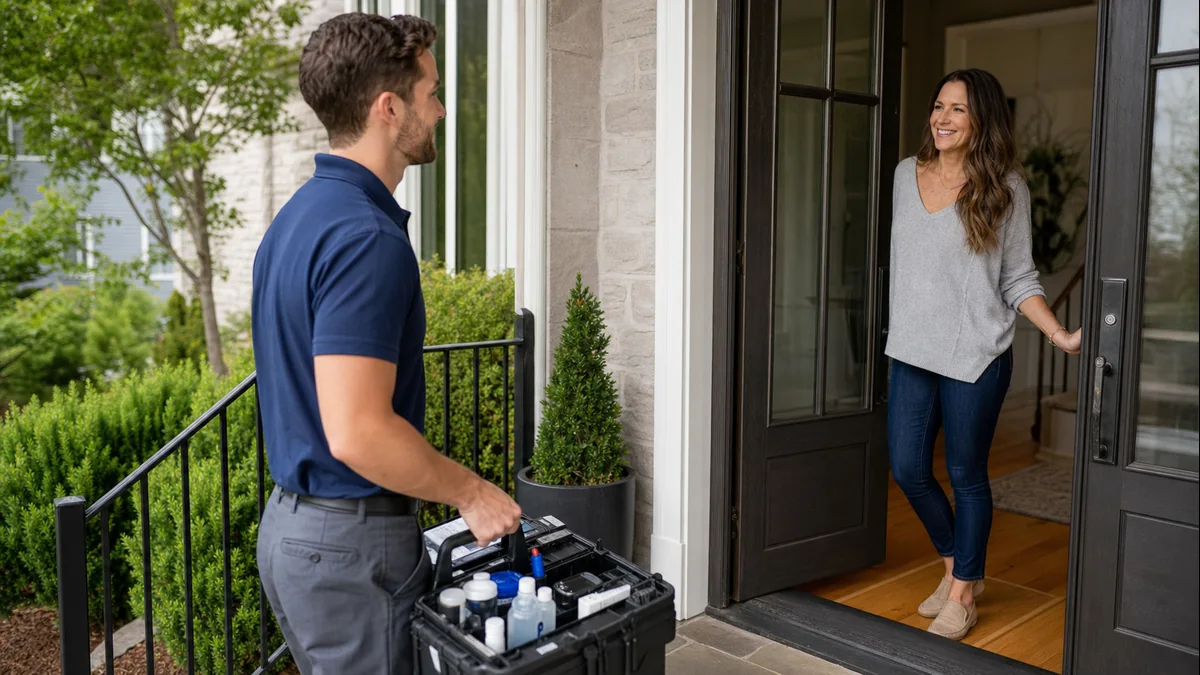
Direct answer: Morrisville has no water plant of its own — Cary has operated its water and sewer utility since April 2006, so Morrisville taps carry Cary's Jordan Lake water. A home test strip can't measure PFAS; only a certified lab using EPA Method 537.1 or 533 can. Once you have a number, PFAS-certified carbon or reverse osmosis removes it — the carbon half of an all-in-one system.
Why Can't I Just Use a Home Test Strip to Check for PFAS in My Morrisville Water?
Home test strips work by triggering a color-change reaction to a specific ion or oxidizer — that's how hardness strips react to calcium and magnesium, and chlorine strips react to a disinfectant residual. PFAS compounds don't produce that kind of reaction, and they're typically present, if at all, at parts-per-trillion concentrations — a thousand times smaller than parts per billion. No consumer test strip sold today is built or calibrated to detect PFAS at that scale.
Detecting PFAS requires laboratory-grade mass spectrometry, not a color chart. That's true everywhere, not just in Morrisville — it's a limitation of the chemistry, not of any particular strip brand.
Does Cary's Water Quality Report Cover Morrisville, and What Does It Show?
Yes. Beginning April 3, 2006, the Town of Cary took over operation, maintenance, and expansion of Morrisville's water and sewer systems under a mutual agreement between the two towns — Cary confirmed this directly in its own announcement at the time. Morrisville does not publish a separate water quality figure of its own; Morrisville taps receive the same finished water Cary delivers to its own customers.
That finished water starts as B. Everett Jordan Lake source water, shared with Cary and Apex. Cary's own system, as reported in the EWG Tap Water Database, shows PFOA at 2.86 parts per trillion (ppt) and PFOS at 3.79 ppt — both under the EPA's 4 ppt legal limit for each, and both a real, published number rather than a guess. Separately, Duke University researchers measured the collection of related fluorinated compounds at 100 to 200 ppt in Jordan Lake's raw, untreated source water in a 2017 study — a watershed-level finding about what feeds the lake. The PFOA/PFOS figures above are what Cary's treatment plant brings that raw-water load down to today.
Those are legitimate, useful data points. What they can't do is tell you what's coming out of your own kitchen faucet on your own street.
What Does a Certified PFAS Lab Test Actually Involve?
A certified lab test is the only way to get a PFAS reading specific to your own address. EPA has approved two primary analytical methods for PFAS in drinking water: Method 537.1 and Method 533, both solid-phase extraction paired with liquid chromatography/tandem mass spectrometry (LC-MS/MS) — instrumentation sensitive enough to detect PFAS compounds at the parts-per-trillion level they're actually present at.
That sensitivity is exactly why sample handling matters so much. A certified lab sends specific collection instructions — bottle type, flush time, how to handle the cap without touching the inside — and following them precisely is what makes the result trustworthy. At ppt sensitivity, something as small as the wrong container material can introduce a false reading.
Turnaround typically runs one to a few weeks depending on the lab, since the sample has to be processed through this instrumentation rather than read on the spot.
How Do I Read My Utility's CCR and UCMR5 Data Instead of Paying for a Test?
Before paying for a private lab test, two free public sources are worth checking first. Cary's annual Consumer Confidence Report (CCR) summarizes what the shared Cary/Morrisville system tested for and found, system-wide, for the year covered.
The second is EPA's fifth Unregulated Contaminant Monitoring Rule (UCMR5), which required public water systems nationwide to sample for 29 PFAS compounds between 2023 and 2025. Results are public through EPA's UCMR5 Data Finder, searchable by water system name — worth checking directly if you want to see what Cary's system actually reported, rather than a summary of it.
Both are genuinely useful starting points. Both are also system-wide, not address-specific — the same limitation the EWG database and Cary's own CCR carry.
| Method | What It Tells You | What It Can't Tell You | Gives a PFAS Number? |
|---|---|---|---|
| Cary's Consumer Confidence Report (covers Morrisville) | System-wide annual testing summary for the shared system | Results for your specific address | Only for what was tested |
| EPA's UCMR5 Data Finder | Public per-system PFAS results collected 2023–2025 | Same system-level limitation | Only if the system was sampled |
| Certified lab test (EPA Method 537.1 or 533) | An actual ppt reading for your own tap, if sampled correctly | Nothing beyond what you test for | Yes — the only source for a real address-level number |
| Free water analysis (Triangle Waterworks) | Hardness, chlorine, and sizing info for your home | A certified PFAS ppt result | No |
My Water Tested Non-Detect for PFAS — Does That Mean I Don't Need to Worry About It?
Non-detect is a real, useful result — it just isn't the whole picture. Cary's chloramine disinfection process, the annual switch to free chlorine, and documented disinfection byproducts are all still present in the water regardless of what a PFAS test shows, and softening a system alone does nothing about any of them.
EPA regulates total trihalomethanes (TTHM) and haloacetic acids (HAA5) specifically because of long-term health effects: EPA's own National Primary Drinking Water Regulations table lists TTHM's potential effect from long-term exposure above the MCL as "liver, kidney or central nervous system problems; increased risk of cancer," and HAA5's as "increased risk of cancer." Every water system in this coverage area is legally compliant — compliance is real. But "legally compliant" is a ceiling set by EPA's own risk tolerance, not a guarantee of zero exposure to the exact compounds that ceiling was built around.
That's the case for carbon filtration whether or not your PFAS number comes back at zero. A clean PFAS result is good news worth having — it's not a reason to skip the carbon stage that handles everything else.
What Actually Removes PFAS From Tap Water If I Find It?
PFAS removal requires activated carbon certified specifically for PFAS reduction (NSF/ANSI 53 or P473) or reverse osmosis (NSF/ANSI 58). Not every carbon filter carries that certification — it confirms the specific media has been tested and verified against PFAS, not just chlorine taste or sediment.
Boiling does not remove PFAS, and it can make the problem worse. Boiling reduces water's overall volume through evaporation, and PFAS doesn't evaporate or break down that way — so whatever was dissolved in the water stays behind in a smaller volume, concentrating rather than reducing it.
A water softener does neither of these jobs. Softening is ion exchange for calcium and magnesium — the minerals behind scale — and it has no effect on PFAS whatsoever. That's exactly why Triangle Waterworks builds its whole-home system as softening resin paired with a carbon stage rather than selling a softener alone: the softening side protects your water heater, dishwasher, washer, and plumbing from mineral buildup, and the carbon side, when certified for it, handles PFAS along with chlorine taste and disinfection byproducts.
Get a Clear Next Step Instead of a Guess
A certified lab test is the only source for an actual PFAS number at your Morrisville address — and whatever that number comes back as, the carbon half of a properly built system is what handles it, along with the chlorine taste and disinfection byproducts a PFAS test doesn't even measure. That's worth setting up now, not sitting on. Take the free 60-second quiz to see what an all-in-one system looks like for your home, or book a free water analysis to get your hardness and chlorine numbers today.
FAQ
I just moved to Morrisville — does Cary's water report actually apply to my house? Yes. Cary has operated Morrisville's water and sewer utility since April 2006, so Morrisville addresses receive Cary's finished water rather than a separate Morrisville supply. Cary's published Consumer Confidence Report and its EWG Tap Water Database entry are the relevant system-wide sources — Morrisville doesn't publish a figure of its own.
Is my water automatically fine if Cary's PFOA and PFOS numbers are under the EPA limit? Being under the legal limit means the system is compliant, which is real and worth knowing — but it's a system-wide average, not a reading from your specific tap, and it says nothing about chlorine taste or disinfection byproducts, which a PFAS number doesn't cover either way. A certified lab test is still the only way to get an address-specific PFAS number.
I got a free water analysis from Triangle Waterworks — did that already test for PFAS? No — our free analysis checks hardness, chlorine, and what your home's plumbing needs for correctly sizing a system. It is not a certified PFAS lab test; for an actual ppt reading, a lab using EPA Method 537.1 or 533 is the source.
What's the actual difference between EPA Method 537.1 and Method 533? Both are EPA-approved solid-phase extraction and LC-MS/MS methods for measuring PFAS in drinking water, and both were used for EPA's UCMR5 monitoring round. They target overlapping but not identical lists of PFAS compounds; a certified lab can tell you which method it runs and which compounds that covers.
Can I just boil my water to get rid of PFAS before I drink it? No. Boiling doesn't break down PFAS, and because boiling reduces the water's volume through evaporation, it can concentrate whatever PFAS was already present rather than remove it. PFAS removal requires PFAS-certified carbon or reverse osmosis.
Will a water softener take care of PFAS along with my hardness problem? No — a water softener is ion exchange for calcium and magnesium only and has no effect on PFAS. That's why a whole-home system pairs softening resin with a separate carbon stage: one handles scale, the other handles PFAS, chlorine taste, and disinfection byproducts when the carbon is certified for it.
Sources
- Town of Cary — "Towns of Cary and Morrisville Set for Monday Utility Merger"
- EPA — PFAS National Primary Drinking Water Regulation overview
- EPA — PFAS Drinking Water Laboratory Methods
- EPA — Fifth Unregulated Contaminant Monitoring Rule (UCMR5)
- EPA — National Primary Drinking Water Regulations
- EWG Tap Water Database — Cary, NC (PWS NC0392020)
- WRAL — Elevated levels of perfluorinated chemicals found in Jordan Lake, Cary drinking water
Related reading: Is Morrisville, NC Water Hard? | Who Installs Water Treatment Systems in Morrisville, NC? | How to Test Your Tap Water for PFAS in Rolesville, NC | How to Remove PFAS from Drinking Water | Does Boiling Water Remove PFAS? No — Here's Why
Answer nine practical questions, then request a written quote or well-water analysis.
Start My Water Analysis