
Why Does Hard Water Clog My Pressure Washer Nozzle in Holly Springs, NC?
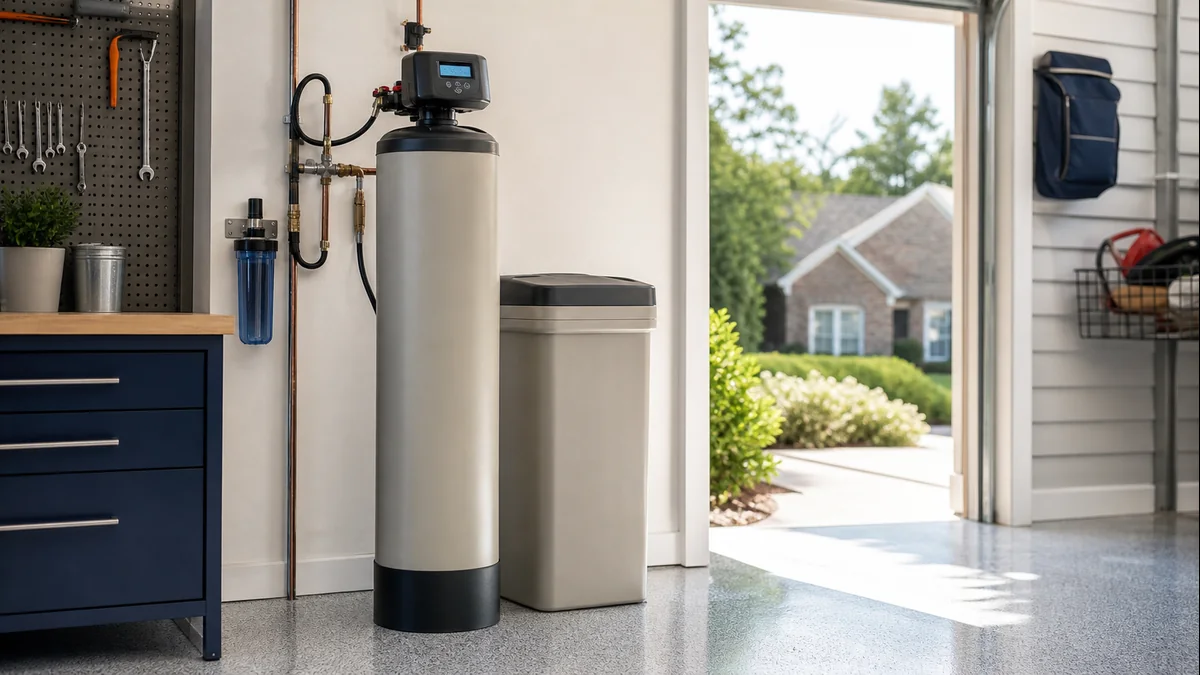
Direct answer: Pressure washer nozzle clogging in Holly Springs comes from dissolved calcium and magnesium — the same minerals in your tap water — building up inside the narrow nozzle orifice and leaving spotting on driveways, siding, and cars as they dry. Holly Springs measures slightly hard on the WQA scale. Softened water at the source, from an all-in-one system, keeps nozzles clear and surfaces spot-free.
Why Does My Pressure Washer Nozzle Keep Clogging in Holly Springs?
The nozzle orifice on a pressure washer tip is tiny — often well under a millimeter — and it's the last thing your water passes through before it hits the surface at high pressure. Dissolved calcium and magnesium in the water don't stay dissolved forever; as water evaporates off the tip between uses, or heats slightly during operation, those minerals crystallize and deposit exactly where the passage is narrowest.
Once that buildup starts, it narrows the orifice further, which changes your spray pattern and cuts your effective pressure before the nozzle clogs outright. It's a gradual problem, not a one-time failure — which is why it tends to show up as "my pressure washer isn't hitting as hard as it used to" before it shows up as a fully blocked tip.
Is Holly Springs' Water Actually Hard Enough to Cause This?
Yes — and the Town's own published numbers are where to start. The Town of Holly Springs' Drinking Water page states its water "is considered moderately soft and usually averages between 30-50 mg/L hardness as calcium carbonate or 1.75-2.92 grains of hardness per gallon."
The label depends on which scale you classify by. On the Water Quality Association scale the Hach Total Hardness Test Kit (Model 5-B) uses — the scale the water-treatment industry classifies by — that same published range, 1.75 to 2.92 gpg, falls inside the "slightly hard" band. Same measurements, two different scales.
Our own in-home testing across the service area measures higher still: 1.6 to 3.7 gpg by ZIP code, spanning slightly hard to moderately hard on that same scale. Neither figure is wrong — the Town's is a system-wide average, and ours is measured address by address — but both describe water that carries enough dissolved mineral to deposit inside a pressure washer nozzle over repeated use.
| Holly Springs Town figure | Triangle Waterworks testing | |
|---|---|---|
| Hardness range | 30–50 mg/L (1.75–2.92 gpg) | 1.6–3.7 gpg by ZIP |
| Town's own label | "Moderately soft" | — |
| WQA/Hach classification | Slightly hard (entire range) | Slightly hard to moderately hard |
| Source | Town of Holly Springs Drinking Water page | In-home testing across the service area |
Why Does My Driveway Get Spotty After I Pressure Wash It?
Because the water carrying the dirt away is also leaving mineral behind as it dries. A pressure washer blasts hard water across concrete, pavers, or a car's paint at volume, and every gallon that evaporates on the surface leaves its dissolved calcium and magnesium exactly where it dried — as a thin white or gray film. It's most visible on dark surfaces, sealed concrete, and glass, where any residue reads as a cloudy spot rather than blending in.
This is the same mineral-spotting mechanism covered in more depth for hard water spots on hardwood floors and for preventing hard water spots on a car — the source is identical, only the surface changes.
Does Hard Water Affect Siding and Cars During Spring Cleaning Too?
Yes, for the same reason. Spring is when most Holly Springs homeowners bring out the pressure washer for pollen, mildew, and winter grime on siding, decking, and driveways — and it's also when spotting from hard water is most noticeable, because it's drying on a large, freshly cleaned surface all at once. A car rinsed with a hard-water hose or pressure washer attachment shows the same film once it air-dries, especially on dark paint.
None of this is a sign anything is wrong with your pressure washer or your technique — it's simply what dissolved mineral does as water evaporates, regardless of the equipment doing the spraying.
How Do I Stop Mineral Deposits From Clogging My Pressure Washer for Good?
The only fix that addresses the water itself, rather than the symptom, is treating it before it ever reaches the hose. An all-in-one whole-home system removes calcium and magnesium through its softening resin at the point where water enters your house, so every outdoor spigot — not just the kitchen sink — runs softened water.
A pressure washer connected to that supply never pulls hard water through its nozzle in the first place, and driveways, siding, and cars dry clean instead of spotty.
- Softened water at the source means every hose bib in the house is already treated — no separate inline filter needed for outdoor use.
- Less mineral scale means nozzles hold their spray pattern longer and clog less often.
- The same softening also protects your water heater, dishwasher, and washing machine from the identical buildup happening inside your plumbing.
What's the Difference Between Softened Water and Filtered Water for Outdoor Cleaning?
Softening and carbon filtration solve two different problems, which is exactly why an all-in-one system pairs them. Softening resin exchanges calcium and magnesium for sodium, which is what stops the mineral deposits behind nozzle clogging and surface spotting.
A carbon stage, running alongside it in the same unit, handles what softening doesn't touch — chlorine and chloramine taste and odor, and disinfection byproducts like TTHMs and HAA5, which pass straight through a softener untouched because it only exchanges hardness minerals.
EPA's National Primary Drinking Water Regulations table lists the potential health effects of long-term exposure to TTHMs above the legal limit as "Liver, kidney or central nervous system problems; increased risk of cancer," and for HAA5 as "Increased risk of cancer."
Those figures describe exposure above the legal limit over the long term, not a claim about any specific water system's current, compliant supply — but they're the reason a carbon stage is worth having alongside softening rather than treating hardness alone. That's the "best of both worlds" logic behind an all-in-one system: one unit, one install, both problems handled.
How Do I Stop Guessing and Find Out What My Water Actually Needs?
A free water analysis at your address settles it, rather than relying on a Town-wide average or a nozzle you've already replaced twice this year. It's a quick way to see exactly where your ZIP falls in the 1.6–3.7 gpg range before deciding what system size fits your household. See what a water softener costs in Holly Springs once you know your number, or read more on whether a softener is worth it here for the fuller case.
FAQ
I just moved to Holly Springs and my new pressure washer already clogs after a few uses — is that normal here? It's common wherever hardness runs in the slightly-to-moderately-hard range, which describes Holly Springs on the WQA scale. A free water analysis at your specific address tells you exactly where you fall in that range and whether a whole-home system would stop it at the source.
My driveway looks spottier after I pressure wash it than before — am I doing something wrong? No — that's mineral residue left behind as hard water evaporates off the surface, not a sign of bad technique. Softened water at the source eliminates the mineral doing the spotting, since there's nothing left to deposit as it dries.
Where does Holly Springs' water actually come from? The Town's own Infrastructure page states the source is the Cape Fear River, processed at the Harnett County water treatment plant and supplied through Harnett Regional Water. That's the same finished water reaching every tap and outdoor spigot in town.
Does the Town of Holly Springs consider its water hard or soft? The Town's Drinking Water page calls it "moderately soft," averaging 30–50 mg/L (1.75–2.92 gpg) — but on the WQA/Hach scale the water-treatment industry uses, that entire range falls in the "slightly hard" band. Both figures are accurate; they're just using different classification scales.
Will a whole-home system stop clogging on every outdoor spigot, or just the ones connected to plumbing fixtures? An all-in-one system treats water at the point it enters your home, so every spigot — outdoor hose bibs included — runs softened water, not just indoor fixtures. That's what makes it effective for a pressure washer plugged into any hose connection on the property.
How is this different from just adding a filter to my pressure washer hose? An inline hose filter can catch sediment, but it doesn't remove dissolved calcium and magnesium, which is what actually deposits inside a nozzle and on drying surfaces. Softening resin at the whole-home level is what removes the mineral itself, rather than filtering debris around it.
See What Your Holly Springs Address Actually Tests At
A free water analysis is the fastest way to know your household's real hardness number before another nozzle clogs. Take the 60-second water quiz or book a free in-home water analysis to see what an all-in-one system would look like for your address.
Sources
- Town of Holly Springs — Drinking Water
- Town of Holly Springs — Infrastructure
- EPA — National Primary Drinking Water Regulations
Related reading: Water Treatment in Holly Springs, NC
Answer nine practical questions, then request a written quote or well-water analysis.
Start My Water Analysis