
New Homeowner Water Checklist for Raleigh, NC
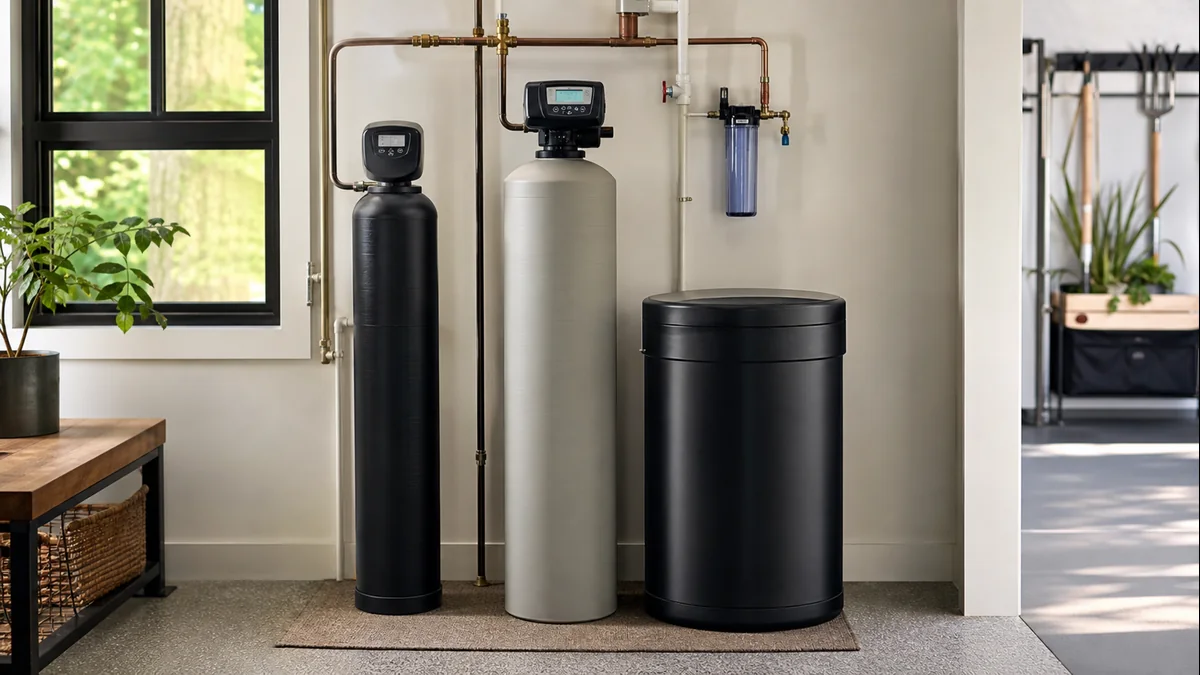
Direct answer: In your first month in a Raleigh home, do four things: find out which utility serves the address, look at the water heater and fixtures for existing mineral deposits, get a free hardness test, and decide on treatment before you replace any appliance. Raleigh Water is slightly hard at about 1.6 grains per gallon on the WQA scale, but deposits accumulate — and an all-in-one softening plus carbon system is the version that covers both minerals and disinfectant taste.
What should I check about the water right after closing in Raleigh?
Five things, and none of them take long.
- Confirm your utility. Raleigh Water serves Raleigh, Garner, Knightdale, Rolesville, Wake Forest, Wendell and Zebulon. Cary, Apex and Morrisville are on the separate Cary/Apex system fed by Jordan Lake. Homes outside those service boundaries are on private wells, which changes everything downstream.
- Open the water heater closet. Look for the manufacture date on the label and any sign of prior sediment flushing. A heater's age tells you how much of its service life is already spent, and whether you're protecting a new asset or a tired one.
- Look at the fixtures. Crusty white deposits on aerators and shower heads, film on glass shower doors, and cloudy spotting on glassware from the previous owner's dishwasher are all evidence of mineral accumulation in this specific house.
- Read the utility's annual report — and know what it can't tell you. It describes system-wide averages for finished water. Our guide to reading your water quality report walks through both halves of that.
- Get the water tested at your address. This is the only step that produces a number describing your house. It's free.
What does a Raleigh utility report actually tell a new homeowner?
That the water is compliant, and roughly what the system produces. Raleigh Water runs about 1.6 grains per gallon, which is slightly hard on the WQA scale — the same one the Hach Total Hardness Test Kit (Model 5-B) uses — and the EWG Tap Water Database lists HAA9 at 19.9 ppb and TTHM at 21.7 ppb for the system. Those disinfection-byproduct figures are within EPA limits; EWG's guidelines are a stricter, non-regulatory benchmark, and it's worth keeping those two bars separate rather than treating them as the same claim.
What no report tells you is your address. Our own testing across the service area measures 1.6 to 3.7 grains per gallon depending on the ZIP code — slightly hard at the bottom of that range, and moderately hard at the top, since 3.7 gpg is about 63 mg/L, just over the WQA scale's 60 mg/L line between slightly hard and moderately hard. A citywide average is the right thing for a utility to publish and the wrong thing to size equipment from.
Why is the first year the best time to decide?
Because two clocks are running and both favor deciding early. The first is appliance service life: whatever the age of the water heater, dishwasher and washer you inherited, every cycle from here forward either runs treated water or untreated water through them. The second is your own project sequence — most people replace an appliance, redo a shower, or refinish a kitchen within the first couple of years of owning a house, and doing water treatment before those projects protects the new work instead of arriving after it.
| Where you are | What treatment protects | What it's too late for |
|---|---|---|
| Just closed, everything inherited | Every remaining year of every appliance's life | Deposits already inside the water heater |
| Before replacing the water heater | The new heater's full service life | — |
| After a shower or kitchen remodel | New glass, tile and fixtures going forward | Nothing yet, if you install soon after |
| After a water heater fails early | The replacement unit | The unit that already failed |
What does soft water actually change day to day?
More than most people expect at 1.6 grains per gallon, because the effects are cumulative rather than dramatic:
- Glassware and dishes come out without the cloudy mineral film that rinse aid only partly masks.
- Soap and shampoo lather with less product, because less of each is consumed reacting with dissolved calcium and magnesium.
- Shower doors and tile stay clear of soap scum longer, since soap scum is the residue of that same reaction.
- Laundry comes out softer and detergent goes further.
- The water heater and plumbing stop accumulating scale on heating surfaces and in the internal passages of appliances.
And the half that softening does not do: chlorine and chloramine taste, and disinfection byproducts. Raleigh Water normally disinfects with chloramine and converts to free chlorine once a year while flushing the distribution system — historically from about the last week of February into the first week of April, with the 2026 window running February 26 to April 2, on the N.C. Department of Environmental Quality's recommendation. That conversion is when most new residents first notice a pool-water taste. Activated carbon handles it, along with the disinfection byproducts, which is exactly why we install both stages as one all-in-one whole-home system rather than a softener alone.
What should a new Raleigh homeowner budget for this?
Locally installed all-in-one systems are sized and priced after the free water analysis, well under what national big-brand installers commonly quote ($6,000 to $12,000). What you're quoted depends on your household's water usage and what the test at your address finds.
Ongoing cost is modest here, and that's a direct consequence of the local water: starting from roughly 1.6 grains per gallon, a softener regenerates infrequently and uses very little salt. Low hardness makes the system inexpensive to own in Raleigh — a reason to buy, never a reason to hesitate. Our Raleigh water softener cost page has the full breakdown.
Start with the number for your own address
Take our 60-second water quiz to see which all-in-one system fits your new Raleigh home, or book a free water analysis — the one step in this checklist that produces a number about your house rather than the city.
Frequently Asked Questions
I just bought a house in Raleigh — how soon should I test the water? Within the first month is a good target, and sooner is better if you're planning any appliance replacement or bathroom work. The analysis is free, takes a short visit, and gives you the hardness reading that any sizing decision should be based on.
My home inspection didn't mention the water — should it have? A standard home inspection covers plumbing condition and visible defects, not water chemistry, so nothing was missed. Hardness and disinfectant residual are measured separately, which is what the free water analysis does.
The previous owner left a water softener — can I just keep using it? Possibly, and it's worth having someone look at it. Age, capacity relative to your household's water use, and whether it was maintained all matter — and an inherited softener alone still won't address chlorine or chloramine taste or disinfection byproducts, which needs a carbon stage.
Should I install a system before or after I replace the water heater? Before, if the heater is on your list. Installing treatment first means the new heater spends its entire service life on treated water instead of starting to accumulate scale from day one.
Does Raleigh's water require anything special that other cities don't? The two things worth knowing are local rather than unusual: hardness varies by ZIP across the area, from 1.6 up to 3.7 grains per gallon, and the annual chloramine-to-free-chlorine conversion produces a seasonal taste change. A whole-home system with both softening and carbon stages covers both.
Related reading: Just Moved to Raleigh: Is the Water OK? | Signs You Need a Water Softener | Water Softener Installation in Raleigh | Benefits of Soft Water in the Home
Answer nine practical questions, then request a written quote or well-water analysis.
Start My Water Analysis