
Reverse Osmosis Membrane Scaling and Hard Water in Apex, NC
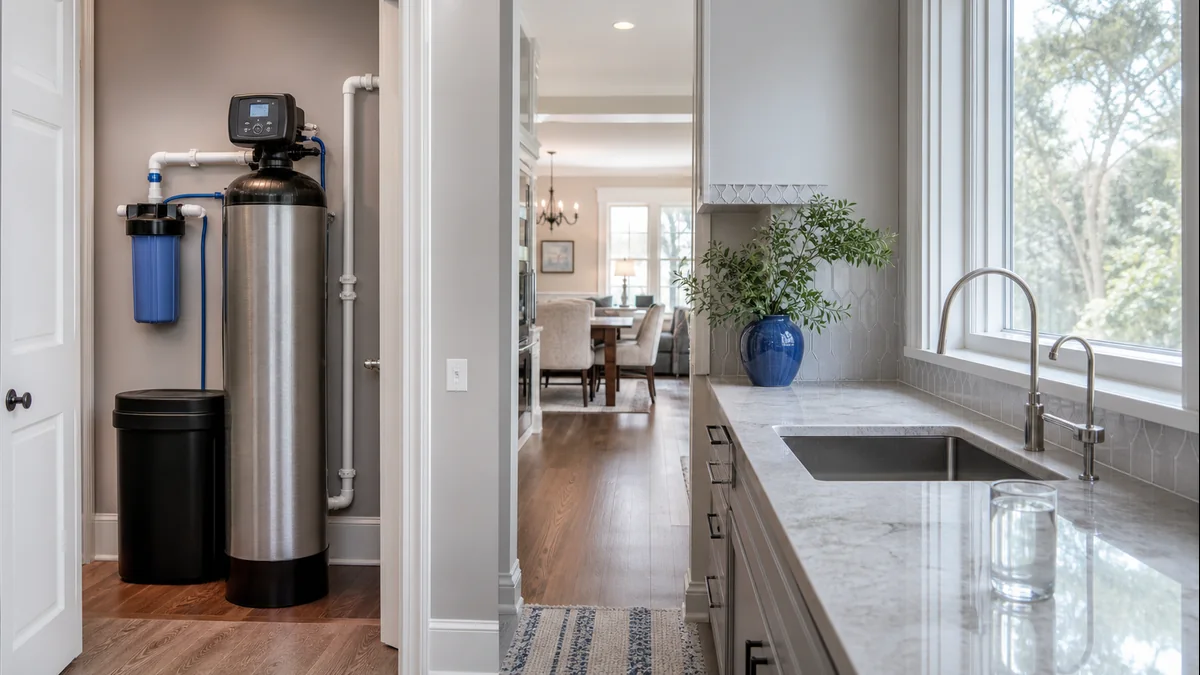
Direct answer: Hard water leaves calcium and magnesium behind on an RO membrane as water passes through, a buildup called scaling that reduces performance over time. Apex measures up to 1.9 gpg by its own report; Triangle Waterworks measures up to 3.7 gpg across the area — real hardness reaching the membrane on an RO-only setup. Softening the water first, as part of an all-in-one system, is the standard fix.
What actually causes RO membrane scaling?
Scaling happens when dissolved minerals in the feed water — calcium and magnesium being the main hardness contributors — build up on the membrane's surface as water is pushed through it under pressure. A University of Nebraska-Lincoln Extension guide to residential reverse osmosis treatment notes that slightly acidic feed water can help reduce scale buildup in an RO system.
That detail is itself evidence hardness minerals in the feed water drive the problem in the first place.
The Water Quality Association's own technical fact sheet on RO membranes lists feed water concentration (measured as total dissolved solids) as one of the four main factors affecting membrane performance, alongside operating pressure, temperature, and recovery rate. Higher feed water concentration is directly tied to declining performance — and calcium and magnesium hardness are part of that dissolved-solids load in any Triangle home's tap water.
Does Apex's water actually carry enough hardness to matter for RO?
Yes. The Town of Apex's 2024 Annual Drinking Water Quality Report lists average total hardness at 33.3 ppm, or 1.9 grains per gallon, which the town itself describes as "moderately soft." That's a real, non-zero mineral load reaching every fixture on an Apex line — including an RO membrane, if nothing removes the hardness first.
Triangle Waterworks' own in-home testing across the service area measures higher: 1.6 to 3.7 gpg by ZIP code, slightly hard to moderately hard on the WQA/Hach scale. Town figures are a plant-wide average; ours are measured address by address, and neither number contradicts the other. Either way, an RO membrane in an Apex home is treating water that carries measurable hardness before it ever reaches the membrane surface.
Does softening the water before RO actually help?
Yes, and this isn't a marketing claim — it's standard treatment-industry guidance. The same University of Nebraska-Lincoln Extension guide states plainly: for relatively hard water, pretreatment by a softener can increase the life of the membrane. That's the entire logic behind pairing softening with RO rather than installing RO alone on a hard-water supply.
The mechanism follows directly from how scaling forms: if calcium and magnesium are exchanged out of the water by a softening stage before the water ever reaches the RO membrane, there's far less hardness mineral left to deposit on the membrane surface as scale. The membrane still has soluble solids, PFAS, and other contaminants to reject — softening doesn't replace RO, it protects it.
Why not just run RO by itself?
RO alone will still work — it's not disabled by hardness — but it's treating harder feed water than it has to. Every gallon that passes through carries Apex or Triangle-area hardness minerals that a softening stage upstream would otherwise have removed. Extension guidance frames this as a direct life-of-membrane concern, not a hypothetical one.
There's also a practical coverage gap running RO alone doesn't solve. RO is typically installed at a single point of use, almost always the kitchen sink, so it treats drinking and cooking water only — not the shower, the laundry, or the water heater, all of which are exposed to the same hardness minerals an RO-only setup never touches.
What does Apex's water actually need removed, beyond hardness?
Hardness isn't the only reason Apex water is worth treating. The town's own 2024 report shows TTHM (total trihalomethanes) averaging 41 ppb and ranging as high as 53 — among the higher verified disinfection-byproduct figures in the Triangle Waterworks service area — plus HAA5 averaging 19 ppb, PFBA at 3.8 ppt, and PFHxA at 3.65 ppt. PFOS and PFOA both tested non-detect in Apex's 2024 report.
EPA's National Primary Drinking Water Regulations table lists TTHM's potential health effect from long-term exposure above the MCL as "Liver, kidney or central nervous system problems; increased risk of cancer," and HAA5's as "Increased risk of cancer."
Apex is fully compliant with every EPA limit that applies to it — none of this is a violation. But a legal limit is a ceiling set at the edge of EPA's own acceptable risk tolerance, not a guarantee that everything under it is worth ignoring. A carbon filtration stage removes TTHM, HAA5, and PFAS compounds directly, rather than relying on staying under a legal number.
How does an all-in-one system solve the whole picture for an Apex home?
An all-in-one system combines softening resin with a carbon filtration stage ahead of an under-sink RO unit. The hardness that would otherwise scale the RO membrane is removed before it gets there, and the chlorine, chloramine, and disinfection byproducts a softener alone never touches are filtered out too.
RO still does its own job on top — reducing dissolved solids and PFAS at the tap you drink from — but it's working with pretreated water instead of raw Apex tap water.
That's the practical upsell from "RO alone" to "RO backed by an all-in-one system": the softening and carbon stages protect the RO membrane and cover the rest of the house, while RO adds the finest layer of reduction at the kitchen sink.
RO alone vs. RO behind an all-in-one system
| RO alone | RO behind all-in-one (softener + carbon) | |
|---|---|---|
| Hardness reaching the RO membrane | Full Apex/Triangle-area hardness (1.6–3.7 gpg) | Removed upstream by softening resin |
| Scale risk on the membrane, per Extension guidance | Present — feed water carries full mineral load | Reduced — softener pretreats the feed water |
| Chlorine/chloramine/TTHM/HAA5 coverage | RO reduces some, not built for whole-house coverage | Carbon stage removes it house-wide |
| Coverage area | Kitchen sink only | Whole home (softening + carbon) plus RO at the sink |
| Hardness protection for water heater, fixtures, laundry | None | Full house |
FAQ
I just installed RO under my kitchen sink in Apex — do I still need a softener? If you want to protect the RO membrane and cover more than your kitchen sink, yes. RO alone treats drinking water at one tap and doesn't stop hardness minerals from reaching the membrane or the rest of your home's plumbing, fixtures, and water heater.
I noticed my RO system's water flow is slower than when it was new — could Apex's hard water be the cause? It's a reasonable possibility. Feed water mineral concentration is one of the factors Water Quality Association technical guidance points to for declining RO membrane performance over time, and Apex's own report shows real, measurable hardness reaching every tap.
Does a water softener replace the need for reverse osmosis in Apex? No — they solve different problems. A softener removes calcium and magnesium; RO reduces dissolved solids, PFAS, and other fine contaminants softening doesn't touch. Extension guidance recommends softening specifically as pretreatment to protect the RO membrane, not as a substitute for it.
Is Apex's hardness level actually high enough to worry about? It's real and measurable — the town's own 2024 report puts it at 1.9 gpg, and our own address-level testing across the service area runs as high as 3.7 gpg. That's slightly hard to moderately hard on the WQA/Hach scale, and it's mineral content an RO membrane has to deal with on every gallon if nothing softens the water first.
Does an all-in-one system install with an existing under-sink RO unit? Yes — softening and carbon filtration go in at the main line, ahead of an existing under-sink RO unit, so the RO continues doing its own job on water that's already been pretreated. A free water analysis is the way to confirm exact configuration for your home.
What does Apex water actually need filtered out besides hardness? The town's own report shows TTHM up to 53 ppb and HAA5 averaging 19 ppb, plus trace PFAS compounds. A carbon filtration stage addresses those directly, which is why an all-in-one system pairs it with softening rather than relying on hardness removal alone.
See What an All-In-One System Would Do for Your Apex Home
Apex's own water report shows real hardness and real disinfection byproducts reaching every tap, including an RO membrane if nothing pretreats the water first. Take the 60-second water quiz or request a free water analysis to see what an all-in-one system plus RO would look like at your address.
Sources
- Town of Apex — 2024 Annual Drinking Water Quality Report
- University of Nebraska-Lincoln Extension — G1490, Drinking Water Treatment: Reverse Osmosis
- Water Quality Association — Reverse Osmosis (RO) Fact Sheet
- EPA — National Primary Drinking Water Regulations
Related reading: Whole House Filter vs. Reverse Osmosis | Carbon Filter vs. Reverse Osmosis | Water Softener in Apex, NC | New-Build Water Treatment in Apex, NC | Is Reverse Osmosis Water Healthy?
Answer nine practical questions, then request a written quote or well-water analysis.
Start My Water Analysis