
Salt-Free Water Conditioner vs. Salt Softener: Which Actually Works?
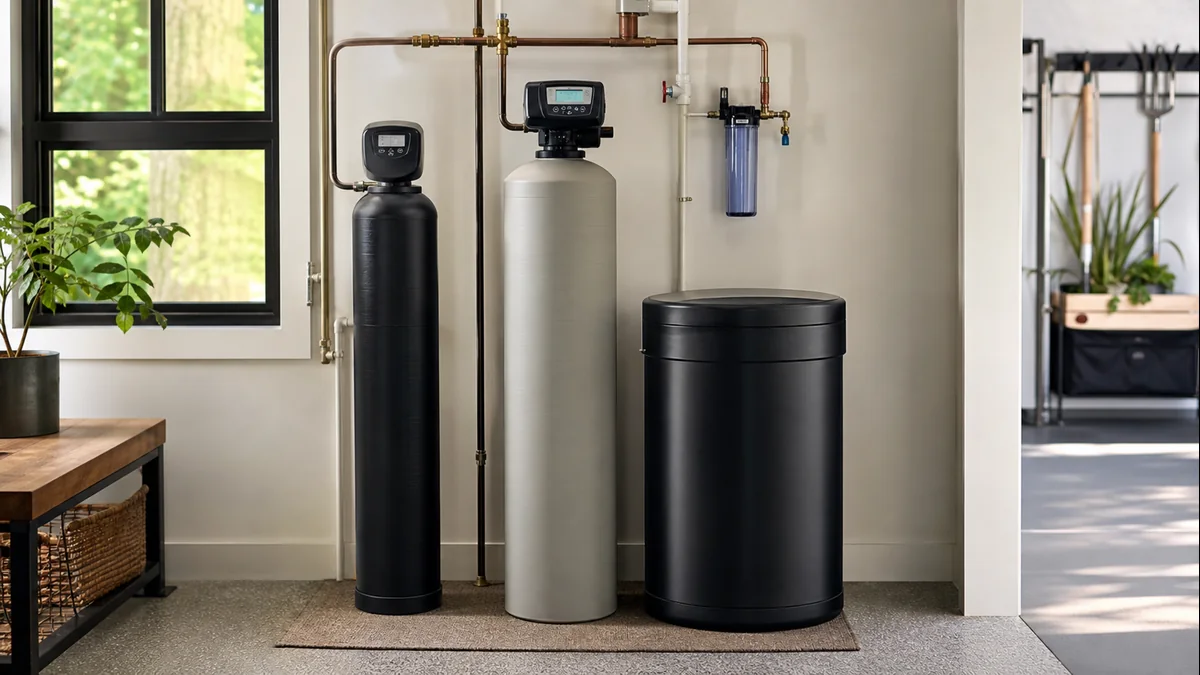
A salt-based softener removes hardness minerals through ion exchange, swapping calcium and magnesium for sodium. A salt-free conditioner doesn't remove anything — it uses a process called template-assisted crystallization (TAC) to change the mineral structure so it's less likely to stick to pipes and fixtures. Both address hardness differently, and on Raleigh (~1.6 gpg, slightly hard on the WQA scale) and Cary (1.6–3.7 gpg, slightly hard at the low end but moderately hard at the top) city water, a salt-based softener is the better fit for most homes — it's the option that actually reduces hardness, which matters most for Cary households at the upper end of that range.
What's the actual difference between salt-free and salt-based?
Salt-based softeners use ion exchange resin. Hard water passes through, calcium and magnesium ions get captured by the resin, and sodium ions take their place — the water leaving the tank is measurably softer because the hardness minerals are gone. The tank periodically regenerates using salt brine, which is where the ongoing salt purchases and drain discharge come from.
Salt-free conditioners work on a different principle. TAC media converts dissolved hardness minerals into microscopic crystals that don't easily bond to surfaces like pipe walls, water heater elements, or fixtures. The hardness minerals are still in the water when it leaves the system — a lab hardness test would show the same reading before and after. What changes is the minerals' tendency to form scale.
Does salt-free actually work?
For scale prevention specifically, TAC conditioning is a real, established technology — it's not a gimmick. What it does not do is soften water in the traditional sense: it won't produce the slicker feel, improved lathering, or lower hardness reading that a salt-based system does, because it isn't removing anything.
That distinction matters when you're comparing the two. If your goal is "stop scale from building up in my water heater and pipes," a salt-free conditioner is built for that. If your goal is "make my water measurably softer," only a salt-based system does that.
When is each the right choice?
A salt-based softener makes sense when hardness is confirmed by testing (common on wells) and you want an actual reduction in hardness — softer-feeling water, less soap needed, no scale.
A salt-free conditioner makes sense for households that want scale protection without sodium added to their water, without ongoing salt purchases, and without the wastewater discharge that comes with softener regeneration cycles. It's also a common choice for people on a sodium-restricted diet who still want to protect plumbing and appliances from scale.
On Raleigh or Cary city water, hardness runs roughly 1.6–3.7 gpg — slightly hard on Raleigh, slightly-to-moderately-hard on Cary. That's still real, measurable hardness, and a salt-based softener is the clearer choice for households that want it actually reduced, especially on Cary's system where the top of the range crosses into moderately hard.
Salt-free vs. salt-based at a glance
| Salt-based softener | Salt-free conditioner (TAC) | |
|---|---|---|
| Removes hardness minerals | Yes, via ion exchange | No — changes crystal structure only |
| Reduces measured hardness (gpg) | Yes | No |
| Prevents scale buildup | Yes | Yes |
| Adds sodium to water | Yes | No |
| Ongoing salt purchases | Yes | No |
| Wastewater discharge from regeneration | Yes | No |
| Best fit | Confirmed hard water, wells, Raleigh/Cary city water | Scale protection without sodium, for households that prioritize that over measurable softening |
Local angle: what this means in the Triangle
If you're on Raleigh Water or Cary's system, a salt-based softener will give you the clearest, measurable result — Raleigh's 1.6 gpg is slightly hard on the WQA scale but still carries minerals worth removing, and Cary's 1.6–3.7 gpg range tips into moderately hard at the top. A salt-free conditioner is worth considering instead if sodium intake, salt handling, or wastewater discharge are concerns for your household, understanding that it's solving scale, not hardness itself.
FAQ
Does a salt-free water conditioner remove hardness? No. It changes the crystal structure of hardness minerals so they're less likely to stick to surfaces, but the minerals stay in the water. A hardness test will read the same before and after.
Is salt-free conditioning as effective as a salt-based softener? For scale prevention, yes, it's a legitimate technology. For actually softening the water — reducing the gpg reading, improving lather, eliminating soap scum — no, only ion exchange does that.
Do I need either one on Raleigh or Cary city water? A salt-based softener is the better fit for most homes on either system. Raleigh tests around 1.6 gpg (slightly hard on the WQA scale) and Cary 1.6–3.7 gpg (slightly hard at the low end, moderately hard at the top) — real hardness that a softener will actually reduce.
Is salt-free better for the environment or my health? It avoids the sodium addition and wastewater discharge that come with salt-based regeneration, which is a real advantage for sodium-restricted households or areas with septic/drain field concerns. It's not a health or environmental claim beyond that — it simply works on a different mechanism.
Can I test my own water to see if I need either system? Yes. On city water, check your utility's public water quality report first. On a well, a comprehensive test covering hardness, iron, pH, sulfur, and TDS gives you an actual number to work from instead of guessing.
Not sure if your water needs softening at all?
Take our 60-second water quiz — it factors in your address and tells you exactly which system makes sense for your water.
Related reading: Whole House Water Filter Cost in Raleigh, NC | Do I Need a Water Softener in North Carolina? | What Size Water Softener Do I Need? | Whole House Filter vs. Water Softener
Answer nine practical questions, then request a written quote or well-water analysis.
Start My Water Analysis