
Salt-Free Water Conditioner vs. Softener in Cary, NC — Which Actually Works?
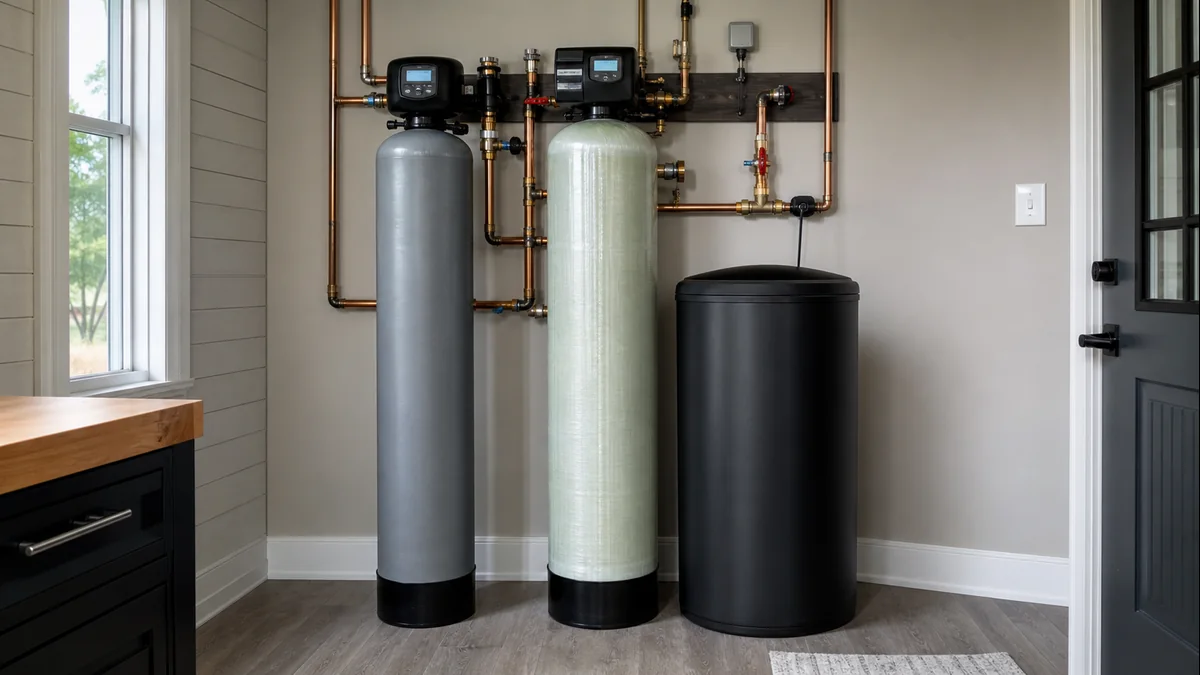
Direct answer: A salt-free conditioner changes how hardness minerals behave so they resist sticking to surfaces — it doesn't remove them. A softener removes calcium and magnesium through ion exchange, measurably reducing hardness. Cary reaches 3.7 gpg at the top of our measured range, moderately hard on the WQA scale — real hardness worth actually removing. An all-in-one system adds carbon filtration for chlorine and byproducts on top.
What's the actual difference between a salt-free conditioner and a softener?
A salt-based softener uses ion exchange resin. Hard water flows through the resin bed, calcium and magnesium ions get captured, and sodium ions take their place — the water leaving the tank is measurably softer because the hardness minerals are gone. A salt-free conditioner works differently: it uses template-assisted crystallization (TAC) to convert dissolved hardness minerals into microscopic crystals that resist bonding to pipe walls, water heater elements, and fixtures.
The minerals are still in the water when it leaves a TAC conditioner. A lab hardness test would read the same before and after. What changes is the minerals' tendency to form scale — not the hardness number itself.
Does a salt-free conditioner actually soften water in Cary?
No, and that's the distinction that matters most for a Cary address. TAC conditioning is a real, established technology for scale prevention — it's not a gimmick. But it won't produce a lower gpg reading, better lather, or the slicker feel that comes from actually removing hardness minerals, because nothing is being removed.
That gap matters more here than in a lot of markets. Cary's own water hardness reaches the top of what Triangle Waterworks measures across the service area: up to 3.7 gpg, which lands in the moderately hard band (3.5–7.0 gpg) on the WQA/Hach scale — the same scale used by the Hach Total Hardness Test Kit, Model 5-B, the at-home GPG test we recommend.
At the low end, hardness in the area runs 1.6 gpg, slightly hard. Cary sits at the strongest end of that range.
Why does hardness matter more for Cary than for other Triangle towns?
Because Cary is where our own measured hardness peaks. The Town of Cary's own Public Works FAQ reports finished water hardness of 25–30 ppm (roughly 1.5–1.75 gpg), which the town calls very soft.
That lower figure doesn't contradict what we measure at individual addresses. The Town's number is an average for finished water leaving the plant; ours is taken at the tap, address by address across the distribution system, and it varies by ZIP — as high as 3.7 gpg at the top of that range.
A conditioner won't lower that number no matter which end of it your address falls on. A softener will. For a household near the top of Cary's range, actually removing calcium and magnesium — not just changing its crystal shape — is what keeps water heater elements, dishwashers, and fixtures from gradually collecting mineral buildup.
What about chlorine, chloramine, and disinfection byproducts? Does either option handle that?
Neither a salt-free conditioner nor a salt-based softener alone touches chlorine, chloramine, PFAS, or disinfection byproducts (DBPs) like TTHM and HAA5 — both technologies work strictly on hardness minerals. That's a separate problem requiring a separate technology: activated carbon.
Cary's 2025 Consumer Confidence Report shows TTHM averaging 37 ppb (ranging 17–43) and HAA5 averaging 17 ppb. Neighboring Apex's 2024 report shows TTHM averaging 41 ppb and ranging as high as 53 — among the higher verified disinfection-byproduct figures in the Triangle Waterworks service area. Both towns are fully compliant with EPA limits; compliance and "worth filtering out" aren't the same question.
EPA's National Primary Drinking Water Regulations table lists TTHM's potential health effect from long-term exposure above the MCL as "Liver, kidney or central nervous system problems; increased risk of cancer," and HAA5's as "Increased risk of cancer."
Compliance here is real — Cary and Apex are not violating anything, and that fact should be taken at face value. But a legal limit is a ceiling EPA set at the edge of its own acceptable risk tolerance, not a guarantee that everything under it is worth ignoring. A carbon filtration stage removes TTHM and HAA5 directly, rather than relying on staying under a legal number.
So which one should a Cary homeowner actually get?
Given Cary's hardness profile, a softener is the clearer fit on the hardness side alone. Neither a softener nor a conditioner touches chlorine or DBPs, though, so the honest answer for most Cary households is a system that does both jobs at once.
An all-in-one system combines softening resin with a carbon filtration stage. The softening side removes calcium and magnesium the way a TAC conditioner can't, and the carbon side removes chlorine taste, chloramine, PFAS, and disinfection byproducts that softening alone — salt-based or salt-free — never addresses.
A salt-free conditioner still has a real place: households on a sodium-restricted diet, on a septic system sensitive to brine discharge, or simply not interested in salt purchases can get genuine scale protection from TAC without any of that. It's a legitimate tradeoff, just a different one than "which system gives Cary's water the most complete treatment."
Salt-free conditioner vs. softener vs. all-in-one, at a glance
| Salt-free conditioner (TAC) | Salt-based softener | All-in-one (softener + carbon) | |
|---|---|---|---|
| Removes hardness minerals | No — changes crystal structure only | Yes, via ion exchange | Yes, via ion exchange |
| Reduces measured hardness (gpg) | No | Yes | Yes |
| Prevents scale buildup | Yes | Yes | Yes |
| Removes chlorine/chloramine taste | No | No | Yes |
| Removes PFAS and disinfection byproducts | No | No | Yes |
| Adds sodium to water | No | Yes | Yes |
| Ongoing salt purchases | No | Yes | Yes |
| Best fit for Cary's 1.6–3.7 gpg range | Scale protection without sodium | Actual hardness removal | Full coverage: hardness + chlorine/DBP/PFAS |
FAQ
I just moved to Cary and installed a salt-free conditioner at my last house — will it work the same way here? It'll work the same mechanism-wise, reducing scale tendency without removing hardness minerals. But Cary's measured range runs up to 3.7 gpg, moderately hard on the WQA scale, so if your goal is a lower hardness reading or noticeably softer-feeling water, a conditioner alone won't get you there — only ion exchange removes the minerals.
My glasses come out spotty even though Cary calls its water "very soft" — is a conditioner enough to fix that? Not fully. Cary's 25–30 ppm figure is a plant average; what we measure across Cary addresses runs up to 3.7 gpg. Spotting is consistent with hardness minerals in the water, and a conditioner doesn't remove those minerals — a softener does.
Does a salt-free conditioner remove chlorine taste from Cary tap water? No. TAC conditioning only affects how hardness minerals behave; it does nothing about chlorine, chloramine, or disinfection byproducts like TTHM and HAA5. Removing those requires an activated carbon stage, which is why an all-in-one system pairs the two.
Is a salt-free conditioner better for my septic system than a softener? Yes, that's one of its real advantages — it doesn't produce the brine discharge that comes with softener regeneration, which matters for septic-sensitive properties. It's a legitimate reason to choose it even in a moderately hard market like Cary, as long as you understand it isn't removing hardness.
Can I just add a salt-free conditioner to my existing softener instead of replacing it? Some households do run them together, but for most Cary homes the more direct route is a single all-in-one system that already combines softening resin with carbon filtration — one line rather than two separate devices to install and maintain.
How do I know if my specific Cary address is closer to 1.6 gpg or 3.7 gpg? The town's published average won't tell you — it's a system-wide figure. A free in-home water analysis gives you the actual number for your address, or you can test yourself with a Hach Total Hardness Test Kit, Model 5-B, which reads out in gpg on the same scale we use.
See What Cary's Water Actually Measures at Your Address
Cary's hardness runs from slightly hard to moderately hard depending on where you are in town, and neither a conditioner nor a softener alone handles the chlorine and DBP side. Take the 60-second water quiz or request a free water analysis to find out what an all-in-one system would actually do for your Cary tap.
Sources
- Town of Cary — 2025 Annual Water Quality Report
- Town of Cary — Public Works FAQ
- Town of Apex — 2024 Annual Drinking Water Quality Report
- EPA — National Primary Drinking Water Regulations
Related reading: Salt-Free Conditioner vs. Water Softener | Water Softener in Cary, NC | Is Cary, NC Water Really Soft? | Best Whole-Home System for Cary, Apex, Morrisville | Water Softener Cost in Cary, NC
Answer nine practical questions, then request a written quote or well-water analysis.
Start My Water Analysis