
Shower Filter vs. Whole-House System in Raleigh, NC — Which Actually Fixes Your Water?
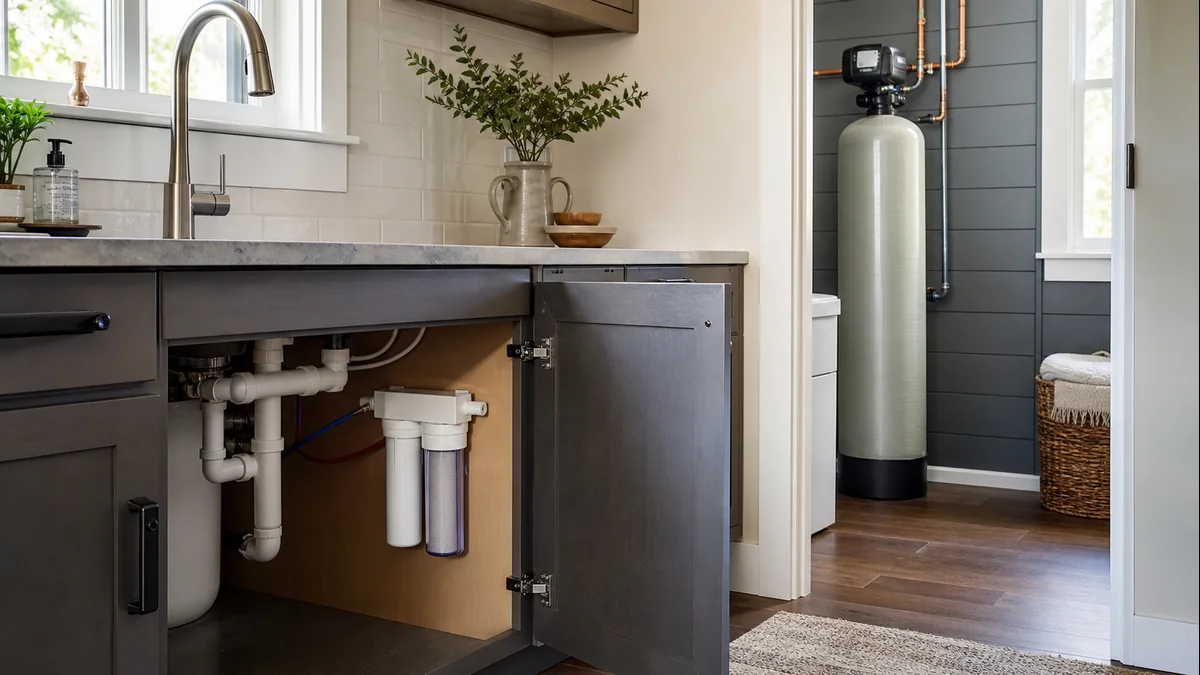
Direct answer: If an in-line showerhead filter noticeably improved how your Raleigh shower feels, that's a real result, not a placebo — it means your water responds to treatment. A shower filter treats one fixture for a few minutes a day, though. A whole-home all-in-one system puts the same idea to work at the point where water enters the house, treating chlorine/chloramine taste and disinfection byproducts at every tap, shower, and appliance continuously, and adds softening resin for scale protection a shower filter can't touch at all.
If you're the Raleigh homeowner who swapped in a cheap in-line shower filter and immediately noticed the water felt different — less harsh, less drying, maybe less of that chemical smell — you were right to notice, and right to act on it. That instinct is the entire case for a whole-home system. You just proved it to yourself at the smallest possible scale.
Does a Showerhead Filter Actually Change How Water Feels?
Yes — a showerhead filter sits directly in the water's path to your skin and hair, so any reduction in chlorine or chloramine odor and any softening of that "stripped" feeling registers immediately, every time you shower. Raleigh Water normally disinfects with chloramine, which the City describes as having no taste or odor associated with it, but a lot of residents still notice a change when a filter is added to the shower line — that's a fair, honest observation, and it's exactly the kind of signal worth paying attention to. A small in-line cartridge has limited media and only a few minutes of contact time before the water leaves the showerhead, so it isn't doing nothing — it's doing a version of what a larger system does, just at a much smaller scale.
What Is a Showerhead Filter Actually Doing, Mechanically?
A showerhead filter runs water through a compact cartridge — usually some combination of carbon and a filtration media — for the few seconds it takes to pass through the fixture, which is why the effect is noticeable but limited to that one tap. Contact time and media volume both matter for how thoroughly a filter can work, and an in-line shower cartridge has far less of each than a whole-home unit sized for the entire house. That's not a flaw in the shower filter — it's doing what a device that size can do. It just can't do what a larger system, installed where water enters the house, is built to do across every fixture at once.
What Does a Shower Filter Not Do That a Whole-Home System Does?
A shower filter only treats water at the shower — every other tap, the dishwasher, the washing machine, and the water heater in a Raleigh home still receive water straight from the main line, untouched. It also doesn't address hardness at all, because softening is a different process entirely (ion exchange, swapping calcium and magnesium for sodium or potassium) than anything a carbon-based shower cartridge performs. A whole-home all-in-one system installs where the main line enters the house, so its carbon stage treats chlorine/chloramine taste and disinfection byproducts on every gallon reaching every fixture, and its softening resin protects the water heater, dishwasher, washer, and plumbing from buildup a shower filter was never designed to touch.
Showerhead Filter vs. Under-Sink Filter vs. Whole-Home All-in-One System
| Showerhead filter | Under-sink filter | Whole-home all-in-one system | |
|---|---|---|---|
| Fixtures covered | One shower only | One tap (usually kitchen) | Every fixture, every tap, every appliance |
| Chlorine/chloramine taste & odor | Reduced at that shower | Reduced at that tap | Reduced house-wide, including drinking, cooking, laundry, and bathing water |
| Disinfection byproducts (HAA9/TTHM) | Minimal — limited media and contact time | Some reduction at that tap, media-dependent | Treated by the carbon stage across the full water supply |
| Hardness / scale | Not addressed | Not addressed | Addressed by the softening resin half of the system |
| Appliance & water-heater protection | None | None (single tap only) | Full — every appliance runs on softened, carbon-treated water |
| Replacement cadence | Frequent, small cartridge | Periodic cartridge swap | Media serviced on a maintenance schedule set for your home |
| Installation | Screws on, no plumbing work | Under-sink plumbing tie-in | Licensed plumbing installation at the main line, sized after a free water analysis |
Every option in this table is doing real, legitimate work at its scale. The difference is coverage — one fixture, one tap, or the whole house — and whether softening is part of the picture at all.
Why Doesn't a Shower Filter Address Hardness?
Because softening isn't a filtration process — it's ion exchange, and a small carbon-based cartridge has no resin bed to perform it. Calcium and magnesium in the water swap places with sodium or potassium ions inside a softening resin tank, which is a completely different mechanism than trapping particles or adsorbing chlorine on carbon media. That's why even a well-built shower filter, doing exactly what it's designed to do, will never soften water — it isn't built for that job, and no amount of upgrading the cartridge changes that. Read more on how a whole-home filter and a softener divide the work if you want the fuller comparison of the two mechanisms.
What Does Raleigh's Water Actually Need Treatment For?
Raleigh Water carries measurable disinfection byproducts and a genuine — if modest — hardness range, both of which respond to whole-home treatment better than to a single fixture. Raleigh Water's own reported figures show HAA9 at 19.9 ppb and TTHM at 21.7 ppb, both legally compliant with EPA limits and above the stricter, non-regulatory EWG guideline; activated carbon removes both effectively, and works better with more media and more contact time than a shower cartridge provides. On hardness, our own testing across the service area measures 1.6 to 3.7 gpg by address — on the Water Quality Association scale the Hach Model 5-B kit uses, that spans slightly hard to moderately hard, a real and cumulative case for softening resin. See the fuller breakdown of chlorine taste in Raleigh tap water for more on the carbon side.
What About the Once-a-Year Chlorine Switch?
Raleigh Water normally disinfects with chloramine but converts to free chlorine once a year, on the N.C. Department of Environmental Quality's recommendation, and flushes the distribution system during the changeover — chlorine residual runs higher system-wide, and some residents notice a stronger smell as a result. Check the City's own announcement for the timing, since the dates shift annually. A shower filter's small cartridge can get overwhelmed faster during that higher-residual window because there's less media to work with; a whole-home carbon stage is sized to handle it all year, at every tap — not just during the switch.
Is a Whole-Home System Just a Bigger Version of My Shower Filter?
In principle, yes — the carbon half of a whole-home all-in-one system does the same basic job as your shower filter, just with more media, more contact time, and coverage of the entire house instead of one fixture. It adds a second half your shower filter never had: softening resin for hardness and scale. The upgrade isn't "your shower filter was wrong" — it's "the thing that worked in miniature now works everywhere, plus it does the one job a shower filter structurally can't do." Compare whole-house and point-of-use filtration side by side for how that scaling works across other devices too.
Frequently Asked Questions
I put an inexpensive in-line filter on my shower in Raleigh and my skin and hair genuinely feel better — was I imagining that, or is a whole-home system really necessary too? You weren't imagining it. A showerhead filter sits directly in the water's path and does real work with the carbon media it has, so a noticeable difference at that one fixture is legitimate. A whole-home system applies that same principle to every tap continuously, plus adds softening resin for hardness — an expansion of what you already proved works, not a correction of it.
What's the difference between a shower filter and an under-sink filter — do I need both, or does a whole-home system replace them? A shower filter treats water at the showerhead; an under-sink filter treats one tap, usually the kitchen sink. Both are single-fixture solutions. A whole-home all-in-one system installs where water enters the house, so it treats every fixture at once, along with the water heater, dishwasher, and washer that neither point-of-use filter reaches.
Does a whole-home system remove the chlorine smell as well as my shower filter does, or better? A whole-home carbon stage generally has more media and more contact time than a small in-line cartridge, and it treats water at every tap rather than just the shower — including during Raleigh Water's once-a-year switch to free chlorine, when residual runs higher system-wide.
I just moved into a Raleigh house and I'm noticing scale buildup on my faucets — will my shower filter ever fix that? No, and it isn't designed to. Softening is ion exchange, a process that removes calcium and magnesium from the water; a carbon-based shower filter has no resin bed and doesn't perform that process. A whole-home all-in-one system pairs softening resin with its carbon stage specifically to address scale — the buildup a shower filter structurally cannot touch.
How often does a shower filter need replacing compared to a whole-home system's media? A small in-line shower cartridge has limited media, so it needs replacing more often than a whole-home system's media, which is sized for the household and serviced on a maintenance schedule set during installation. A free water analysis is how that sizing gets set correctly for your Raleigh home.
Is installing a whole-home system a bigger project than screwing on a shower filter? Yes — a shower filter is a DIY swap, while a whole-home all-in-one system is licensed plumbing work installed at the main line, sized and placed during a free water analysis. It's a bigger step, and it's the one that turns a one-fixture improvement into a whole-house one, including water-heater and appliance protection a shower filter never provided.
See What Your Raleigh Water Actually Needs
You already have the proof that treatment works — your shower filter gave it to you. The next step is finding out what the same principle does for the rest of your Raleigh home: every tap, every appliance, plus the softening a shower filter was never built to provide. Take the 60-second water quiz at /quiz, or book a free water analysis to get the exact readings from your own tap.
Answer nine practical questions, then request a written quote or well-water analysis.
Start My Water Analysis