
How to Stop Soap Scum on Shower Doors
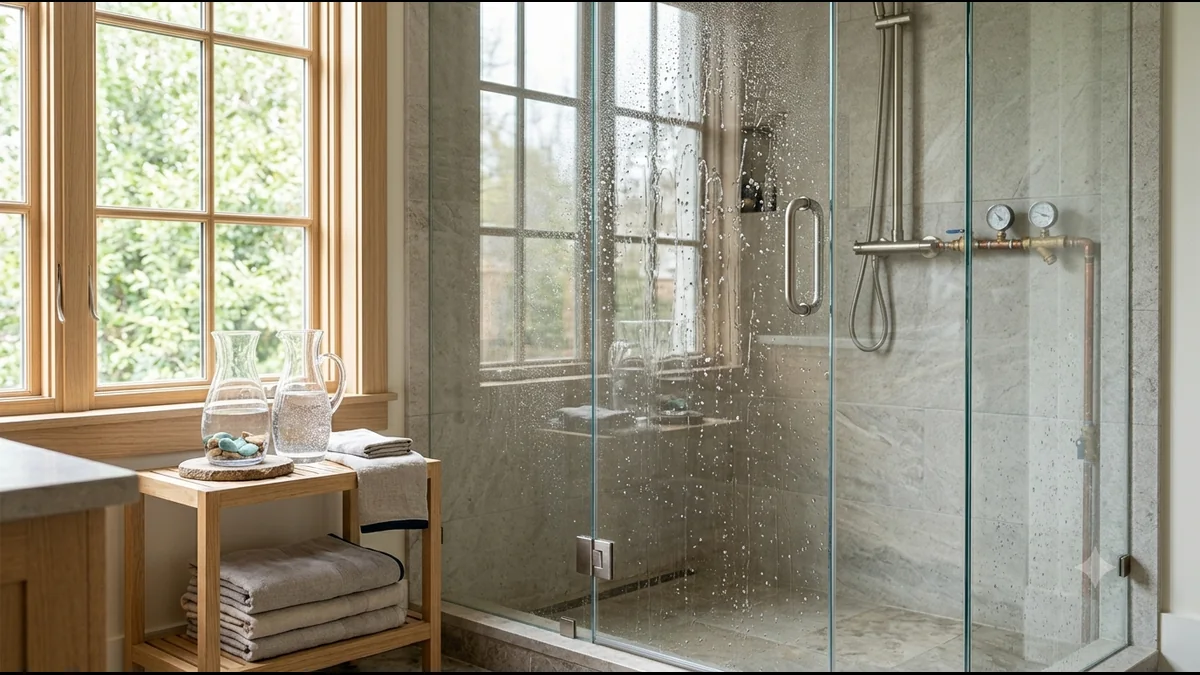
Direct answer: Soap scum forms when soap reacts with dissolved calcium in your water, creating an insoluble film that clings to shower glass, tile, and fixtures. Scrubbing it off every weekend only clears what's already there — it doesn't stop more from forming, because the calcium causing it is still in every gallon that hits your shower. A whole-home system with a softening stage removes that calcium before it reaches your plumbing, so scum stops forming at the source, while a paired carbon stage handles the chlorine taste softening can't touch.
What actually causes soap scum on a shower door?
Soap scum is a chemical reaction, not just dirt. The U.S. Geological Survey explains that hardness in water is dissolved calcium and magnesium, and when soap meets that calcium, it reacts to form an insoluble substance — soap scum, sometimes called soap curd — that can cling to your hands or your shower walls. It's not soap residue alone and it's not just body oils; it's a byproduct of soap chemically combining with the minerals already dissolved in your water supply. That's why it forms whether or not you're using more or less soap — as long as calcium and soap are both present, the reaction happens.
Why does it feel like I'm using more soap than I should need?
Because you likely are. USGS notes that harder water needs more soap or detergent to get the same cleaning result, that soap is harder to work into a lather in the first place, and that more water is needed afterward to rinse the scum away. So a shower with more dissolved calcium isn't just leaving more scum on the glass — it's also quietly costing you more product per shower, since part of every squeeze of body wash or shampoo is being spent reacting with minerals instead of cleaning.
Why does scrubbing never seem to keep it from coming back?
Because cleaning only removes what has already formed — it doesn't change what's in the water hitting your shower door tomorrow. Every shower with calcium-bearing water deposits a small amount of new scum, and a weekly scrub just resets the surface back to clean for a few days before the cycle starts again. That's the core distinction worth understanding: cleaning treats the symptom on a repeating schedule, while removing the calcium that causes the reaction in the first place treats the cause. A softener uses ion exchange to pull calcium and magnesium out of your water before it ever reaches your shower, so there's nothing left for soap to react with when it hits the glass.
Where does soap scum actually show up, and does it look different in each spot?
Yes — the same reaction shows up differently depending on the surface.
| Surface | How soap scum typically shows up | What treats it |
|---|---|---|
| Glass shower door | Hazy, streaky film that builds up in the same spots each week | Squeegee after each use for the film already there; softening stops new film from forming |
| Tile and grout | Duller finish, scum settling into grout lines where it's harder to scrub out | Regular cleaning for existing buildup; softening reduces how much reaches the grout to begin with |
| Fixtures and showerheads | Filmy coating on chrome or nozzle openings, sometimes narrowing spray pattern over time | Periodic cleaning of visible deposits; softening addresses the calcium causing both scum and mineral buildup |
What's the best way to clean the soap scum that's already there?
For glass, a daily squeegee pass right after your last shower of the day is the single most effective habit, since it clears water (and the minerals in it) before they have a chance to sit and dry into a film. For scum that's already built up on glass or tile, a solution of white vinegar and a small amount of dish soap, left to sit for a few minutes before wiping with a non-abrasive cloth or sponge, handles most existing buildup without scratching the surface. Avoid abrasive scouring pads on glass shower doors — they can dull or scratch the surface over time, which then gives future scum more texture to cling to. For fixtures and showerhead openings, a similar soak-and-wipe approach clears visible film without the need for anything abrasive.
Does cleaning-only ever really solve this, or is it always temporary?
Cleaning is never a permanent fix on its own, because it doesn't change the water supplying the calcium that reacts with soap in the first place. As long as the water reaching your shower carries dissolved calcium, new scum will form after every cleaning, on the same schedule as before. That's not a failure of the cleaning method — it's simply treating the visible result rather than the mineral source. The only way to stop new scum from forming is to remove the calcium before it reaches the shower, which is what a softening stage is built to do.
How does the all-in-one system fit into this?
Softening resin removes the calcium and magnesium that react with soap to form scum, which addresses shower doors, tile, and fixtures all at once, since they're all fed by the same water line. That's the mechanical fix for the scum problem itself. Separately, a carbon filtration stage in the same system handles chlorine and chloramine taste and odor — something softening resin has no effect on, since it's built specifically for calcium and magnesium exchange. Pairing both stages in one installed system means a household gets the scum-prevention benefit of softening and the taste-and-odor benefit of carbon filtration together, rather than needing two separate pieces of equipment.
Frequently Asked Questions
I scrub my shower door every weekend and the scum is always back within days — is that normal? Yes. Scrubbing removes existing scum but doesn't change the calcium in the water hitting your shower every day after, so new film keeps forming on the same cycle. Softening addresses the calcium directly, which is the only way to change that pattern rather than just repeating the cleaning.
My shower glass looks hazy no matter what cleaner I use — what am I missing? Most glass cleaners are designed to cut through the film that's already there, not to prevent new film from forming, since they don't affect your water supply. If the haze returns quickly after cleaning, that points to ongoing mineral buildup from the water itself rather than a cleaning-product issue.
Does soap scum mean my water is definitely hard? It means calcium is present in your water, which causes the reaction described by USGS regardless of exactly how much hardness you have. Some scum can form even at lower hardness levels since the reaction just needs calcium and soap together; a free water analysis can tell you where your specific water falls.
Will a water softener stop scum on my tile and grout too, or just the glass door? All three — glass, tile, and fixtures — are fed by the same water supply, so removing calcium at the source reduces scum formation across all of them, not just the shower door.
I just want the chlorine smell gone from my shower — does a softener handle that? No, that's a separate issue. Softening resin only exchanges calcium and magnesium; it has no effect on chlorine or chloramine taste and odor. That's handled by the carbon stage in the all-in-one system, alongside the softening stage that addresses scum.
How long until I notice less soap scum after a system is installed? Since scum builds up gradually with each shower, most households notice less new film accumulating within the first few weeks, once calcium is no longer reaching the shower to react with soap.
Ready to see what your water needs?
Take our 60-second water quiz to find out what system fits your home if you're on city water, or request a free water analysis if you're on a well.
Related reading: What Are the Benefits of Soft Water in Your Home? | Signs You Need a Water Softener | Water Softener North Carolina | Water Softener vs. All-in-One System | Hard Water Cost: Appliance Damage
Answer nine practical questions, then request a written quote or well-water analysis.
Start My Water Analysis