
Why Does My Shower Door in Cary Keep Getting Cloudy With Soap Scum?
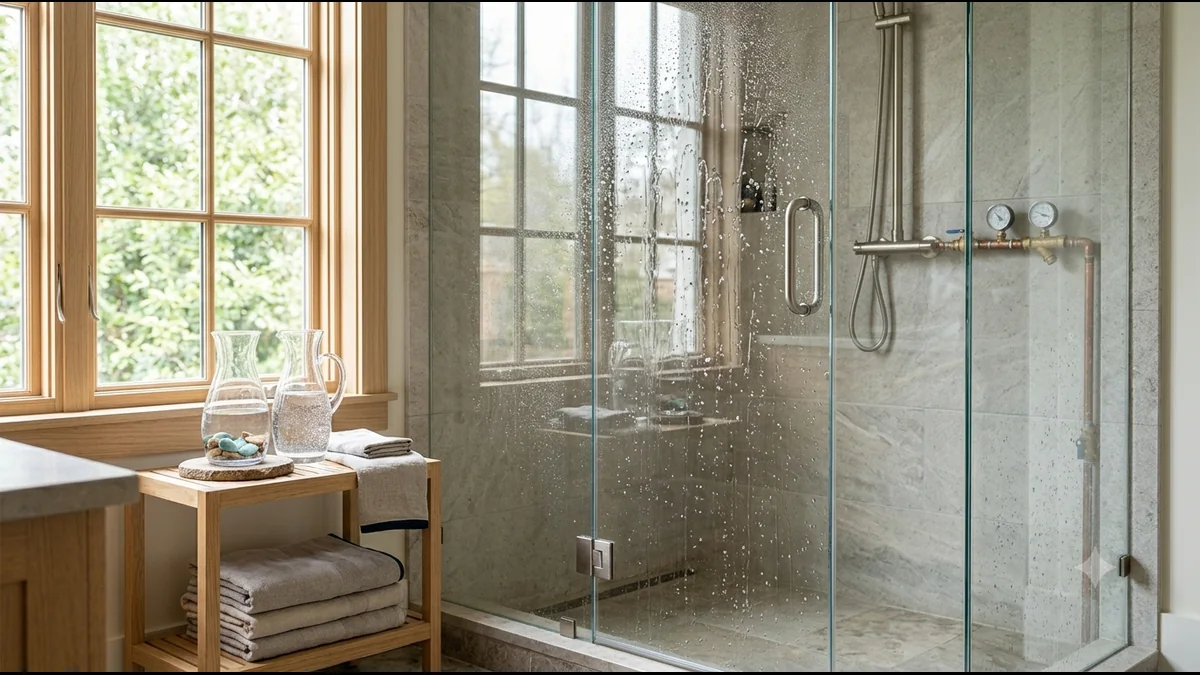
Direct answer: Calcium and magnesium in Cary's water react with soap, forming an insoluble film — soap scum — that clings to glass instead of rinsing off. Cary's Public Works FAQ calls the water "very soft" at 25–30 ppm, while our address-level testing runs 1.6–3.7 gpg by ZIP, reaching "moderately hard" at the top on the Water Quality Association scale. An all-in-one softening and carbon system removes the minerals causing it.
Why does my shower door in Cary keep getting cloudy with soap scum?
Soap scum forms through a straightforward chemical reaction, not bad luck or poor cleaning habits. Calcium and magnesium ions dissolved in the water bind with soap molecules on contact, and that reaction produces a precipitate — an insoluble residue that doesn't rinse away the way soap alone would. It clings to whatever it touches: shower glass, tile grout, chrome fixtures.
Every shower deposits another layer. The more calcium and magnesium available in the water, the more scum forms per shower and the faster it builds back after cleaning.
Does Cary's own "very soft" water rating mean this shouldn't be happening?
Not necessarily, and it's worth reconciling directly rather than ignoring. The Town of Cary's Public Works FAQ states finished water hardness runs 25 to 30 ppm — roughly 1.5 to 1.75 grains per gallon — and the Town describes that as very soft. That figure is accurate and it's not in dispute.
It's also a plant average measured where water leaves the treatment facility, not a reading from any specific address. Our own testing across Cary homes, by ZIP code, runs 1.6 to 3.7 gpg. On the Water Quality Association scale the Hach Total Hardness Test Kit, Model 5-B uses, 1.6 gpg sits in the "slightly hard" band, and 3.7 gpg (about 63 mg/L) crosses the line into "moderately hard."
Same water, two honest numbers: one is a scale difference, the other is a plant-average-versus-your-tap difference, and neither contradicts what Cary publishes. See a fuller breakdown of what "very soft" actually means for Cary tap water if you want the full reconciliation.
Is this a cleaning problem or a water problem?
If squeegeeing after every shower and switching cleaners hasn't stopped the haze from returning within days, that pattern itself is the answer. Cleaning products remove scum that has already formed and bonded to the glass. They do nothing to change what's dissolved in the water hitting that glass on the next shower.
- Cleaning removes existing residue after the reaction has already happened.
- Softening removes calcium and magnesium before they ever reach the shower door, so there's nothing left to react with soap.
A cleaning routine can keep up with light buildup for a while, but at the top of Cary's measured range, most households find the upkeep keeps climbing rather than leveling off.
Will a water softener actually stop this, or just slow it down?
A softener addresses the mechanism directly. Ion exchange swaps calcium and magnesium ions for sodium (or potassium) before water reaches any fixture in the house. With those minerals gone, soap rinses clean instead of reacting into a film, and it takes less soap to work up a lather in the first place.
Softening alone doesn't cover everything in Cary's water, though. The Town's 2025 Annual Water Quality Report lists total trihalomethanes (TTHM) at 37 ppb (ranging 17–43) and haloacetic acids (HAA5) at 17 ppb (ranging 9–17) — both compliant, both disinfection byproducts a softener was never built to remove.
Those two compounds are regulated for a reason worth knowing. EPA's National Primary Drinking Water Regulations table lists the potential health effects of long-term exposure above the legal limit for TTHMs as "Liver, kidney or central nervous system problems; increased risk of cancer," and for haloacetic acids as "Increased risk of cancer."
Cary's reported levels sit under those limits, and that compliance is real. But a legal limit is a ceiling set at the edge of EPA's own acceptable risk, not a guarantee that everything beneath it is worth ignoring — and a carbon stage removes these compounds outright rather than relying on staying under a number.
That's the case for pairing softening resin with a carbon filtration stage in one all-in-one system, so the shower-door problem and the taste-and-odor issue get addressed in the same install.
What actually stops soap scum on a Cary shower door?
| Approach | Ongoing effort | Addresses the mineral cause? |
|---|---|---|
| Squeegee after every shower | Daily, indefinitely | No — removes surface water, not minerals |
| Vinegar or commercial scum remover | Recurring, gets more frequent over time | No — cleans existing scum, doesn't stop new scum |
| Specialty glass coating or spray | Needs reapplication over time | No — a temporary barrier, not a water change |
| Softened water from an all-in-one system | One install, minimal ongoing effort | Yes — removes calcium and magnesium before they reach the glass |
What else changes once the minerals are gone?
Softened water changes more than the shower door once calcium and magnesium are out of the supply:
- Dishes and glassware come out of the dishwasher without the cloudy spotting hard water leaves behind.
- Soap and shampoo lather more easily, so less product is needed per use.
- Skin feels less dry after a shower, and hair loses the flat, weighed-down texture mineral buildup causes.
- Laundry comes out softer, and colors hold their brightness longer instead of dulling from mineral buildup in the fabric.
- Scale buildup inside the water heater, dishwasher, and washing machine slows down, protecting those appliances over years of use.
The carbon side of an all-in-one system adds a separate benefit on top of that: removing chlorine and chloramine taste and smell, PFAS, and disinfection byproducts — the parts of Cary's water that hardness alone never explains. See how softened water protects appliances around a Cary home for more on where that buildup shows up beyond the shower.
Does the reconciliation between the Town's number and ours actually matter for fixing this?
Not for deciding whether to act — either number describes water with enough calcium and magnesium to react with soap and leave scum on glass. It matters for sizing: a free water analysis measures the actual reading at your address inside that 1.6–3.7 gpg range, so the system is matched to what's really coming out of your tap rather than a townwide average. See the full Triangle-wide hardness breakdown by town if you're comparing Cary to neighboring service areas.
Fix the cause, not just the glass
Scrubbing and squeegeeing manage soap scum after it forms; an all-in-one system stops it from forming in the first place by removing the calcium and magnesium before they reach the shower. See how an all-in-one system fits a Cary home for the fuller local picture, then take the 60-second water quiz to find out how it fits yours, or book a free water analysis to see exactly where your address falls in the range.
FAQ
I moved into a newer Cary neighborhood and my glass shower door is already hazy within a week — is that normal? Yes. New construction doesn't change what's dissolved in the water supplying it, and Cary's measured hardness can reach 3.7 gpg depending on ZIP code — "moderately hard" on the Water Quality Association scale. A week is a fast turnaround, which usually means your address is closer to the top of that range.
Cary's website says the water is "very soft" — so why does my shower door disagree with that? Both descriptions are accurate. Cary's Public Works FAQ reports a 25–30 ppm plant average, which the Town calls very soft; our own testing at the address level runs up to 3.7 gpg, which crosses into moderately hard on the WQA scale the Hach test kit uses. The plant-average figure and what actually reaches your specific tap aren't the same measurement.
Is soap scum really caused by hard water, or is my soap just bad quality? It's the water, not the soap. Calcium and magnesium ions react chemically with soap molecules to form an insoluble residue that clings to surfaces instead of rinsing away — the same soap in genuinely soft water rinses far more cleanly because that reaction doesn't happen.
I've tried vinegar soaks, a glass coating spray, and a daily squeegee — nothing keeps the haze from coming back for long. What's left? Of those options, none changes what's in the water itself, which is why the haze keeps returning. Softened water removes calcium and magnesium before they ever reach the shower door, which is the only approach that stops new scum from forming rather than just managing what's already there.
Does a softener fix the chlorine smell in my Cary water too? Not on its own — hardness and chlorine or chloramine taste are separate issues. An all-in-one system pairs softening resin, which stops the scum, with a carbon filtration stage, which handles chlorine, chloramine, and disinfection byproducts, in the same install.
How do I find out exactly where my Cary address falls in that 1.6–3.7 gpg range? A free in-home water analysis measures your actual tap water directly rather than relying on a townwide average or a neighbor's experience. That reading also determines how the softening side of an all-in-one system gets sized for your home.
Sources
- Town of Cary — Public Works FAQ
- Town of Cary — Annual Water Quality Report
- EPA — National Primary Drinking Water Regulations
Answer nine practical questions, then request a written quote or well-water analysis.
Start My Water Analysis