
What Causes Soap Scum on Shower Doors in Garner, NC?
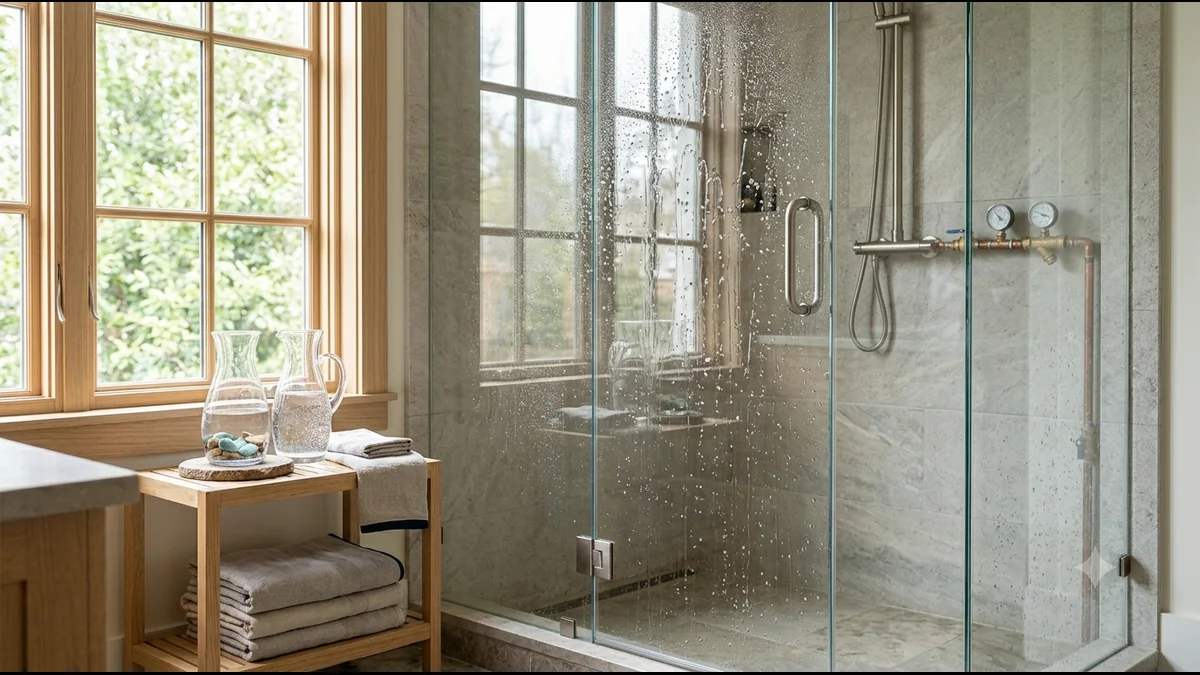
Direct answer: Soap scum forms when soap reacts with dissolved calcium and magnesium instead of rinsing away, and it re-forms with every shower unless the minerals are removed first. Garner is served by Raleigh Water, around 1.6 gpg — slightly hard, not hard — but what we measure at Garner taps runs up to 3.7 gpg by ZIP, enough to build a film. Softening resin stops that film from forming at all.
What Is Soap Scum, Chemically Speaking?
Soap scum forms when soap molecules bond with dissolved calcium and magnesium instead of dissolving into the water and rinsing away. The result is a waxy, slightly sticky compound that clings to glass, tile, and fixtures rather than going down the drain with the rinse water.
The more calcium and magnesium available in the water, the more of that compound forms with each use. It's not a cleaning failure — it's a chemical reaction happening every single time soap meets hard-water minerals, whether the glass gets wiped down after or not.
Is Garner's Water Actually Hard Enough to Cause This?
Garner doesn't run its own water utility — it's supplied by Raleigh Water, which publishes an average hardness around 1.6 gpg. On the Water Quality Association scale the Hach Model 5-B test kit uses, 1.6 gpg is classified slightly hard, not hard; that band doesn't start until 7 gpg.
Slightly hard is still hard enough to react with soap and build residue over time, though, and what we actually measure at Garner taps varies by ZIP and runs as high as 3.7 gpg — moderately hard on the same scale. The town-wide figure is a plant average; the number that determines how fast scum builds on a specific shower door is the one from that address.
Why Does Scum Keep Coming Back No Matter How Often I Clean It?
Wiping down the glass removes the scum that's already formed, but it doesn't change what's in the water hitting the glass tomorrow. Every shower after a cleaning starts the same reaction over again, using the same minerals dissolved in the same supply.
That's the core difference between managing a symptom and removing its cause. Cleaning products handle the buildup that already happened; only reducing the calcium and magnesium in the water before it reaches the shower stops the next layer from forming at all.
Does a Softener Alone Solve Everything, or Is There More to It?
Softening resin exchanges calcium and magnesium for sodium, which is exactly the mechanism that stops soap scum from forming — a genuinely complete fix for that specific problem. It doesn't do anything about chlorine or chloramine taste and smell, though, since those are separate compounds a softener was never built to touch. Disinfection can also form byproducts including trihalomethanes (TTHM) and haloacetic acids (HAA5), which EPA regulates under enforceable limits.
EPA's National Primary Drinking Water Regulations table lists TTHM's potential long-term health effect above the legal limit as "Liver, kidney or central nervous system problems; increased risk of cancer," and HAA5's as "Increased risk of cancer." Raleigh Water stays under those limits, and that compliance is real — but it's a ceiling set at the edge of EPA's own acceptable risk, not a guarantee everything under it is worth ignoring. A carbon stage removes these compounds directly rather than relying on staying under a legal number.
An all-in-one system pairs that softening resin with a carbon filtration stage in one unit, so the shower-door problem and the taste/chemistry issue both get addressed through a single install rather than two separate systems.
Cleaning the Scum vs. Preventing It: A Comparison
| Approach | What It Does | What It Doesn't Do |
|---|---|---|
| Scrubbing or scum-remover sprays | Removes buildup that's already formed | Nothing prevents next week's film from forming again |
| Squeegeeing glass after every shower | Reduces how much residue dries onto the glass | Requires doing it every single time, without fail |
| Rinse-aid glass treatments | Makes existing film easier to wipe away | Doesn't change what's in the water reacting with soap |
| Softening resin (calcium/magnesium removal) | Stops the mineral reaction that forms scum in the first place | Doesn't address chlorine/chloramine taste or smell |
| All-in-one softening + carbon system | Prevents scum formation and addresses taste/smell together | Sized to your home only after a free water analysis |
What Does Fixing This Actually Look Like in a Garner Home?
The starting point is a free in-home water analysis, since a Garner-wide average doesn't tell you what a specific address is dealing with. From there, an all-in-one system installs into the home's existing plumbing and treats water at the source, before it ever reaches a shower door.
Once softening resin is in place, the reaction that forms soap scum has nothing left to react with. Glass and fixtures stop accumulating that film going forward — the difference is in what never forms, not just in what gets wiped away after the fact.
FAQ
I clean my shower door every single week and it's still cloudy within days — what am I doing wrong? Nothing, most likely. Regular cleaning removes existing scum, but it can't stop the next round from forming, because the minerals causing it are still in every gallon of water hitting the glass. The fix is treating the water itself, not the cleaning routine.
Is Garner's water actually "hard," or is that an exaggeration? It's supplied by Raleigh Water, which measures around 1.6 gpg — that's slightly hard on the Water Quality Association scale, not hard outright. What we measure at individual Garner addresses runs higher, up to 3.7 gpg by ZIP, which is enough to cause the soap-scum reaction even though the town average sounds mild.
Will a water softener actually stop soap scum completely, or just reduce it? Softening resin removes the calcium and magnesium that react with soap to form scum, so once it's in place there's little left for that reaction to use. It's one of the more complete fixes available for this specific problem.
We just bought a house in Garner and the shower glass already had a heavy film when we moved in — is that fixable, or is the glass ruined? Existing buildup can usually be cleaned off with the right products or a professional glass treatment; softening prevents new buildup going forward. The two are separate steps — one addresses what's already there, the other stops the next layer from forming.
Does it matter which part of Garner we're in, since it's all technically Raleigh Water? Yes. Raleigh Water's published figure is a system-wide average; what actually reaches a specific address varies by ZIP and runs as high as 3.7 gpg in what we measure. A free water analysis at your address is the only way to know your actual number.
Do I need a separate filter for chlorine smell, or does a softener also handle that? A standalone softener only removes calcium and magnesium — it won't touch chlorine or chloramine taste or smell. An all-in-one system adds a carbon filtration stage alongside the softening resin so a single install covers both.
Stop Scrubbing and Start Preventing It
Cleaning the shower door handles this week's film; treating the water stops next week's from forming at all. Take the 60-second water quiz to see how an all-in-one system fits your Garner home, or book a free in-home water analysis with Triangle Waterworks.
Sources
Related reading: Water Treatment in Garner, NC | Water Softener Installation in Garner, NC | Soap Scum and Shower Door Buildup: The Fix | Who Installs Water Softeners in Garner, NC?
Answer nine practical questions, then request a written quote or well-water analysis.
Start My Water Analysis