
What Is Soap Scum, and Why Doesn't Scrubbing Ever Fully Remove It in Holly Springs, NC?
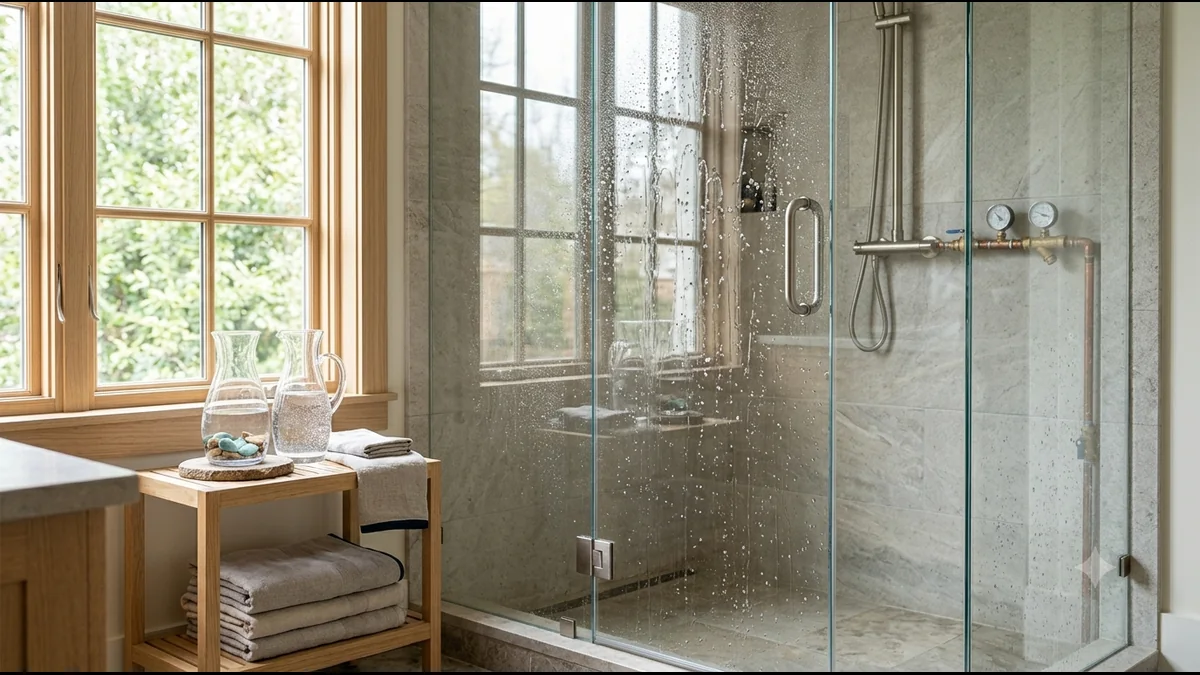
Direct answer: Soap scum isn't leftover soap — it's a new, insoluble compound created when soap reacts with dissolved calcium and magnesium, which is why scrubbing only ever clears what has already formed. Holly Springs' own figures put hardness at 1.75 to 2.92 grains per gallon, slightly hard on the Water Quality Association scale. An all-in-one system removes the minerals feeding that reaction before it happens.
What Is Soap Scum, Chemically Speaking?
Ordinary bar soap is a fatty acid salt, usually built on sodium. When that molecule meets calcium or magnesium ions dissolved in water, the sodium gets displaced and a new compound forms in its place — a calcium or magnesium "soap" that doesn't dissolve in water the way the original sodium soap did. The result is the opposite of what soap is meant to do: instead of a soluble cleaning agent, you get an insoluble curd.
That curd is soap scum. It isn't soap that failed to rinse away — it's a physically different substance, created fresh with every wash, that clings to whatever surface it's near: glass, tile, grout, chrome.
Understanding that distinction matters, because it explains why a product built to dissolve "soap" often barely touches scum. You're not fighting soap residue — you're fighting a mineral compound soap residue turned into.
Why Doesn't Scrubbing Harder Ever Actually Solve It?
Scrubbing removes the curd that has already bonded to a surface. It does nothing to the water supplying tomorrow's shower, so the moment soap and hard water meet again, the same reaction runs again and deposits a fresh layer. Harder scrubbing, stronger acids, and pricier glass cleaners all operate downstream of the actual chemistry — they're clearing evidence, not stopping the reaction that produces it.
That's a useful way to separate the two categories of fix available:
- Anything applied after the shower — a squeegee, a wipe-down, a scum remover — addresses curd that already exists.
- Anything that changes the water itself — softening — removes the calcium and magnesium so the reaction has nothing left to work with.
Only the second category stops the next layer from forming.
Is Holly Springs' Water Actually Hard Enough to Drive This Reaction?
Holly Springs is one of the few Triangle towns that publishes its own hardness figure directly in grains per gallon, which makes this easier to check than in most nearby towns. The Town's Drinking Water page states its water "is considered moderately soft and usually averages between 30-50 mg/L hardness as calcium carbonate or 1.75-2.92 grains of hardness per gallon."
On the Water Quality Association scale — the same scale behind the Hach Total Hardness Test Kit, Model 5-B, used for at-home testing — 1.75 to 2.92 gpg sits inside the "slightly hard" band (1.0–3.5 gpg) across its entire published range. That's a genuine, if modest, mineral load, and exactly the kind of calcium-and-magnesium content the soap-scum reaction runs on.
The Town's own "moderately soft" label and the WQA's "slightly hard" label describe the same water on two different scales. Naming both, rather than picking one, is what lets a reader check the math themselves.
Where Does Holly Springs' Water Come From, and Does That Affect the Minerals?
Holly Springs draws its water from the Cape Fear River, processed at the Harnett County water treatment plant and delivered through Harnett Regional Water. Surface-water sources like the Cape Fear pick up dissolved calcium and magnesium as they move across the watershed, which is the raw material for both the town's published hardness figure and the soap-scum reaction happening in a Holly Springs shower.
None of that treatment process removes hardness — municipal treatment plants are built to disinfect and clarify water, not soften it. Softening is a separate step that happens at the home, through ion exchange, and it's the only stage in the entire chain from river to shower door built specifically to intercept calcium and magnesium.
Does the Same Reaction Explain Spotty Glasses and Cloudy Faucets Too?
Yes — it's the same chemistry showing up wherever soap or mineral-laden water gets a chance to dry on a surface. Dishwasher glassware develops a similar film for a related reason: as water evaporates from a glass, the calcium and magnesium it carried behind stays put, drying into a chalky residue. Faucets and fixtures pick up mineral spotting the same way, just without the soap involved.
Shower glass has it worse than most surfaces because it combines both mechanisms at once — soap reacting with minerals, then water evaporating and leaving even more mineral behind — on a surface you look at closely, at eye level, every single day.
What Actually Stops the Reaction at the Source?
A water softener uses ion exchange: as water passes through a resin bed, calcium and magnesium ions swap places with sodium (or potassium) ions bound to the resin. The water leaving the softener carries the sodium/potassium instead, and neither of those ions reacts with soap the way calcium and magnesium do. Once that swap happens before the water ever reaches a shower, faucet, or dishwasher, there's no raw material left for the soap-scum reaction to use.
That's a meaningfully different outcome than any cleaning product can offer, because cleaning happens after the chemistry, and softening happens before it.
Comparing the Options: What Changes the Chemistry vs. What Just Cleans Up After It
| Method | What it actually does | Changes the water's mineral content? |
|---|---|---|
| Acidic shower spray or vinegar wipe | Dissolves curd that has already bonded to glass | No |
| Daily squeegee | Clears standing water before minerals concentrate as it dries | No |
| Water-repellent glass coating | Reduces how much water clings to the surface | No |
| Softening resin (ion exchange) | Swaps calcium and magnesium for sodium/potassium before water reaches any fixture | Yes |
What Does an All-in-One System Add Beyond Stopping the Scum?
A softener resolves the mineral side of the equation completely, but it's an ion-exchange process — it has no effect on anything that isn't calcium or magnesium. The all-in-one build solves that by putting a carbon stage in the same cabinet as the resin, so one visit stops the scum reaction and also handles the taste and water-quality complaints minerals were never responsible for. See what a whole-home system actually covers for a Holly Springs house for the fuller picture of what gets addressed.
Once minerals are out of the supply, the change reaches beyond the shower:
- Dishes and glassware air-dry without the chalky spotting evaporation currently leaves behind
- Less soap and shampoo needed to build a lather
- Fixtures and chrome keep a clear finish rather than dulling
- Laundry loses the stiff, mineral-weighted feel that comes from calcium building up in fabric fibers over time
Frequently Asked Questions
I moved into a newer home in Holly Springs and the glass shower door was already hazy within the first month — is that even possible that fast? Yes. A new house doesn't change what's dissolved in the water supplying it, and Holly Springs' own published range runs up to 2.92 grains per gallon — slightly hard on the WQA scale. A month of daily showers is more than enough exposure for the calcium-magnesium-soap reaction to build a visible layer.
Is soap scum actually different from just soap that didn't rinse well, or is that the same thing? They're chemically different substances. Ordinary soap residue that simply didn't rinse would dissolve back into water fairly easily; soap scum is an insoluble compound formed when soap reacts with dissolved calcium and magnesium, and that compound doesn't dissolve back into plain water no matter how long you run the shower.
I scrub my shower door in Holly Springs every weekend and it's cloudy again by Wednesday — am I using the wrong cleaner? Not necessarily — you're likely using a cleaner that works fine on existing curd, which just doesn't address what's dissolved in the water for your next shower. Every wash after a cleaning restarts the same reaction, so the schedule you're seeing is closer to expected than to a product failure.
Holly Springs calls its water "moderately soft" — does that mean a softener is overkill here? Not on the chemistry. "Moderately soft" and "slightly hard" describe the same 1.75–2.92 gpg range on two different scales, and that range still carries enough calcium and magnesium to drive the soap-scum reaction, just more gradually than in a harder-water market. The softening fix works the same way regardless of which scale the number is read on.
Does a water softener also handle the chlorine taste I sometimes notice? Softening resin only ever touches calcium and magnesium — it has no effect on taste or chemistry unrelated to hardness. That's why an all-in-one system pairs the softening resin with a separate carbon filtration stage, so both the mineral problem and the taste side get addressed in one install.
What's the fastest way to find out how hard my specific Holly Springs address actually is? A free in-home water analysis measures your tap directly rather than relying on a townwide published range. See how to test tap water hardness at home in Holly Springs, NC for how that test works, or book one through Triangle Waterworks.
Stop the Reaction Instead of Chasing the Residue
Soap scum keeps coming back because the chemistry that creates it resets every time hard water meets soap — no amount of scrubbing changes that. Take the 60-second water quiz to see how an all-in-one system fits your Holly Springs home, or book a free water analysis to get your exact reading. If mineral spotting has already reached your floors, see why mopping leaves spots and streaks in Holly Springs, NC, and for the full ownership picture, is a water softener worth it in Holly Springs, NC.
Sources
Answer nine practical questions, then request a written quote or well-water analysis.
Start My Water Analysis