
Why Does the Film on My Morrisville Shower Door Keep Coming Back No Matter What I Clean With?
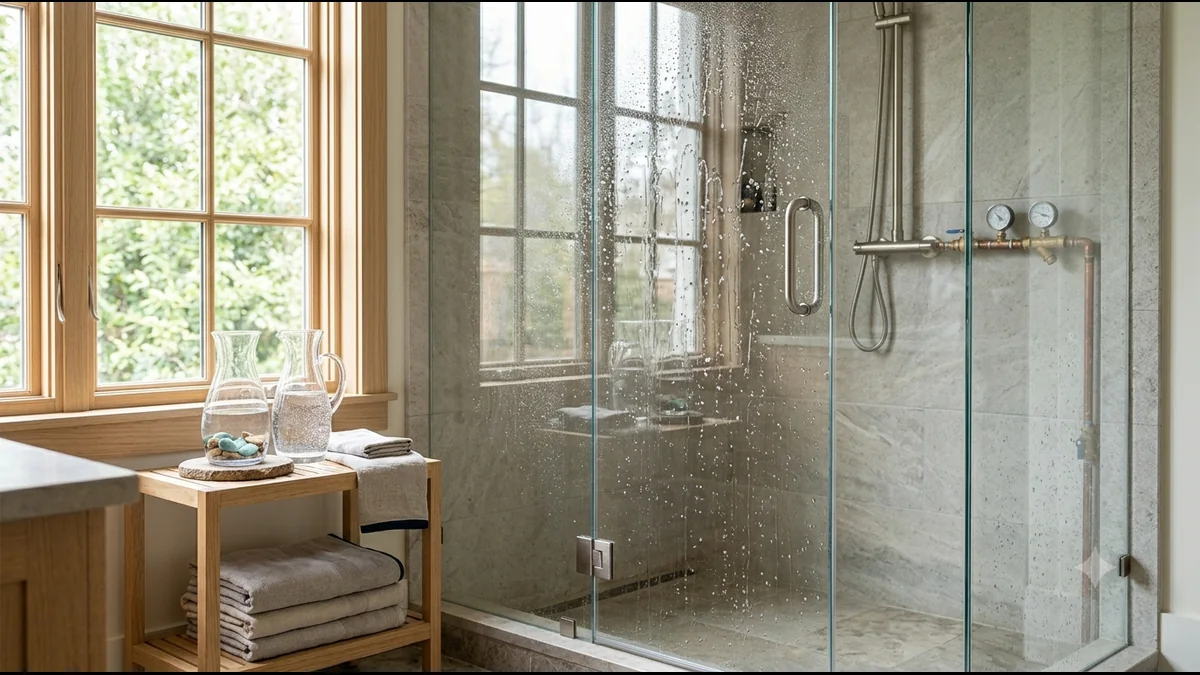
Direct answer: Cleaning only removes film that's already there — it never stops the next layer forming. Morrisville receives Cary's finished water; Cary's FAQ reports 25–30 ppm hardness, while our address-level testing runs 1.6–3.7 gpg. Every shower deposits a fresh trace of that mineral load, and it accumulates on glass over months and years. Softening removes it at the source instead of managing it after the fact.
Why Does a Stronger Cleaner Only Work for a Few Days?
Most Morrisville homeowners chasing shower-door haze go through the same escalation: switch cleaners, add a squeegee, try a name-brand scum remover, then eventually a specialty glass coating. Each one buys a few extra days before the film returns, but none of them stop it from coming back at all.
That pattern isn't a sign anything is being done wrong. Every one of those products treats the glass after the fact — they dissolve or wipe away residue that has already formed. None of them touch what's dissolved in the water for tomorrow's shower, so the underlying supply keeps delivering the same raw material for the next layer.
Where Does Morrisville's Water Actually Come From?
Morrisville doesn't run its own water utility. The Town of Cary has operated Morrisville's water and sewer system since April 2006, so Morrisville homes receive Cary's finished water end to end — same treatment plant, same source, same distribution chemistry. Anything true of Cary's water is functionally true of what comes out of a Morrisville tap.
Cary's Public Works FAQ reports finished water hardness of 25 to 30 ppm, which works out to roughly 1.5 to 1.75 grains per gallon — a figure Cary itself calls very soft. That's a plant-average reading measured where the water leaves the treatment facility, not a reading from inside any specific Morrisville home.
Is the Cleaning-Product Treadmill a Sign the Water Is Harder Than Cary Reports?
It can be, and it's worth being precise about why rather than assuming the town's number is wrong. Triangle Waterworks' own in-home testing across the wider service area measures hardness running 1.6 to 3.7 grains per gallon by ZIP code — higher than Cary's 25–30 ppm plant average across most of that range.
Two things explain the gap without contradicting Cary's figure at all. First, the plant reading is an average taken at the source, while individual addresses vary depending on where they sit in the distribution system.
Second, on the Water Quality Association scale the Hach Total Hardness Test Kit uses, that same 1.6–3.7 gpg range spans slightly hard up through moderately hard — a different labeling system than the one Cary's FAQ uses. Neither figure is inflated or understated; they're two honest measurements of two different things.
How Does the Buildup Actually Accumulate Over Years, Not Just Days?
A single shower leaves behind a trace of residue too small to notice on its own. The problem is that hard water never runs out — every shower after that one delivers another dose of the same calcium and magnesium, and none of it goes away between uses.
Over a few weeks, that accumulation is what shows up as the recurring haze homeowners scrub at. Over a few years, the same mechanism is what leaves glass with a permanently etched look no amount of cleaning restores, tile grout darkened with mineral residue, and chrome fixtures that never come back to a true shine even right after polishing. The surfaces don't fail all at once — they lose ground slightly with every wash, and cleaning products can only ever chase that loss, never close it.
What Happens If You Just Keep Cleaning Instead of Treating the Water?
The realistic long-term pattern is a slow escalation: mild soap and a sponge stop being enough, so the household moves to acidic sprays; those stop being enough on their own schedule, so a squeegee habit gets added; eventually a glass coating gets applied, and it needs reapplying every few months as it wears off faster than expected. The workload increases even as the underlying water hasn't changed at all — the household is just running further ahead of accumulation that keeps adding up regardless.
- Cleaning products manage what has already deposited on a surface, for as long as someone keeps applying them.
- Softening removes the calcium and magnesium before they ever reach a fixture, so there's nothing left to deposit in the first place.
Only the second approach actually reduces the workload over time instead of just keeping pace with it.
The Cleaning-Product Escalation vs. Treating the Water at the Source
| Stage of the treadmill | What it requires | Does the buildup stop accumulating? |
|---|---|---|
| Mild soap and a sponge | Weekly, then more often over time | No |
| Acidic spray or vinegar solution | Weekly to biweekly, strength increasing | No |
| Squeegee after every shower | Every single use, without skipping | No — slows new deposits, doesn't remove the source |
| Specialty glass coating | Reapplied every few months as it wears | No — a barrier, not a water change |
| Softening resin at the point of entry | One install, minimal upkeep after | Yes — nothing left in the water to deposit |
What Does Softening Actually Change About This Cycle?
A softener uses ion exchange to swap calcium and magnesium for sodium (or potassium) before water reaches any fixture in the house. That's a change to the water itself, not another product added to the cleaning routine, which is why it's the only approach on the list above that stops new buildup instead of managing it.
The effect isn't limited to the shower door. Once minerals are removed at the source, the same protection extends everywhere that water reaches:
- Glass and fixtures throughout the house stop accumulating new residue, not just the shower
- Dishes and glassware come out of the dishwasher without the spotty film that builds the same way — see does soft water protect appliances in Morrisville, NC for the fuller appliance picture
- Laundry stays softer over time instead of stiffening as minerals build up in the fabric year over year — more on that in soft water laundry benefits for Morrisville, NC homes
- Less soap and shampoo are needed to work up a lather in the first place
For the full picture of what a whole-home system does for a house on Cary's finished water, see Water Softener Morrisville, NC. The all-in-one build puts a carbon stage and the softening resin into a single cabinet on the main line, so one visit handles both the mineral side of the problem and the broader water-quality side that hardness alone never explained.
Frequently Asked Questions
I've replaced my shower cleaner three times this year in Morrisville and nothing sticks around longer than a week — is that normal? Yes, and it's the clearest sign the issue is the water supply, not the product. Every cleaner removes what's already there but leaves the water unchanged, so a new layer starts forming the moment the next shower runs. Rotating cleaners doesn't break that cycle because none of them touch what's dissolved in the water itself.
Cary says its water is "very soft" — so why does my Morrisville glass tell a different story? Both are accurate at once. Cary's FAQ reports a 25–30 ppm plant average for water leaving the treatment facility, which the Town calls very soft; our own address-level testing across the service area runs up to 3.7 gpg, moderately hard on the WQA scale at the top of that range. The plant figure and what reaches a specific tap aren't the same measurement.
We've had a squeegee habit for over a year and the glass still looks etched — is that permanent, or can it be reversed? A squeegee slows new deposits but can't undo mineral buildup that has already bonded to the glass over time; some etching may need a professional glass restoration to fully clear. Softening stops the buildup from continuing, which is the piece a squeegee alone was never going to solve.
Does it matter that Morrisville doesn't have its own water utility? It matters for where to look for information — Morrisville has been on Cary's system since April 2006, so Cary's published figures and treatment process apply directly. It doesn't change the fix: an address-level water analysis and softening work the same way regardless of which town issues the water bill.
Is there a way to know exactly how hard my specific Morrisville address is instead of guessing between Cary's number and Triangle Waterworks' range? A free in-home water analysis measures your actual tap water directly, which is the only way to know where your address falls between the low and high ends of the range. That reading also determines how a softening system gets sized for your home.
Does fixing the mineral buildup also handle any chlorine taste I notice? No — softening resin is built specifically for calcium and magnesium and has no effect on chlorine or chloramine taste. An all-in-one system adds a separate carbon filtration stage alongside the softening resin so a single install covers both.
Break the Cleaning Cycle Instead of Keeping Up With It
The film on your shower door isn't a cleaning failure — it's a water supply depositing the same minerals every single day, faster than any product can permanently clear. Take the 60-second water quiz to see how an all-in-one system fits your Morrisville home, or book a free water analysis to find your exact reading. For the cost side of that decision, see How Much Does a Water Softener Cost in Morrisville, NC?
Sources
Answer nine practical questions, then request a written quote or well-water analysis.
Start My Water Analysis