
Why Does Soap Scum Keep Coming Back on My Shower Door in Raleigh, NC?
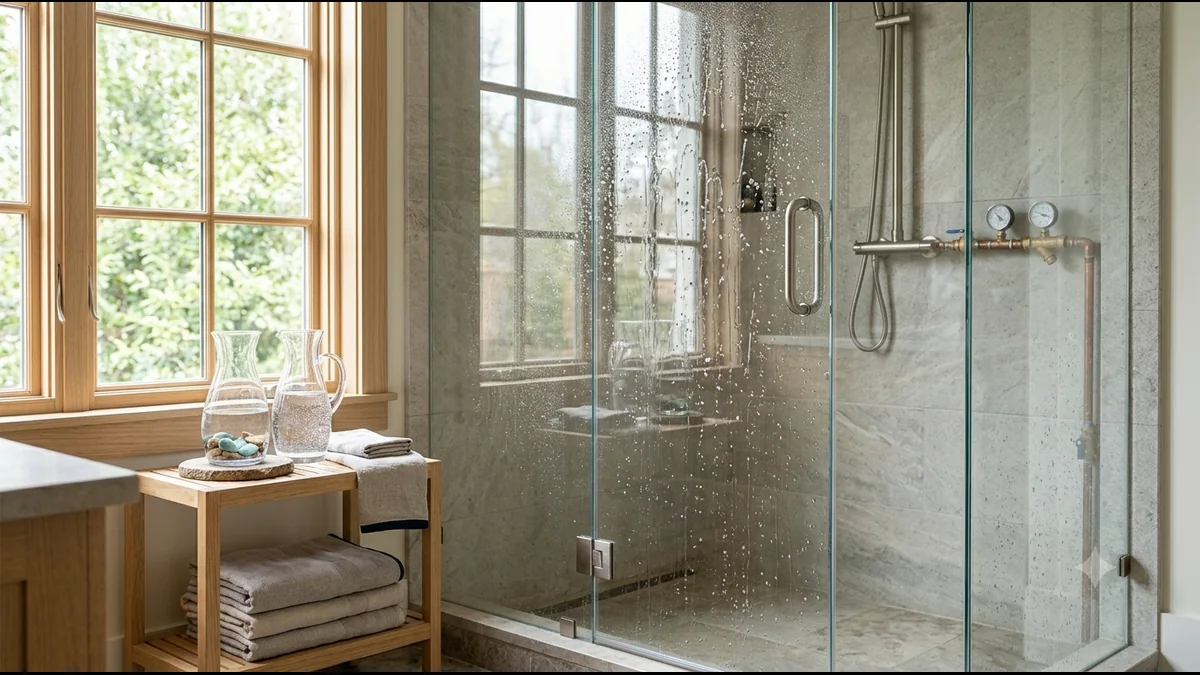
Direct answer: Soap scum on a Raleigh shower door is a chemical reaction, not a cleaning failure — calcium and magnesium in the water bind with soap before it fully rinses away, leaving an insoluble film on glass. Raleigh Water measures around 1.6 grains per gallon, "slightly hard" on the WQA scale, so the reaction runs slower here — but the deposits are cumulative over months. An all-in-one softening and carbon system removes the minerals at the source.
Why Does Soap Scum Keep Coming Back on My Shower Door in Raleigh, NC?
Soap scum forms because calcium and magnesium ions dissolved in the water react chemically with soap molecules before that soap ever makes it down the drain. That reaction produces an insoluble precipitate — soap scum, sometimes called soap curd — that clings to whatever surface it touches: shower glass, tile grout, chrome fixtures. It happens anywhere calcium and magnesium are present, at any level above zero.
Triangle Waterworks' own testing measures Raleigh-area hardness at roughly 1.6 grains per gallon (gpg), which falls in the "slightly hard" band on the Water Quality Association scale the Hach Total Hardness Test Kit uses. That's a lower mineral load than a lot of markets carry, so the scum reaction here runs slower. But slower isn't absent. Every shower deposits a microscopic new layer, and because the layers are cumulative, they build over weeks and months until the glass looks permanently etched — even though no single shower did the damage.
Is This a Cleaning Problem or a Water Problem?
If you've switched cleaning products, added a daily squeegee, and the haze still returns within days, the pattern itself is the answer. Cleaning products remove scum that has already formed and bonded to the glass. They don't change what's dissolved in the water hitting the door on your next shower. As long as calcium and magnesium are present, each shower deposits a fresh layer, and the cycle resets.
That's the real difference between the two approaches:
- Cleaning removes scum after it has already formed and bonded to glass, tile, or fixtures.
- Softening removes the calcium and magnesium before they ever reach the shower door, so there's nothing left to react with the soap.
A cleaning routine can keep pace for a while at Raleigh's lower hardness level, but the maintenance never actually stops — it just repeats on a longer cycle than it would in a harder-water market.
Where Does Raleigh's Own Water Report Put My Water on the Hardness Scale?
Raleigh Water's Water Service FAQ states hardness is usually under 30 mg/L, and that figure is accurate. Our own testing across the wider service area — Raleigh, Garner, Knightdale, Rolesville, Wake Forest, and Wendell — finds readings that range from about 1.6 up to 3.7 grains per gallon depending on the specific address.
The two figures aren't in conflict; they're measuring different things. Raleigh's published number reflects finished water leaving the treatment plant, averaged system-wide. Our readings come from individual taps, and on the WQA/Hach scale — the scale behind the Hach Total Hardness Test Kit, Model 5-B — those household-level numbers land anywhere from "slightly hard" (1.0–3.5 gpg) up toward "moderately hard" (3.5–7.0 gpg) at the top of the range. Both numbers are correct; they answer different questions. The one that predicts what's forming on your shower glass is the reading at your own tap, and a free water analysis is the only way to know exactly where your address falls.
Will a Water Softener Actually Stop the Soap Scum?
Yes — a softener addresses the exact mechanism causing it. Softening works through ion exchange: it swaps calcium and magnesium ions for sodium (or potassium) ions before water reaches any fixture in the house. With those minerals gone, soap rinses cleanly instead of reacting into a residue, less soap is needed to work up a lather, and what little is left wipes away instead of bonding to the glass. At Raleigh's slightly hard reading, a softener also regenerates less often and runs on less salt than it would in a harder-water market — an advantage of treating water here, not a reason to skip it.
Softening resin only touches hardness, though. Raleigh Water normally disinfects with chloramine, which the City describes as having no taste or odor of its own. Once a year, on the state's recommendation, Raleigh temporarily switches to free chlorine only and flushes the distribution system, with dates announced by the City each time; chlorine residual runs higher than normal during that window and is often noticeable in the shower. Raleigh's water also carries measurable disinfection byproducts — HAA9 at 19.9 ppb and TTHM at 21.7 ppb, both compliant with EPA limits but above the EWG's stricter, non-regulatory health guideline. Softening does nothing about any of that, which is the case for pairing it with a carbon filtration stage in the same system.
What Actually Stops Soap Scum on a Raleigh Shower Door?
| Approach | Effort required | Frequency needed | Addresses root cause? |
|---|---|---|---|
| Daily squeegee after every shower | Moderate, ongoing | Every single shower, indefinitely | No — clears surface water, not minerals |
| Vinegar or commercial scum remover | High, recurring | Weekly or biweekly | No — removes existing scum, doesn't stop new scum forming |
| Glass coatings or sealant sprays | Moderate upfront, needs reapplication | Every few weeks to months | No — creates a temporary barrier, doesn't change water chemistry |
| Softened water (all-in-one system) | One installation, minimal upkeep | Ongoing, automatic | Yes — removes calcium and magnesium before they reach any fixture |
What Else Does Softened Water Change Around the House?
Once calcium and magnesium are out of the water supply, the effects reach well past the shower door:
- Dishes and glassware come out of the dishwasher without the cloudy, spotty film mineral content leaves behind.
- Soap and shampoo lather more easily, so less product is needed per use.
- Skin feels less dry after showering, and hair loses the flat, weighed-down texture minerals can leave in it.
- Laundry comes out softer, and colors stay truer instead of dulling from mineral buildup in the fabric.
- Scale buildup inside the water heater, dishwasher, and washing machine slows down, protecting those appliances over years of daily use.
Pairing the softening stage with carbon filtration adds a separate set of benefits: removal of chlorine and chloramine taste and smell, PFAS, and disinfection byproducts like HAA9 and TTHM — the things softening alone never touches. It's the best of both worlds in a single whole-home install.
What Does It Cost to Fix This in Raleigh?
There's no single number to publish here — household size, bathroom count, and what a free water analysis finds at your specific address all move the price. Systems are custom-configured per home after that analysis, not sold off a fixed price sheet. National big-brand dealers commonly quote $6,000 to $12,000 for a comparable whole-home system, but the only way to get an accurate number, and to confirm where your address falls in the 1.6–3.7 gpg range, is a free water analysis.
Frequently Asked Questions
Why is my shower door hazy again just a few days after I clean it? That's calcium and magnesium in the water reacting with soap on every shower, not a sign you're cleaning wrong. Even at Raleigh's slightly hard reading, a fresh layer of insoluble residue forms each time soap meets the water, so the haze returns on a predictable schedule until the minerals themselves are removed.
I scrub my glass shower door every weekend in Raleigh and the film is back by midweek — why? You're treating the surface, not the source. Scrubbing removes scum that has already bonded to the glass, but it doesn't change what's dissolved in the water hitting the door on your next shower. Softened water removes the calcium and magnesium before they ever reach the glass, which is the only way to stop new scum from forming.
Is soap scum really caused by water hardness, or is it just soap residue? Both play a role, but hardness is what turns ordinary soap residue into stubborn scum. Calcium and magnesium ions react chemically with soap molecules to form an insoluble precipitate that clings to surfaces instead of rinsing away — plain soap in low-mineral water rinses far more cleanly because that reaction barely happens.
My tap water tested lower than 1.6 gpg — does that mean I don't have a soap scum issue? A lower reading at your tap means the reaction runs even slower, which is good news, but it doesn't mean zero calcium and magnesium are present. Scum still forms, just more gradually and with less buildup over the same stretch of time — a free water analysis at your address will show exactly where you land.
I've tried vinegar, glass coatings, and a squeegee — what actually works long-term? Of the options available, only softened water addresses the root cause. Vinegar, coatings, and squeegees all manage existing residue or slow buildup temporarily, but none of them stop calcium and magnesium from reacting with soap in the first place. An all-in-one softening and carbon system removes the minerals before they ever reach your shower.
Does fixing the soap scum also fix the chlorine smell I notice once a year? Not with softening alone — hardness and chlorine/chloramine taste are two separate issues in Raleigh's water. That's why the all-in-one system pairs softening resin, for the scum-causing minerals, with a carbon filtration stage, for chlorine and chloramine taste and smell, PFAS, and disinfection byproducts like TTHM, in one install that handles both.
Ready to Stop the Scum for Good?
Take our 60-second water quiz to see which all-in-one system fits your Raleigh home, or request a free water analysis to find out exactly where your address falls in the local hardness range.
Related reading: Soap Scum & Shower Door Buildup: The Real Fix | Raleigh Water Hardness | Soft Water Skin and Hair Benefits | White Residue on Faucets and Glasses | Water Softener Installation in Raleigh
Answer nine practical questions, then request a written quote or well-water analysis.
Start My Water Analysis