
Why Does My Shower Door Keep Getting Cloudy with Soap Scum in Wake Forest, NC?
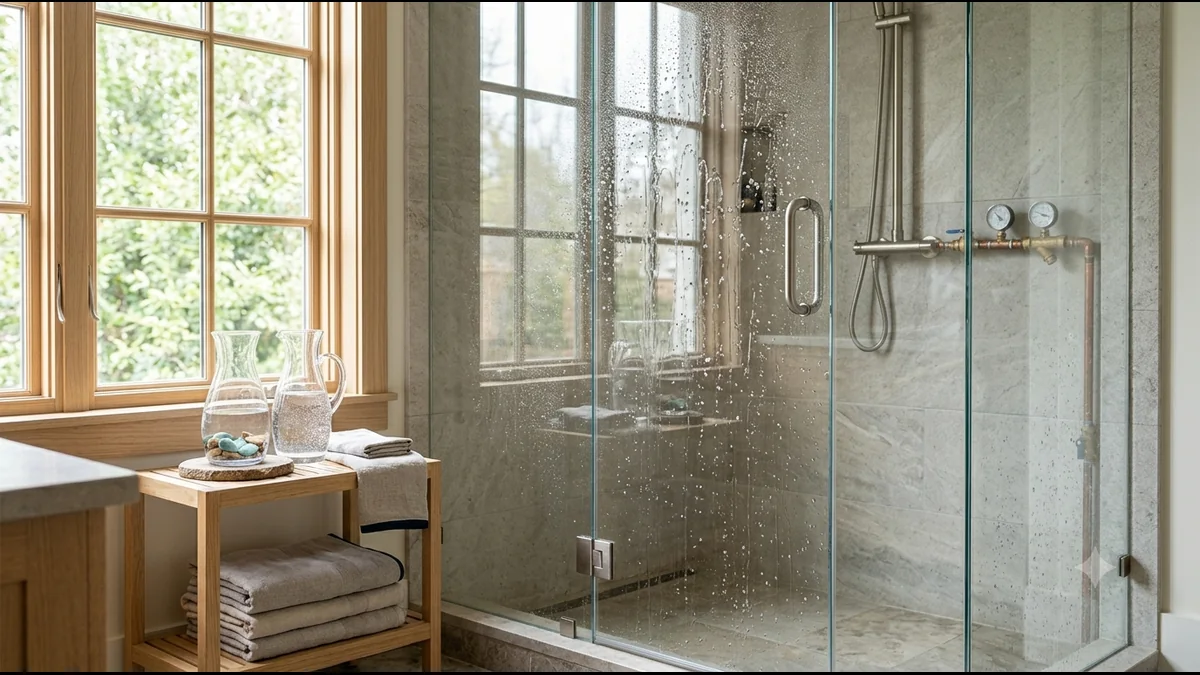
Direct answer: Soap scum on a Wake Forest shower door forms when calcium and magnesium in the water react with soap to create an insoluble film that bonds to glass. It is not dirt, so scrubbing only removes what is already there — it does not stop the next film from forming. A whole-home softener removes the calcium and magnesium at the main line before it ever reaches the shower, which is the only way to stop the buildup at the source rather than fighting it every week.
What is soap scum actually made of?
Soap scum is the byproduct of a chemical reaction, not surface grime. When soap meets water carrying dissolved calcium and magnesium, the minerals bond with the soap's fatty compounds and form a curd — a soft, waxy film instead of a rinse-away lather. That curd clings to glass, tile grout, and fixtures, and it keeps a wet, sticky texture until it dries into the hazy white coating homeowners recognize as soap scum. Bar soap, shower gel, and shampoo all contribute; the reaction happens with any of them the moment hardness minerals are present in the water.
Why does the film come back a few days after I clean it?
Because cleaning removes the film that already formed — it does nothing to the water still coming out of the showerhead. Every shower after that first cleaning deposits a fresh, thin layer of the same calcium-and-magnesium-soap curd. On its own the layer is nearly invisible; over repeated showers it thickens until it clouds the glass again. That is why scrubbing works for a week and then the door looks the same as before — the buildup is cumulative, and nothing about wiping the glass changes what happens the next time the water runs.
How much mineral content is actually in Wake Forest's tap water?
Wake Forest is on Raleigh Water, the utility that also serves Raleigh, Wendell, Garner, Rolesville, and Knightdale, drawing its primary supply from Falls Lake and treating it at the E.M. Johnson Water Treatment Plant. Raleigh Water's own numbers put finished-water hardness at roughly 1.6 grains per gallon — on the water-treatment industry's own five-tier scale (the one the Hach Total Hardness Test Kit, Model 5-B, reads out on), that is classified as slightly hard water, not the "hard" tier that starts much higher, at 7 grains per gallon. Our own testing across the service area measures a wider range, 1.6 to 3.7 grains per gallon depending on the address, because what comes out of a specific tap can run higher than a utility-wide average. Either way, the takeaway for a shower door is the same: there is enough hardness mineral present, every single day, to keep feeding the reaction that builds soap scum. Slightly hard water is still hard enough to leave a film — it just builds more slowly than it would in a more mineral-heavy part of the state, which is exactly why the buildup can look surprising after only a year or two in a new house.
What actually removes soap scum that's already on the glass?
An acidic cleaner is what breaks the existing film down — the calcium-and-magnesium curd dissolves in acid, which is why vinegar-based sprays and commercial "hard water" glass cleaners work where an all-purpose soap or degreaser does not. Apply it, let it sit on the glass for a few minutes so it has time to react, then rinse and dry the door completely. Keeping the glass dry between showers matters as much as the cleaner itself: standing water is what lets the next layer of curd set instead of evaporating away.
Does a squeegee actually stop the film from forming?
No — a squeegee is a maintenance habit, not a fix. Pulling water off the glass right after a shower reduces how much residue is left behind to dry and bond, which does slow how fast the film builds. But the water still contains the same calcium and magnesium every time, so a squeegee only buys time between cleanings. It does not change the water, and the water is the actual source of the problem.
| Approach | What it does | Stops new scum from forming? |
|---|---|---|
| Squeegee after every shower | Removes standing water before it can dry and bond to glass | No — slows buildup, doesn't remove the minerals causing it |
| Acidic glass cleaner | Dissolves the calcium-and-magnesium curd already on the glass | No — clears existing film, the next shower starts a new one |
| Whole-home softener | Removes calcium and magnesium at the main line, before the shower | Yes — no hardness minerals in the water means no curd to form |
Is a whole-home softener the only thing that addresses this at the source?
Yes. A softener works by ion exchange, swapping the calcium and magnesium in the water for sodium before the water ever reaches a fixture. With those minerals gone, soap no longer has anything to react with, so the curd that clouds glass simply stops forming — on the shower door, on faucets, and inside the water heater, where the same mineral buildup accumulates over years and reduces efficiency. That is the difference between managing a symptom and removing the cause: squeegees and acidic cleaners both treat the glass after the fact, while a softener changes what's in the water in the first place.
Does a softener take care of chlorine, PFAS, and other water-quality concerns too?
No — softening resin only addresses calcium and magnesium. That's why Triangle Waterworks installs whole-home systems that pair softening resin with a carbon filtration stage in one unit, often called an all-in-one system. The carbon side handles what softening alone never touches: chlorine and chloramine taste and odor, PFAS, and disinfection byproducts that form during treatment. Wake Forest homeowners dealing with cloudy shower glass are usually dealing with both issues at once — mineral buildup and disinfectant-related taste — and an all-in-one system is built to answer both from a single install rather than requiring two separate pieces of equipment.
Does it matter whether my house is new construction or in the historic district?
Not for this problem. Wake Forest is a mix of fast-growing new subdivisions and the National Register historic district, full of much older homes near downtown — and both draw from the same Raleigh Water supply. A brand-new glass shower door in a subdivision home accumulates the identical calcium-and-magnesium film as a decades-old door in a historic-district bathroom; the water reaching both addresses carries the same hardness minerals. The only real difference is how long the buildup has had to accumulate and, in an older home, whether the plumbing itself has scale built up from years on untreated water.
Frequently asked questions
I clean my shower door every week and the film comes back within days. What's going on? The film you're removing is a calcium-and-magnesium-soap curd, and every shower after you clean deposits a new, thin layer of it. Weekly cleaning removes what has already built up but does nothing to the water itself, so the reaction starts over immediately. Softening the water removes the minerals causing the reaction rather than repeating the cleanup indefinitely.
I just moved into a new subdivision in Wake Forest and the glass is already cloudy. Is that normal for a new house? It's common. New construction doesn't come with treated water, so a glass door in a brand-new bathroom is exposed to the same hardness minerals as an older home from day one. A year or two of daily showers is enough for the film to become visibly noticeable, especially on dark-framed glass doors where haze shows up clearly.
What's the difference between soap scum and mineral scale on glass? Soap scum specifically requires soap — it's the curd formed when calcium and magnesium react with soap's fatty compounds. Mineral scale (sometimes called limescale) can form from mineral-laden water alone, without soap, as water evaporates and leaves dissolved minerals behind. Showers usually show a mix of both, which is part of why plain water rinsing alone doesn't keep the glass clear.
Will a squeegee alone keep my glass door clear? It slows buildup but doesn't stop it. A squeegee removes standing water before it dries and deposits residue, which reduces how quickly the film accumulates. The calcium and magnesium are still in the water every time you shower, so a squeegee is a maintenance habit that buys time rather than a permanent fix.
Does a whole-home system fix the chlorine smell too, or just the scum? A softener alone only addresses hardness minerals. The all-in-one systems Triangle Waterworks installs pair softening resin with a carbon filtration stage specifically to also handle chlorine and chloramine taste, PFAS, and disinfection byproducts — the parts of the water that softening resin doesn't touch on its own.
I want to test my own water before I decide on a softener. How do I do that? The Hach Total Hardness Test Kit, Model 5-B, is a simple drop-count titration kit that reads out directly in grains per gallon on the same scale used to classify Wake Forest's water as slightly hard. It's a good first step at home. From there, a free water analysis gives an address-specific reading and lets a specialist size a system to your actual water rather than a service-area average.
Ready to see what's actually coming out of your tap? Take the quick water quiz and Triangle Waterworks will follow up with a free water analysis for your Wake Forest address.
Related reading: soap scum shower door buildup fix, water heater scale buildup prevention, does soft water protect appliances in Wake Forest, wake forest historic district old home plumbing, water softener cost in Wake Forest, NC
Answer nine practical questions, then request a written quote or well-water analysis.
Start My Water Analysis