
How to Get Spotless Dishes and Glasses in Fuquay-Varina, NC
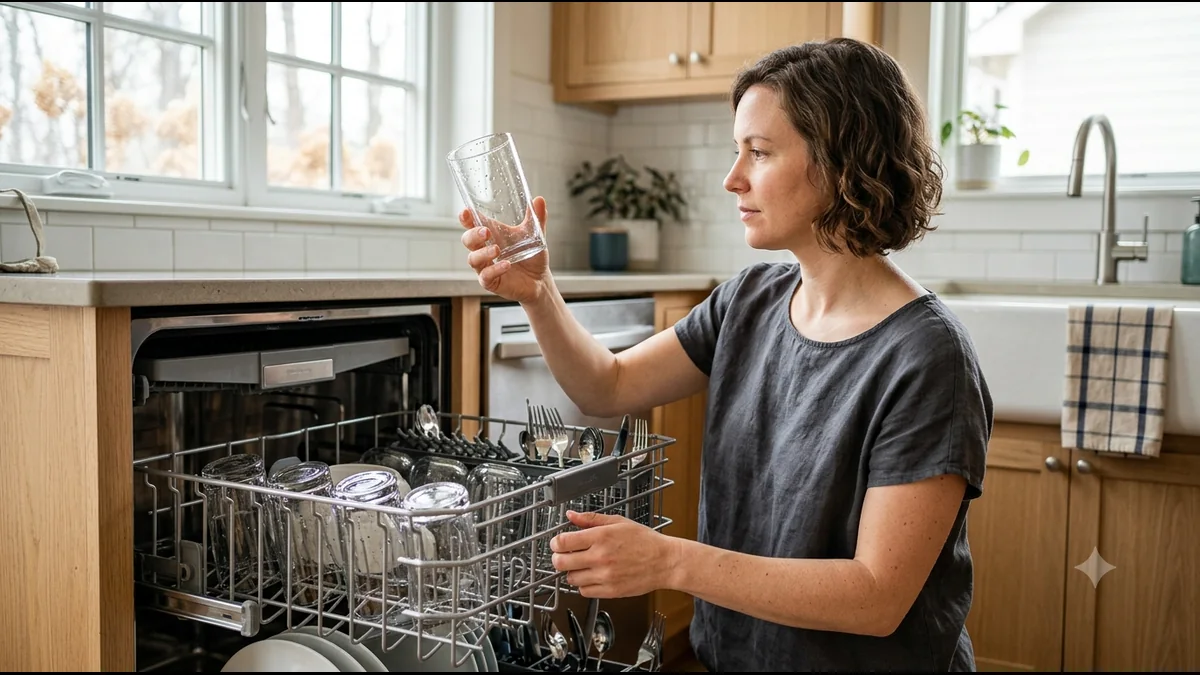
Direct answer: Spotless dishes and glasses in Fuquay-Varina start with removing calcium and magnesium before they reach your dishwasher — rinse aid and vinegar only manage the film after it forms. Because Fuquay-Varina blends water from three different systems, there's no single town-wide hardness number, so the real starting point is a free water analysis at your own address. An all-in-one softening and carbon system stops mineral deposits at the source and clears chlorine taste at the same time.
Why do my glasses come out cloudy after the dishwasher in Fuquay-Varina?
Because dissolved calcium and magnesium in your water are left behind as the dishwasher's dry cycle evaporates moisture off the glass. That mineral residue shows up first on glassware because a glass's large, flat, smooth surface makes spotting far more visible than it is on a plate or a mug. It happens with any water that carries dissolved minerals — it isn't unique to "hard" water in the traditional sense — and one cycle barely registers. Hundreds of cycles over a few years is what turns into the hazy, chalky film homeowners in Fuquay-Varina notice on wine glasses and drinking glasses.
What makes Fuquay-Varina a little different from a single-source town like Raleigh or Cary is that there's no one number to point to. Fuquay-Varina doesn't run its own treatment plant — it purchases treated water wholesale and blends three separate systems: the City of Raleigh (drawing from Falls Lake), Harnett County (drawing from the Cape Fear River), and Johnston County (drawing from the Neuse River). Depending on where in town you live and how that blend is running, your tap could be leaning toward one source or a mix of all three at any given time.
Is Fuquay-Varina's water hard or soft?
There's no single verified hardness figure for Fuquay-Varina, and publishing one wouldn't be honest — a supply blended from three different rivers and reservoirs doesn't sit at one fixed number the way a single-source town's water does. That's not a dodge; it's the most accurate answer available for a town that buys its water from three utilities instead of running one plant.
It's also the reason the free address-level test matters more here than almost anywhere else in the Triangle. In a town with one treatment plant, a published plant average is at least a reasonable starting point for what's coming out of your faucet. In a blended supply like Fuquay-Varina's, that starting point barely exists — two neighbors on different sides of town can genuinely be drawing from different points in the blend and getting water that reads differently at the tap. A test at your own address replaces a guess with your home's real number, which is the only number worth sizing a system around.
What's actually causing the spots and film on my dishes?
Two things working together: mineral deposits and detergent residue. As water evaporates or heats during the dishwasher's dry cycle, any dissolved calcium and magnesium in that water come out of solution and settle on the glass as a thin, chalky layer. At the same time, those same minerals can react with dishwasher detergent to form an insoluble residue that clings to glass instead of rinsing cleanly away. Both effects happen at any hardness level above zero — they don't require "hard" water in the extreme sense, just water carrying dissolved minerals, which is true of every source feeding Fuquay-Varina.
A few things make it worse in a dishwasher specifically:
- Heated dry cycles speed up evaporation, giving minerals less time to rinse away before they bake onto the glass.
- Hard-to-rinse detergent formulas leave more residue behind for minerals to bond with.
- Reused rack positions mean the same glasses sit in the same water-exposure pattern, load after load.
- Older glassware develops microscopic surface roughness that gives deposits more to grip.
Will rinse aid or vinegar actually fix it?
They help temporarily, but neither one removes the minerals from the water feeding your dishwasher, so the film comes back with the next load. Rinse aid changes the surface tension of water so it sheets off glass instead of forming droplets that evaporate in place — that reduces spotting, but it does nothing to the calcium and magnesium themselves. A vinegar rinse dissolves existing mineral deposits (vinegar's acidity breaks down the scale), which is why it can restore hazy glasses to clear, but the next load run in the same water starts building the film right back up. Both are maintenance routines you repeat indefinitely, not a fix at the source.
| Approach | What it actually does | Stops new buildup? | Ongoing effort |
|---|---|---|---|
| Rinse aid | Helps water sheet off glass instead of pooling and evaporating | No | Refill every few weeks |
| Vinegar rinse | Dissolves existing mineral deposits after they've formed | No | Manual, repeated as spotting returns |
| Hand-drying | Removes water before it can evaporate and leave residue | No | Every load, every time |
| Softened water (all-in-one system) | Removes calcium and magnesium before they reach any fixture or appliance | Yes | None — runs automatically |
Softened water removes the calcium and magnesium before they ever reach the dishwasher, which is the difference between managing the symptom load after load and removing the cause. And because your address is the only thing that tells you where in the blend you actually sit, that's the reading a system gets sized to — not a town-wide guess.
Does chlorine taste affect my glasses and drinking water too?
Not the spotting itself, but it's part of the same water filling your glass and your ice trays, and softening alone doesn't touch it. Because Fuquay-Varina blends water from Raleigh, Harnett County, and Johnston County, the disinfectant your tap carries can vary the same way hardness does, depending on which source is feeding your part of town. Softening resin is ion exchange built specifically for calcium and magnesium — it doesn't remove chlorine, chloramine, or disinfection byproducts. Activated carbon does, which is why that stage matters for a glass of water and a tray of ice, not just shower taste and odor.
What fixes spotty dishes and glasses for good?
A hardness and water-quality reading from your own tap, followed by an all-in-one whole-home system sized to that reading. Because Fuquay-Varina has no town-wide hardness figure to fall back on, the free water analysis is the real first step here, not an optional add-on. From there, an all-in-one system pairs softening resin, which removes the calcium and magnesium causing the spotting, with carbon filtration, which handles the chlorine taste and disinfection byproducts softening never touches. One install covers every fixture in the house instead of managing the dishwasher symptom on repeat. Pricing depends on your home's plumbing and where your address falls in the blend, which is why it isn't published here — a free water analysis is how a system gets sized and quoted for your house. For context, national big-brand installers commonly quote $6,000 to $12,000 for comparable whole-home coverage.
For more on what water treatment looks like town-wide, see water treatment in Fuquay-Varina, NC. For the same spotless-glassware mechanism explained in general terms, see what actually gets you spotless glasses, and for the same fix as it plays out in nearby Raleigh, see spotless dishes and glasses in Raleigh, NC. If deposits have already spread past the dishwasher to your faucets, see white residue on faucets and glasses. And if you're weighing who actually installs and services this in Fuquay-Varina, see how to choose a water treatment company in Fuquay-Varina, NC.
See what's actually in your Fuquay-Varina water
Take the 60-second water quiz to see which all-in-one system fits your home, or book a free water analysis to find out exactly what's reaching your kitchen sink — since Fuquay-Varina blends three sources, your address is the only reading that tells the real story.
Frequently Asked Questions
I just moved to Fuquay-Varina and my glasses come out spotty every time — is that normal here? It's common, and it's tied to whichever mix of the town's three water sources reaches your address. Fuquay-Varina buys treated water wholesale from Raleigh, Harnett County, and Johnston County rather than running its own plant, so mineral content can vary by street. A free water analysis at your own tap is the only way to know what's causing it and how to size a fix.
My neighbor a few streets over says their dishes come out fine — why would mine be different? Because Fuquay-Varina blends three separate water sources across its distribution network, and where a house sits relative to those connection points affects which source, or mix of sources, actually reaches the tap. Two houses on different sides of town can genuinely see different water. That's exactly why a town-wide hardness figure doesn't apply here and an address-level test does.
Is it worth buying a water softener if Fuquay-Varina doesn't even publish a hardness number? Yes — the absence of a published town figure is the reason to test rather than the reason to skip it. Every one of the three sources feeding Fuquay-Varina carries some level of dissolved calcium and magnesium, and a free water analysis tells you exactly how much is in your water so a system can be sized correctly for your address.
Does hand-washing dishes avoid the spotting problem instead of using the dishwasher? Not entirely — the same minerals that spot glassware in a dishwasher's dry cycle can also leave water spots as hand-washed dishes air-dry, just more slowly since there's no heated dry cycle accelerating evaporation. The mineral content of the water is the actual cause either way, not the appliance.
What's the difference between spotting and permanent etching on glassware? Spotting is a removable mineral and detergent film sitting on top of the glass; etching is permanent damage to the glass surface itself. A vinegar test tells you which one you're dealing with — if the cloudiness dissolves and the glass goes clear, it was mineral film; if the haze stays, it's etched in and no rinse brings it back.
Will a whole-home system also help with the chlorine taste in my drinking water and ice, or only the spotting? Both. The softening side of an all-in-one system removes the calcium and magnesium behind the spotting, and the carbon side removes chlorine, chloramine taste, and disinfection byproducts from every tap in the house — including the one filling your glass or your ice maker.
Answer nine practical questions, then request a written quote or well-water analysis.
Start My Water Analysis