
How to Get Spotless Dishes and Glasses in Raleigh, NC
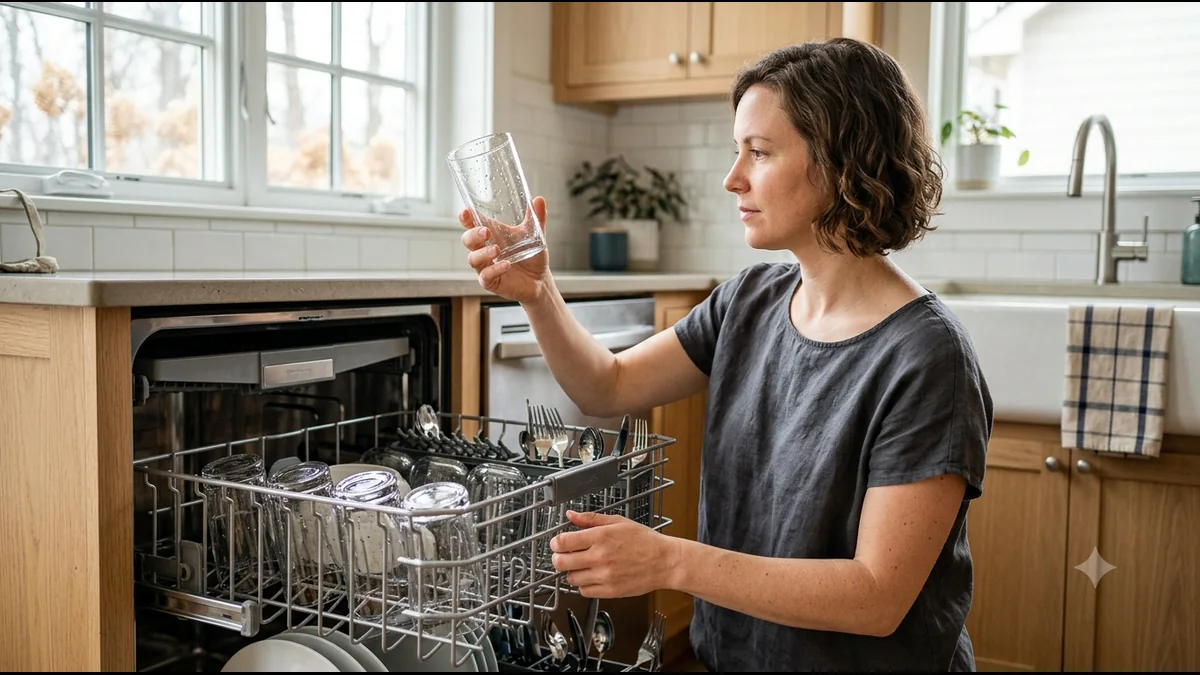
Direct answer: Spotless dishes and glasses in Raleigh start with removing the calcium and magnesium before they ever reach your dishwasher — rinse aid and vinegar only manage the film after it's already forming. Raleigh Water runs slightly hard, and those minerals build cumulatively over hundreds of cycles. An all-in-one softening and carbon system stops the deposits at the source and clears the chlorine taste at the same time.
Why are my dishes and glasses still spotty if Raleigh's water is only slightly hard?
Because "slightly hard" still means dissolved calcium and magnesium in every gallon, and those minerals don't disappear just because there's less of them. Raleigh Water measures around 1.6 grains per gallon (gpg) — slightly hard on the Water Quality Association scale, the same scale the Hach Total Hardness Test Kit (Model 5-B) uses to classify hardness at home. Slightly hard is not mineral-free. Every dishwasher cycle evaporates water off the surface of a glass during the dry phase, and whatever calcium and magnesium were dissolved in that water get left behind. One cycle barely registers. Hundreds of cycles over a few years is what turns into the hazy film homeowners notice on wine glasses and drinking glasses first, since their large flat surfaces show spotting more visibly than plates or bowls.
Our own testing across the wider service area — Raleigh, Cary, Apex, Morrisville, and the surrounding towns — measures hardness anywhere from 1.6 to 3.7 gpg depending on the ZIP code. That top end crosses into moderately hard territory on the same WQA/Hach scale. The point isn't that your water is dramatically different from what the utility reports — it's that the number driving your spotting problem is the one at your own tap, not a citywide average.
What's actually causing the cloudy film on glassware?
Two things working together: mineral deposits and detergent residue. As water evaporates or heats during the dry cycle, dissolved calcium and magnesium come out of solution and settle on the glass surface as a thin, chalky layer. At the same time, those same minerals can react with dishwasher detergent to form an insoluble residue that clings to glass rather than rinsing cleanly away. Neither of these steps requires "hard" water in the traditional sense — they happen at any hardness level above zero, which is why even a slightly hard supply like Raleigh's produces a visible result over time.
What makes it worse in a dishwasher specifically:
- Heated dry cycles speed up evaporation, giving minerals less time to rinse away before they're baked onto the glass
- Hard-to-rinse detergent formulas leave more residue behind for minerals to bond with
- Reused rack positions mean the same glasses sit in the same water-exposure pattern, cycle after cycle
- Well-worn glassware develops microscopic surface roughness that gives deposits more to grip
Will rinse aid or vinegar actually fix it?
They help temporarily, but neither removes the minerals from the water supplying your dishwasher, so the cycle repeats every time you run a load. Rinse aid changes the surface tension of water so it sheets off glass instead of forming droplets that evaporate in place — that reduces spotting, but it does nothing to the calcium and magnesium themselves. A vinegar rinse dissolves existing mineral deposits (vinegar's acidity breaks down the scale), which is why it can restore hazy glasses to clear, but the next load run in the same water starts building the film right back up. Both are maintenance routines you repeat indefinitely rather than a fix. Softened water removes the calcium and magnesium before they ever reach the dishwasher, which is the difference between managing the symptom and removing the cause.
| Approach | What it actually does | Stops new buildup? | Ongoing effort |
|---|---|---|---|
| Rinse aid | Helps water sheet off glass instead of pooling and evaporating | No | Refill every few weeks |
| Vinegar rinse | Dissolves existing mineral deposits after they've formed | No | Manual, repeated as spotting returns |
| Hand-drying | Removes water before it can evaporate and leave residue | No | Every load, every time |
| Detergent upgrade | May reduce residue formation slightly | No | Ongoing cost, marginal difference |
| Softened water (all-in-one system) | Removes calcium and magnesium before they reach any fixture or appliance | Yes | None — runs automatically |
Does Raleigh's chlorine or chloramine affect my dishes too?
Not the spotting itself, but it's part of the same water your dishwasher runs on, and softening alone doesn't touch it. Raleigh Water normally disinfects with chloramine, which the City describes as having no taste or odor associated with it under normal operation. Once a year, on the North Carolina Department of Environmental Quality's recommendation, the system converts to free chlorine only and flushes the distribution network — during that period, chlorine residual runs higher than normal system-wide, and it's the time of year residents are most likely to notice a chlorine taste or smell at the tap. Dates shift year to year, so check the City's own announcement rather than relying on a fixed date.
There's also what a softener alone will never touch: disinfection byproducts. The EWG Tap Water Database lists Raleigh's HAA9 at 19.9 ppb and TTHM at 21.7 ppb — both legally compliant with EPA limits, both above the EWG's stricter, non-regulatory health guideline. Softening resin is ion exchange built for calcium and magnesium; it doesn't remove chlorine, chloramine, or disinfection byproducts. Activated carbon does. That's the whole case for pairing the two stages in one system rather than installing a standalone softener and calling the water problem solved.
What's the difference between spotting and permanent etching?
Spotting is a removable deposit sitting on top of the glass; etching is permanent damage to the glass surface itself, and no rinse fixes it. Mineral film and detergent residue sit on top of glass — that's why vinegar restores them to clear. Etching is different: repeated exposure to hard water conditions combined with certain detergent chemistries can physically roughen glass over years, scattering light instead of reflecting it cleanly. A vinegar test tells you which one you're dealing with — if the cloudiness dissolves and the glass goes clear, it was mineral film; if the haze stays, it's etched into the glass and no amount of rinsing brings it back. Preventing new deposits from forming is the only lever that matters for glassware you haven't already lost to etching, and that's a water-supply fix, not a dishwasher setting.
Where do I start if I want this handled for good?
With a hardness reading from your own tap, not a citywide average. The Hach Total Hardness Test Kit gives you a real number using drop-count titration on the same WQA scale referenced throughout this article, and it's the same starting point a free water analysis begins with. From there, sizing an all-in-one system is straightforward — soften for the calcium and magnesium causing the spotting, add carbon for the chlorine, chloramine, and disinfection byproducts softening never touches. For a deeper look at what mineral buildup does beyond glassware, see the guide linked below on white residue on faucets and glasses.
See what your water is actually doing to your dishes
Take our short water quiz to see how an all-in-one softening and carbon system fits your home, or book a free water analysis and get an exact hardness reading at your own tap before you buy anything.
Frequently Asked Questions
My glasses come out of the dishwasher cloudy every single time — what actually fixes that? The cloudiness is mineral film and detergent residue building up because calcium and magnesium in the water are evaporating onto the glass and reacting with detergent. Softened water removes those minerals before they ever reach the dishwasher, which stops the film from forming in the first place rather than just rinsing it off after each load.
I already use rinse aid and my dishes are still spotty — why isn't it working? Rinse aid changes how water beads and sheets off glass, but it doesn't remove the calcium and magnesium causing the spots. It reduces spotting somewhat without addressing the source, so the same minerals keep arriving with every load. Softening the water removes them before they reach the dishwasher at all.
Does a water softener remove the chlorine taste too, or do I need something else? Softening resin is built for calcium and magnesium only — it doesn't touch chlorine, chloramine, or disinfection byproducts. That's handled by activated carbon, which is why an all-in-one system pairs softening with a carbon stage in one unit rather than leaving half the water problem unaddressed.
How long does it take before I actually notice cleaner dishes after installing a system? Most homeowners notice a difference within the first few dishwasher cycles, since new deposits stop forming immediately once softened water reaches the appliance. Glasses that were already etched won't reverse, but glassware that still shows removable mineral film typically comes out visibly clearer within the first week or two.
Is my water too soft in Raleigh for a softener to make a real difference? No — Raleigh's slightly hard water still carries enough dissolved calcium and magnesium to build a visible film over hundreds of cycles, and there's a real upside to starting from a lower baseline: the softening side of an all-in-one system regenerates less often and uses less salt here than in a harder-water region, so it's inexpensive to run.
What's the difference between the spots on my glasses and permanent etching? Spots and film sit on top of the glass and dissolve with a vinegar rinse; etching is physical damage to the glass surface itself and doesn't come off with any rinse. If a vinegar soak clears the haze, it was mineral deposit. If the haze remains, the glass is etched, and preventing new etching going forward comes down to what's in the water supplying the dishwasher.
Related reading: What Causes White Residue on Faucets and Glasses | Raleigh Water Hardness | How to Test Water Hardness at Home | Benefits of Soft Water in the Home
Answer nine practical questions, then request a written quote or well-water analysis.
Start My Water Analysis