
How to Get Spotless Glasses From the Dishwasher
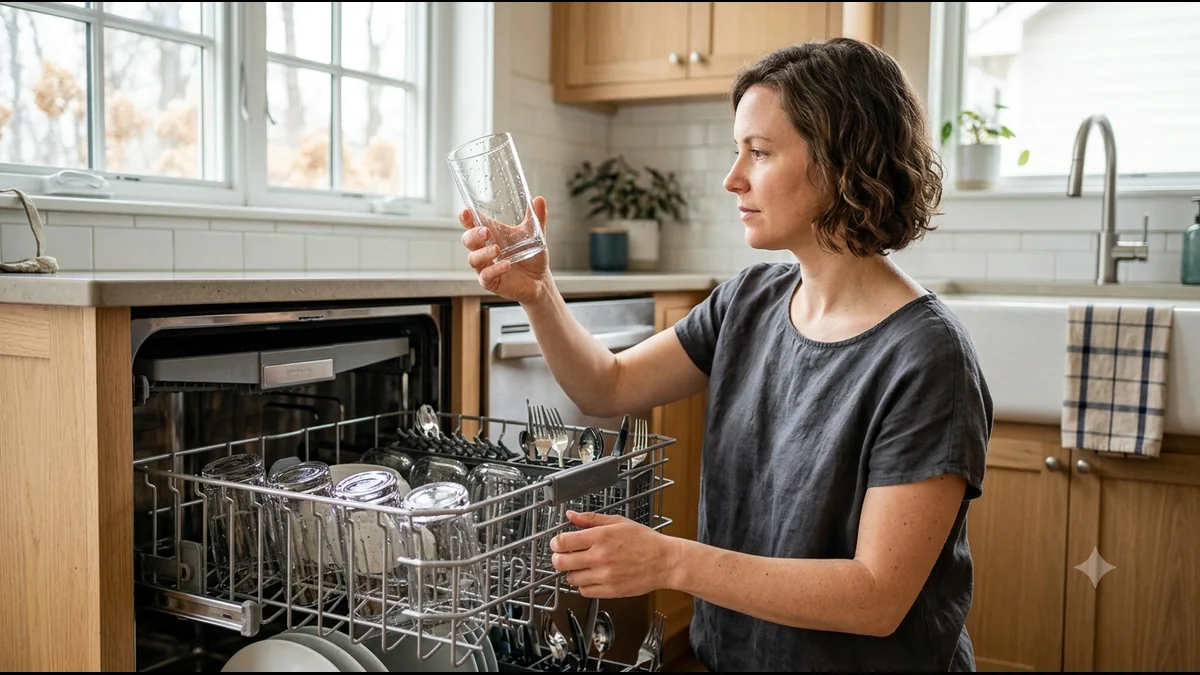
Direct answer: Cloudy glasses and chalky film after a dishwasher cycle are almost always dissolved calcium and magnesium drying on the surface as the water evaporates — a hardness effect that shows up even at Triangle's lower hardness levels, because the deposits are cumulative and a dishwasher's heat and evaporation concentrate whatever minerals are in the water. A whole-home system that pairs softening resin with a carbon stage removes the minerals causing the spotting and handles the chlorine taste that softening alone can't touch.
Why do my glasses come out of the dishwasher cloudy or spotty?
The film you're seeing is mineral residue, not soap residue. Water carries dissolved calcium and magnesium — the two minerals that make up what's called hardness. Inside a dishwasher, hot water sprays onto glass and then evaporates during the dry cycle, and whatever calcium and magnesium were dissolved in that water don't evaporate with it. They're left behind as a thin, chalky deposit on the surface. Run enough cycles and that deposit becomes visible as cloudiness or spotting, especially under light.
Isn't Triangle's water only slightly hard? Why would this happen here?
It can happen at any hardness level, including ours, because the effect is cumulative rather than a one-time hardness threshold. Raleigh Water tests at roughly 1.6 grains per gallon, which classifies as slightly hard on the Water Quality Association (WQA) scale — the same scale the Hach Total Hardness Test Kit (Model 5-B) uses. Cary, Apex, and Morrisville span a wider range — roughly 1.6 to 3.7 gpg — running slightly-to-moderately hard, with the top of that range crossing into moderately hard territory. Even at the lower end, a household runs hundreds of dishwasher cycles a year, and each one leaves a small amount of mineral residue behind. Over time, that residue accumulates on glass the same way it accumulates inside a water heater or on a showerhead — gradually, and it's worse the higher up the hardness range you happen to fall.
Why does a dishwasher make spotting worse than washing dishes by hand?
Heat and evaporation are the two ingredients that concentrate minerals onto a surface, and a dishwasher's dry cycle is built around both. Hand-washing rinses dishes under running water and you typically towel them dry before minerals have a chance to evaporate in place. A dishwasher's heated dry cycle does the opposite: it holds hot water on the glass and then evaporates it right there on the surface, concentrating dissolved minerals exactly where you don't want them. That's also why glasses on the top rack — closer to the heating element and drier air — often show more spotting than dishes lower down.
Is my glass permanently etched, or is it just mineral film?
These are two different problems, and it's worth telling them apart before you assume a fix. Mineral film is a surface deposit — it sits on top of the glass and can be removed. Etching is different: it's a change to the glass itself, a permanently roughened or frosted surface that scatters light instead of reflecting it. Etching tends to develop gradually on certain glass types after long-term exposure to hot water and detergent, and once it's happened, no amount of cleaning or after-the-fact water treatment reverses it. Softening addresses mineral film at the source. It does not restore glass that has already etched.
| Symptom | Cause | Can softening fix it? |
|---|---|---|
| Cloudy or chalky film, often washes off partially with vinegar | Mineral deposits drying on the surface | Yes — removes the minerals causing new film going forward |
| Spots that reappear cycle after cycle | Ongoing mineral residue from hardness | Yes — treats the source, not just each cycle's result |
| Permanent frosted or rough-feeling surface that doesn't wipe off | Glass surface etching, unrelated to minerals | No — etching is not reversible by water treatment |
| Rainbow or hazy sheen under certain light | Can be either film or early-stage etching | Only if it's film; worth checking with a fingernail test first |
A simple way to tell them apart: run a fingernail lightly across the cloudy area, or try wiping it with a vinegar-dampened cloth. If the haze lifts or the surface still feels smooth, you're looking at mineral film. If the roughness is baked into the glass and won't wipe away, that's etching, and no water treatment claim should promise to undo it.
Will a water softener actually fix the spotting?
Yes, for mineral film specifically. A softener uses ion exchange to remove calcium and magnesium from the water before it ever reaches your dishwasher, which means there's nothing left to dry into a chalky deposit on your glassware in the first place. This is the direct, source-level fix for spotting and film — rather than a rinse aid or detergent change that only manages the symptom cycle to cycle.
What about the chlorine taste — does softening handle that too?
No, and that's exactly why the fix Triangle Waterworks installs isn't a standalone softener. Softening resin is built specifically to exchange calcium and magnesium; it has no effect on chlorine, chloramine, or the taste and odor they can leave behind. NSF/ANSI 42 is the certification standard that specifically covers aesthetic effects like chlorine, chloramine, taste, and odor — a different job than the softening side handles. That's why the all-in-one system pairs softening resin with a carbon filtration stage in a single installed unit: the softening side stops mineral spotting on your glassware, and the carbon side addresses the chlorine taste and odor that softening was never designed to touch.
What actually gets you spotless glasses, start to finish
- Softening resin removes the calcium and magnesium causing chalky film and water spots on glassware, dishes, and flatware.
- A carbon stage removes the chlorine or chloramine taste and odor that can carry over into water used for rinsing.
- Proper sizing matters — an undersized system can fall behind during peak household demand, so a free water analysis is the right starting point rather than guessing at a unit size.
- Existing etching, if you already have it, stays as-is either way; softening prevents new mineral film, it doesn't restore glass that has already changed texture.
Frequently Asked Questions
I just moved to Cary and my glasses are coming out of the dishwasher with a cloudy film — is that fixable? Yes, if it's mineral film rather than etching. Try the vinegar-wipe or fingernail test described above; if the haze lifts or the surface is still smooth, a properly sized whole-home system with a softening stage removes the minerals causing that film going forward.
My dishwasher already uses a rinse aid — why are my glasses still spotty? A rinse aid helps water sheet off surfaces rather than bead up, but it doesn't remove the calcium and magnesium in your water supply. If the minerals are still there, some residue can still dry onto glass even with a rinse aid in use. Softening addresses the mineral source directly.
Is it my dishwasher detergent causing the spots, or the water? Detergent and rinse aid choice can affect how noticeable spotting is, but the underlying cause of chalky mineral film is dissolved calcium and magnesium in the water supply, not the detergent itself. Changing detergent can mask the issue somewhat; it doesn't remove the minerals.
Can etched glass be reversed by a water softener or any water treatment? No. Etching is a permanent change to the glass surface, not a mineral deposit sitting on top of it. Water treatment of any kind, including softening, prevents future mineral film — it does not undo etching that has already occurred.
Will a whole-home system also fix the chlorine smell in my tap water? Yes, but that's the carbon side of the system doing the work, not the softening side. Softening resin only removes calcium and magnesium; the carbon stage is what addresses chlorine and chloramine taste and odor.
How do I know if my glasses are etched instead of just filmy? Wipe the cloudy area with a vinegar-dampened cloth or run a fingernail lightly across it. Film often lifts or feels smooth underneath; etching feels permanently rough and won't wipe away. If you're unsure, a free water analysis can help rule mineral hardness in or out as the cause.
Ready to see what your water needs?
Take our 60-second water quiz to find out what system fits your home if you're on city water, or request a free water analysis if you're on a well.
Related reading: What Are the Benefits of Soft Water in Your Home? | Raleigh Water Hardness | What Size Water Softener Do I Need? | Hard Water Cost: Appliance Damage | Water Softener vs. All-in-One System
Answer nine practical questions, then request a written quote or well-water analysis.
Start My Water Analysis