
What Does Soft Water Actually Do for Your Skin and Hair?
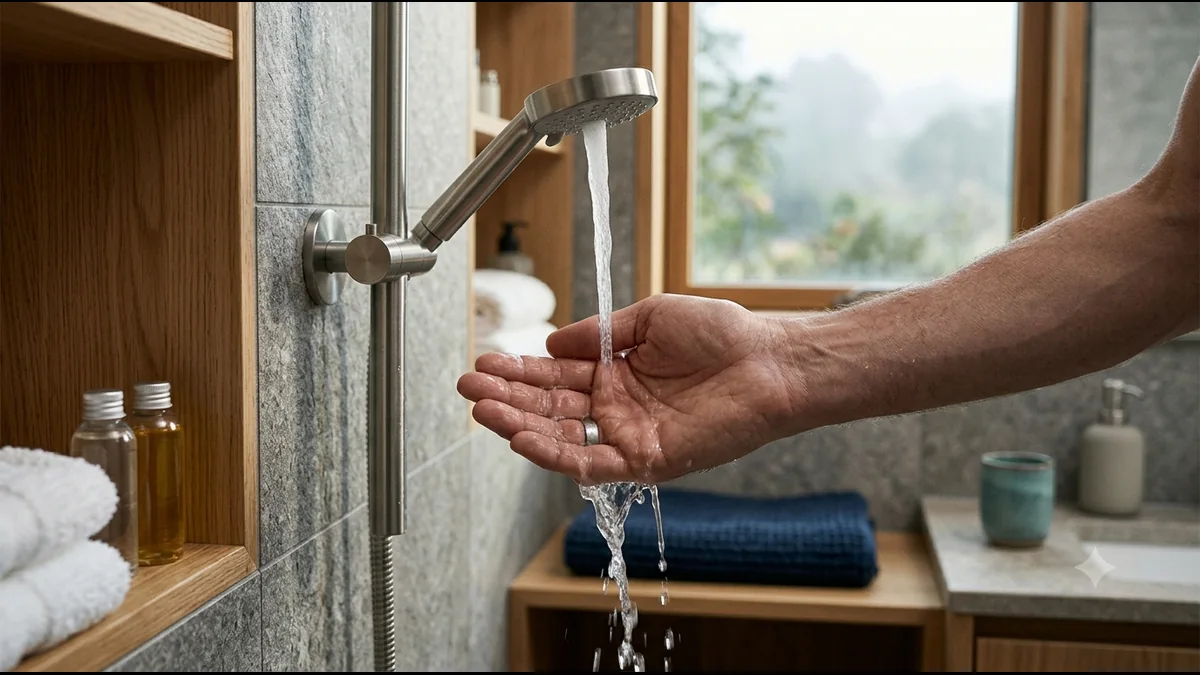
Direct answer: Soft water changes the chemistry of a shower: calcium and magnesium in hard water react with soap and shampoo to form an insoluble film that resists rinsing, so softened water lets soap lather more easily, rinse more completely, and leave less residue on skin and hair. On city water, that's the softening half of Triangle Waterworks' all-in-one system, paired with a carbon stage that handles what softening structurally can't touch.
Why does hard water make soap harder to rinse off?
Hard water contains dissolved calcium and magnesium, and USGS explains that those minerals react directly with soap to form what's commonly called soap scum — an insoluble substance that can temporarily adhere to your hands or the shower walls. Because that reaction consumes soap before it can do its job, hard water needs more soap or detergent to get the same result, and USGS notes that soap is also harder to work into a lather in the first place. More water is then needed to rinse the leftover scum away.
What actually changes on softened water?
Softening removes the calcium and magnesium at the source, before that water ever reaches your showerhead. With those minerals gone, soap and shampoo don't have anything left to react with, so:
- Soap and shampoo work into a fuller lather with less product.
- Rinsing clears the soap completely instead of leaving a film behind.
- Less residue builds up on skin after a shower.
- Hair rinses cleaner, without a filmy coating left in it after washing.
- Less soap-scum buildup forms on the tub, shower glass, and fixtures themselves.
Does that mean I'll need less shampoo and body wash?
Likely, yes, in the sense that less product is required to reach the same lather. Because the calcium-and-magnesium reaction is what consumes extra soap in the first place, removing those minerals means the same amount of shampoo or body wash goes further. That follows directly from the mechanism USGS describes, not a separate claim about the products themselves.
Why does hair sometimes feel coated or heavy after a shower?
That's usually the same soap-scum mechanism at work. When shampoo doesn't rinse cleanly, some of the insoluble residue it forms with calcium and magnesium stays behind in hair. On softened water, there's nothing left to form that residue, so shampoo rinses out more completely — which is why people switching to softened water commonly describe hair as rinsing cleaner rather than feeling weighed down.
What's driving the difference, in one table
| In the shower | What's happening | On softened water |
|---|---|---|
| Soap or shampoo won't lather well | Calcium and magnesium react with soap before it can foam | Minerals removed, soap lathers as designed |
| Filmy residue on skin after rinsing | Insoluble soap scum clings to skin | Nothing left to form scum, rinse is cleaner |
| Hair feels coated after washing | Scum residue stays in hair after rinse | Shampoo rinses out completely |
| Soap scum on tub and shower glass | Same reaction, deposited on surfaces | Less to no scum forms |
| More product needed per shower | Extra soap consumed by the mineral reaction | Same product goes further |
Does this apply to Triangle city water?
It applies wherever calcium and magnesium are present, and the effect scales with how much hardness is in the water. Raleigh Water tests at roughly 1.6 gpg, which sits at the low end of the scale — classified as slightly hard, not soft, on the Water Quality Association (WQA) scale the Hach Total Hardness Test Kit uses. Cary, Apex, and Morrisville span a wider range, 1.6–3.7 gpg, running slightly-to-moderately hard, with the top of that range moving into moderately hard territory. The soap-scum effect described above is real but modest on Raleigh's supply, and more noticeable toward the top of the Cary/Apex/Morrisville range — which is exactly where softening makes the biggest felt difference in the shower.
What doesn't softening change?
This is worth being direct about. Softening resin does one job: it exchanges calcium and magnesium out of the water. It has no effect on chlorine or chloramine, the disinfectant residual utilities maintain all the way to your tap, and no effect on disinfection byproducts like HAA9 and TTHM. Those are documented in Triangle water — Raleigh's system shows HAA9 at 19.9 ppb and TTHM at 21.7 ppb, while Cary's system runs higher, at HAA9 27.5 ppb and TTHM 38.2 ppb, tied to its Jordan Lake source water. All of these figures are legally compliant with EPA limits; they're referenced here against EWG's stricter, non-regulatory guideline as a separate benchmark, not a violation.
That's why the shower-feel benefits above are only half the picture. A carbon filtration stage is what addresses chlorine taste and odor and disinfection byproducts — softening resin isn't built to touch those. Triangle Waterworks' all-in-one system combines softening resin and a carbon stage into one installed unit, so the same shower that lathers and rinses better on the softening side also runs through carbon filtration for what softening leaves untouched.
Frequently Asked Questions
I just moved to Apex and my shampoo won't lather no matter how much I use — is that a hardness thing? It can be. Apex runs toward the higher end of the local hardness range, and USGS explains that calcium and magnesium react with soap and shampoo, consuming it before it can build a full lather. If shampoo that used to lather easily suddenly needs much more product, checking your local hardness level is a reasonable first step.
Does my skin actually feel different switching from hard to soft water, or is that just marketing? The mechanism is documented: USGS describes hard-water minerals forming an insoluble scum with soap that can adhere to skin, and softened water removes the minerals that cause that residue. The felt difference people describe — a cleaner rinse, less filmy residue — follows directly from that chemistry.
I use a lot of shampoo on my hair and still get a filmy residue — what's causing that? That residue is consistent with the soap-scum reaction USGS describes between calcium, magnesium, and the surfactants in shampoo. Using more product doesn't remove the minerals causing the reaction; only removing the calcium and magnesium themselves, through softening, addresses it at the source.
Will a water softener fix the chlorine smell I notice in my shower? No. A softener only exchanges calcium and magnesium — it has no effect on chlorine, chloramine, or disinfection byproducts. That requires a carbon filtration stage, which is why the all-in-one system pairs softening resin with carbon rather than selling either alone.
Is the soap-scum effect worse in Cary and Apex than on Raleigh's supply? Yes, proportionally. Raleigh Water tests slightly hard at around 1.6 gpg on the WQA scale, while Cary, Apex, and Morrisville span a wider range, 1.6–3.7 gpg, running slightly-to-moderately hard. Because the soap-scum reaction scales with how much calcium and magnesium is present, households toward the top of that range see a more noticeable rinse-and-lather difference after softening.
My towels and washcloths feel stiff even though my skin feels fine after a shower — is that related? It can be the same mineral mechanism showing up in fabric instead of on skin. Minerals and soap residue can settle into fibers over repeated hard-water washes, which is a laundry-specific version of the same soap chemistry described above.
See what your water needs
Take the 60-second water quiz to see what system fits your home if you're on city water, or request a free water analysis if you're on a well — hardness varies enough well to well that sizing is based on actual test results rather than a general estimate.
Related reading: What Are the Benefits of Soft Water in Your Home? | Raleigh Water Hardness | Water Softener vs. All-in-One System | What Hard Water Costs You in Appliance Damage | Haloacetic Acids in Drinking Water
Answer nine practical questions, then request a written quote or well-water analysis.
Start My Water Analysis