
Will Durham, NC Water Scale a Tankless Water Heater?
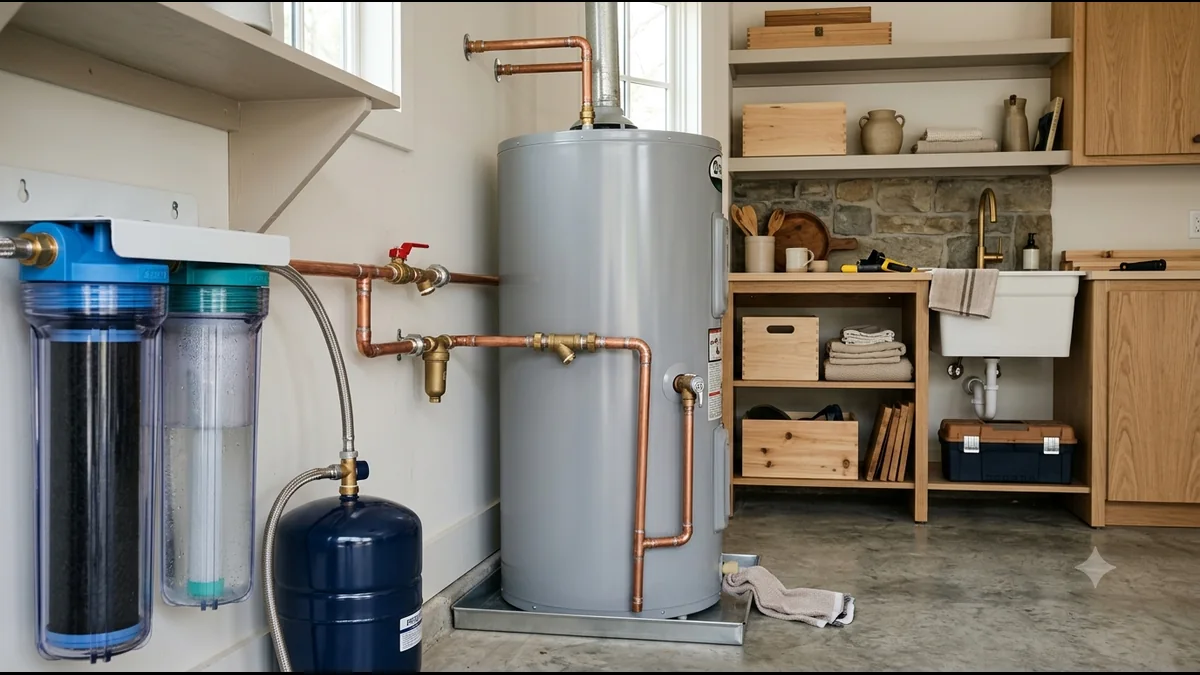
Direct answer: Durham's own 2025 annual water quality report never states a hardness figure — the word doesn't appear in it — so there's no published number to check your tankless unit against. Minerals are still present in the water regardless of what the report covers, and a tankless heater's heat exchanger is one of the most scale-sensitive parts of a home. A free water analysis at your address, paired with a whole-home softening and carbon system, is the only way to answer the question and protect the unit at the same time.
Does Durham's Water Quality Report Say Anything About Hardness?
No — Durham's 2025 Annual Drinking Water Quality Report does not publish a total hardness figure anywhere in it, and the word "hardness" does not appear in the document at all. That's different from a town that reports a low number; Durham simply doesn't measure or publish one for its customers to look up.
That gap matters more for a tankless water heater than for almost any other appliance in the house, because a tankless unit's performance is far more sensitive to scale than a tank heater's is. Without a published figure, the only way to know what your own tankless unit is actually running on is a test at your own address — which is free, and which Triangle Waterworks measures across the wider Triangle service area as 1.6–3.7 gpg, varying by ZIP code, based on our own testing. That range is not a Durham number and shouldn't be read as one; it's context for what a Triangle-area home commonly runs, until your own address is tested.
Why Does a Tankless Water Heater Scale Differently Than a Tank Heater?
A tankless water heater has no storage tank — it heats water on demand by pushing it across a heat exchanger at high temperature, through narrow internal passages designed to transfer heat as fast as possible. Scale forms preferentially on hot surfaces, which makes that heat exchanger and its narrow passages exactly where calcium and magnesium deposit first.
A tank water heater handles the same minerals very differently. Sediment settles to the bottom of the tank and can sit there largely harmlessly for years without affecting how the unit heats water day to day. A tankless unit doesn't have that luxury — its entire job depends on those internal passages staying clear, so buildup shows up as a performance problem almost immediately rather than as slow, invisible sediment.
| Factor | Tank Water Heater | Tankless Water Heater |
|---|---|---|
| Where scale forms | Settles as sediment at the bottom of the tank | Builds up inside the heat exchanger's narrow passages |
| How it shows up | Can sit unnoticed for years | Shows up quickly as a performance change |
| Common symptom | Rumbling or popping sounds over time | Reduced flow, temperature swings, error codes |
| What fixes buildup once it's there | An occasional tank flush | A manufacturer-recommended descaling service |
| Best way to prevent it | Softening upstream still helps | Softening upstream is the highest-leverage fix |
What Are the Signs a Tankless Water Heater Is Already Scaling Up?
The clearest signs are reduced flow at the tap, hot water temperature that swings mid-shower instead of staying steady, and the unit short-cycling or throwing a scale or maintenance error code on its display. All three point to the same underlying cause: mineral deposits narrowing the passages inside the heat exchanger and interfering with how efficiently it transfers heat.
Manufacturers require periodic descaling or flushing service to keep a tankless unit running as designed and to keep its warranty intact. Descaling treats the symptom, though — it clears deposits that have already formed, and it has to be repeated on an ongoing basis because the same untreated water keeps flowing across the same hot surfaces afterward. It's a maintenance task, not a fix for what's causing the buildup in the first place.
What Does Durham's Water Actually Contain, Even Without a Hardness Figure?
Durham draws its water from surface sources — Lake Michie and the Little River Reservoir — treated at the Williams and Brown water treatment plants, and the city also purchased water from the Town of Cary during the report year. Durham's 2025 report shows both chlorine and chloramine residuals in the distribution system, with a running annual average of 0.63 ppm for chlorine and 1.5 ppm for chloramines, both well under the 4.0 ppm regulatory limit.
The more notable numbers are the disinfection byproducts. Durham's highest reported TTHM level is 56 ppb against an 80 ppb limit, and its highest reported HAA5 level is 49 ppb against a 60 ppb limit — both fully compliant, with no violation of any kind. But 56 ppb is the highest verified disinfection byproduct figure anywhere in our service area, higher than the Town of Apex's 41 ppb (ranging to 53) and well above Raleigh Water's 21.7 ppb. Compliance means Durham's water meets every EPA limit; it doesn't mean the byproducts aren't there, and activated carbon is what removes them effectively. That's the case for the carbon stage of a whole-home system, and you can read more about what these compounds are in our trihalomethanes explainer.
Durham's 2025 report also lists PFAS compounds as unregulated contaminants detected in its 2025 sampling: PFOA averaging 3.8 ppt (range 2.8–5.7) and PFOS averaging 5.6 ppt (range 4.6–7.2). Durham reports these as detected, unregulated substances — not as a violation of any standard, and not evidence of a health effect, since neither is claimed anywhere in the report. Reducing PFAS requires carbon certified under NSF/ANSI 53 or P473, or reverse osmosis certified under NSF/ANSI 58; see our guide on whether activated carbon removes PFAS for how that certification works. One detail worth knowing: Durham's report does not describe an annual free-chlorine conversion the way some neighboring towns do, so nothing about seasonal disinfectant switching applies here.
How Should a Durham Homeowner With a Tankless Water Heater Actually Protect It?
Since there's no published hardness number to plan around, the sequence is straightforward: get a free water analysis first, so you have a real reading for your own address instead of a service-area range. Our guide on testing water hardness at home covers what that test looks like and what the reading means once you have it.
A tankless water heater is one of the most scale-sensitive appliances in a house, which makes softening upstream of it the single highest-leverage protection available — deposits never form in the heat exchanger in the first place, rather than needing to be flushed out after the fact once flow and temperature are already affected. Pair that with a carbon stage sized for Durham's TTHM and PFAS profile, and a whole-home all-in-one system covers both problems in a single footprint. For more on what scale does to a water heater generally, see our water heater scale buildup prevention guide, and if you have a softener already, our Durham softener guide covers what Durham-specific factors to weigh when sizing one.
Never skip treatment on a tankless unit and rely on descaling alone — softening the water upstream is what keeps the appliance itself protected, and it's a better long-term position than repeatedly clearing an exchanger that keeps getting exposed to the same untreated water.
Frequently Asked Questions
I just installed a tankless water heater in Durham — do I need to worry about scale?
It's worth checking rather than assuming either way. Durham's own report publishes no hardness figure, so there's no town number to compare against, and minerals are present in water regardless of what a report covers. A free water analysis at your address will tell you exactly what your tankless unit is running on, and softening upstream is the most effective way to protect the heat exchanger going forward.
How can I tell if scale is already building up inside my tankless unit?
Watch for reduced flow at the tap, hot water temperature that swings instead of holding steady mid-shower, and the unit short-cycling or displaying a scale or maintenance error code. Any of those three, especially in combination, points to mineral deposits narrowing the passages inside the heat exchanger.
Does Durham's water report a hardness number I can use to size a softener?
No — Durham's 2025 annual water quality report doesn't include a hardness figure anywhere, so there's nothing published to size against. A free water test at your own address gives you a real reading, which is what a softener actually needs to be sized correctly rather than an estimate.
My shower temperature keeps swinging and the unit throws an error — what should I do?
That combination is a common sign of scale buildup inside a tankless heat exchanger, and a manufacturer-recommended descaling service can clear existing deposits. Descaling addresses the buildup that's already there, though, so pairing it with softening upstream of the unit stops new deposits from forming in the first place.
Is Durham's TTHM level safe, and does it affect my tankless heater?
Durham's highest reported TTHM figure is 56 ppb against an 80 ppb limit, which is fully compliant with no violation. It doesn't affect scale formation in a tankless unit — TTHM is a disinfection byproduct, not a hardness mineral — but it's a strong reason to add a carbon stage alongside softening in a whole-home system.
I'm buying a Durham home with a tankless water heater already installed — what should I check first?
Ask for any service or descaling records on the unit, and get a free water analysis at that address as part of your due diligence, since Durham publishes no hardness figure to rely on instead. If the analysis shows meaningful hardness, a whole-home softening and carbon system installed before problems show up is far simpler than dealing with a scaled exchanger later.
Ready to find out what your own tap is running on? Take our water quiz or book a free water analysis, and we'll size a whole-home system to your actual numbers — not a service-area average.
Related reading: Water Softener in Durham, NC · Water Heater Scale Buildup Prevention · Trihalomethanes in Tap Water · Does Activated Carbon Remove PFAS? · How to Test Water Hardness at Home
Answer nine practical questions, then request a written quote or well-water analysis.
Start My Water Analysis