
Why a Custom-Sized Water System Beats a Catalog Softener
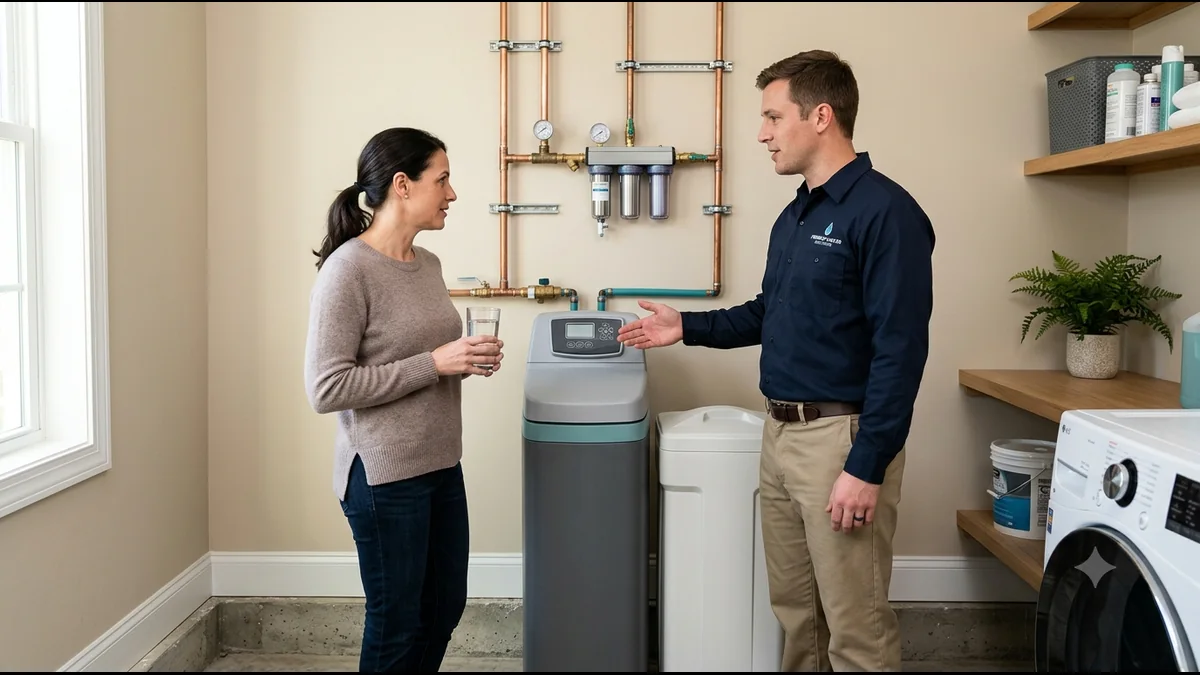
Direct answer: A custom-sized water treatment system is configured from your actual water test, household size, number of bathrooms, and daily water use — not picked off a shelf. For Triangle city water, that almost always means an all-in-one system pairing softening resin with carbon filtration, sized correctly the first time. A free water analysis is the fast, no-cost first step that makes the sizing possible.
What actually determines what size water treatment system I need?
Six inputs, not a shelf label. Your water source (city utility or private well), its measured hardness in grains per gallon, what your utility's treatment leaves behind, how many people live in the home and how much water they use daily, how many bathrooms need coverage, and where the equipment can physically go. A catalog system is built around none of them — it's the same box whether you're a mile from downtown Raleigh or twenty minutes out on a well in Chatham County.
Here's why each input matters:
- Water source — City water arrives already treated, so what's left behind is chlorine or chloramine taste, and in some systems, disinfection byproducts or trace PFAS depending on the source. Well water isn't treated at all before it reaches your tap, and North Carolina doesn't regulate private well water after construction, so it has to be tested directly rather than assumed.
- Measured hardness — The actual grains-per-gallon (gpg) number, from your city utility's published data or a direct test, determines how much softening capacity your household genuinely needs. Guessing this number means guessing the whole system.
- What treatment leaves behind — Raleigh and Cary tap water both carry documented disinfection byproducts (haloacetic acids and trihalomethanes), and both utilities are compliant with EPA's legal limits. Activated carbon is what handles that — it's a separate question from hardness entirely.
- Household size and daily use — More people running more loads of laundry, dishes, and showers means more gallons moving through the system every day.
- Number of bathrooms — More fixtures drawing water, sometimes at the same time, changes how a system needs to be configured to keep pace.
- Where the equipment can go — Every home's utility space, crawl space, or garage layout is different, and that affects what installation actually looks like.
What happens if a system is undersized for my home?
It works harder than it should. An undersized softener regenerates far more often than it needs to, uses more salt over time, and wears out its components faster than a correctly sized unit would. During high-use stretches — guests in the house, back-to-back laundry loads — an undersized system can also let hard water slip through between regeneration cycles, right when you're using the most water.
What happens if a system is oversized for my home?
It costs more upfront than the household actually needed. Oversizing doesn't make the water any better — a system built for a much larger household or a much harder water supply than yours just means paying for capacity that never gets used. An oversized system still delivers great water every day; it simply means paying up front for capacity your household won't draw on, which correct sizing avoids entirely — and the analysis that gets the sizing right is free.
Both outcomes trace back to the same root cause: guessing instead of testing. A free water analysis eliminates the guess before you ever place an order.
Why do two homes twenty minutes apart need different systems?
Because hardness genuinely varies across the Triangle. Raleigh Water tests at roughly 1.6 grains per gallon — slightly hard, on the Water Quality Association (WQA) scale, the same one the Hach Total Hardness Test Kit (Model 5-B) uses. Cary, Apex, and Morrisville span a wider range, 1.6–3.7 gpg, reaching moderately hard at the top of that range. That's a real difference in what a softener has to remove, not a rounding error.
| Area | Measured hardness | WQA classification |
|---|---|---|
| Raleigh (also Garner, Knightdale, Rolesville, Wake Forest, Wendell, Zebulon) | ~1.6 gpg | Slightly hard |
| Cary / Apex / Morrisville | 1.6–3.7 gpg | Slightly hard to moderately hard |
| Private wells | Varies by property | Must be tested individually — no default assumption |
A well twenty minutes outside either city is its own case again. Wells aren't on a published utility number at all, so hardness, iron, and pH all have to be measured on-site before a system can be configured.
What does a free water analysis actually check, and how fast is it?
It's the first step of buying, not a delay before buying. A water analysis measures your home's actual hardness, checks for the specific contaminants relevant to your water source, and confirms your household details — bathroom count, typical daily use, and where equipment can be installed. That combination is what lets a system get configured correctly on the spot, rather than shipped as a generic size and hoped to fit. There's no cost and no separate step between the analysis and getting a system sized for your address.
How much does a custom-sized whole-home system cost compared to a catalog guess?
A whole-home all-in-one system — softening resin and carbon filtration together — is priced only after your analysis configures exactly what your home needs. National big-brand whole-home installers commonly quote $6,000–$12,000 for comparable coverage. Sizing correctly from the start, rather than defaulting to a large catalog unit "to be safe," is part of what keeps the true cost of the right-sized system down.
| Catalog / off-the-shelf system | Custom-sized system (post-analysis) | |
|---|---|---|
| Sizing basis | One generic size across many homes | Your test results, household size, bathrooms |
| If too small for the home | Works harder, regenerates more often | Configured to your actual water use |
| If too large for the home | Costs more upfront for unused capacity | Configured to your actual needs, nothing extra |
| Water source considered | Same box for city or well | Configured differently for city vs. well |
| Typical installed price | National big-brand: $6,000–$12,000 | Set after a free water analysis |
The all-in-one system, sized to your address
For Triangle city water, the system that comes out of this process is almost always the same category: an all-in-one whole-home unit that pairs softening resin with carbon filtration in one setup. The softening side handles the calcium and magnesium your local water carries — protecting your water heater, dishwasher, and plumbing from scale buildup over years of daily use, and giving you cleaner glassware and better lather. The carbon side handles what softening never touches: chlorine and chloramine taste, and documented disinfection byproducts. Sizing that combination correctly is exactly what a water analysis is for, and it's the same analysis whether your address lands on the slightly-hard end of the scale or the moderately hard end.
Frequently Asked Questions
I just moved into a house in Cary and have no idea what my water tests at — where do I even start? Start with a free water analysis rather than guessing from what a neighbor has. It measures your home's actual hardness and checks for the contaminants relevant to city water, so any system recommendation is based on your address, not an assumption.
My neighbor a few streets over has a completely different system quoted than what I'm looking at — why would that be? Because hardness and household details can genuinely differ street to street, especially across Cary, Apex, and Morrisville's 1.6–3.7 gpg range. Two homes on the same utility can still land on different sides of the slightly-hard-to-moderately-hard line, and household size and bathroom count factor in too.
I'm on well water — does this same sizing approach apply to me? Yes, and it matters even more. Wells don't have a published utility hardness number, so a water analysis is what establishes your actual numbers before any system gets sized, rather than assuming your well behaves like a neighbor's.
Does a bigger system automatically mean better water? No — a bigger system than your home needs doesn't improve water quality, it just adds unused capacity and upfront cost. Correct sizing, based on your actual hardness and household use, gives you the same water quality outcome without paying for capacity you won't use.
How long does the water analysis take, and does it cost anything? It's free and it's fast — that's the point. It's designed as the first step toward getting a correctly configured system, not a separate errand you have to schedule around.
Can I just buy the same softener a friend has if we live in the same town? It's not a safe assumption, even in the same town. Hardness can vary within a single water system, and household size, bathroom count, and daily water use all factor into sizing — which is exactly why the analysis is done per address rather than per zip code.
Ready to see what fits your address?
Take our 60-second water quiz to get a system recommendation sized to your home, or request a free water analysis as the real first step — not a delay — toward a system built around your actual water, not a catalog guess.
Related reading: What Size Water Softener Do I Need? | How to Choose a Water Softener | All-in-One Water System Cost in NC | How to Test Water Hardness at Home | Water Softener vs. All-in-One System
Answer nine practical questions, then request a written quote or well-water analysis.
Start My Water Analysis