
New Construction Homes in Triangle NC: When Should Water Treatment Go In?
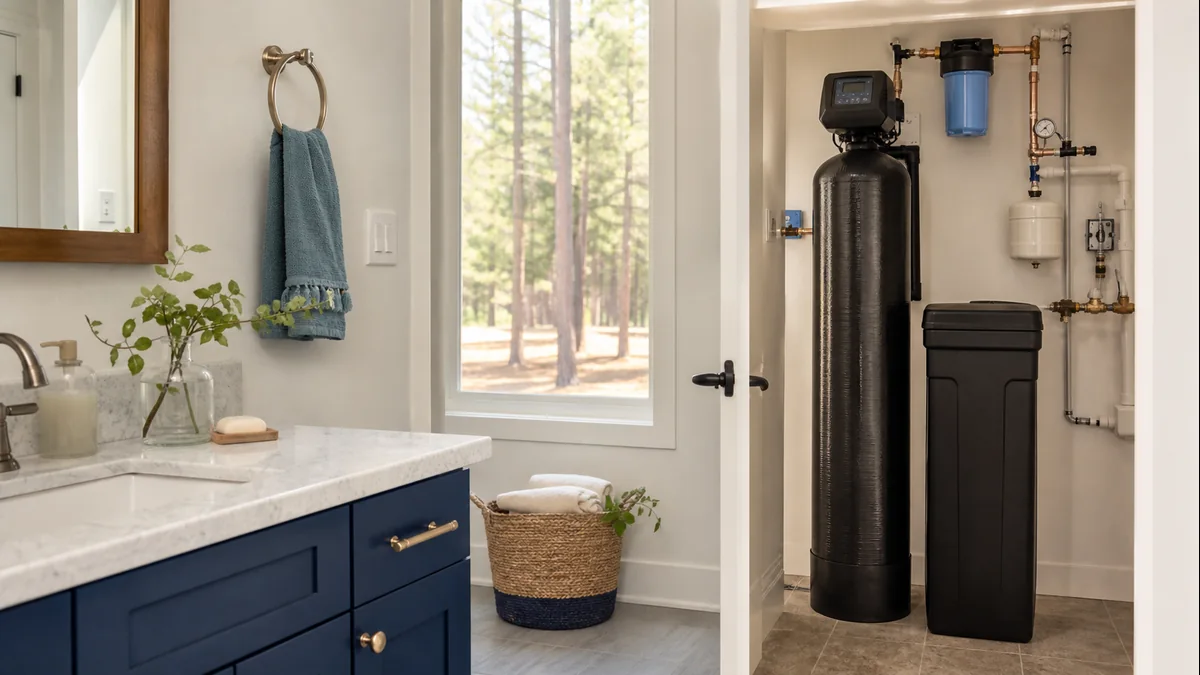
Direct answer: Move-in day is the earliest — and best — moment to install a whole-home water system in a new Triangle NC build. Scale and chlorine taste start acting on brand-new PEX and copper the same way they act on 20-year-old pipe, because the water source doesn't change with the age of the plumbing. An all-in-one softening-plus-carbon system installed at closing protects appliances and fixtures for their entire service life instead of only part of it.
Why does new construction water treatment matter across the whole Triangle?
Raleigh, Cary, Apex, Morrisville, and Wake Forest are all part of one of the fastest-growing corners of the Triangle, with new subdivisions going up across all five towns at once. That growth means thousands of new closings a year — and every one of those homes starts its water history on day one, whether the buyer thinks about it at closing or five years later.
The towns don't share identical water, but they share the same fact pattern:
- Raleigh, Garner, Knightdale, Rolesville, Wake Forest, Wendell, and Zebulon are served by Raleigh Water, which our own testing across the service area measures at roughly 1.6 grains per gallon — slightly hard on the WQA/Hach scale.
- Cary, Apex, and Morrisville share the Cary/Apex Water Treatment Facility, drawing from Jordan Lake. Our testing across that system runs 1.6 to 3.7 grains per gallon depending on the address — slightly hard at the low end, moderately hard at the high end (3.7 gpg is just over the 60 mg/L line that separates the two tiers). Morrisville has had its water and sewer utility run by the Town of Cary since April 2006, which is why it sits on the same system as Cary and Apex.
- Both systems carry a disinfectant residual — chlorine or chloramine — to keep the water safe in the pipes between the treatment plant and your tap. That residual is what gives municipal water its characteristic taste and smell, and it's also the source of disinfection byproducts like HAA9 and TTHM.
None of that is unsafe water. It's exactly what a whole-home system is built to address: softening resin for the hardness minerals, and a carbon stage for chlorine, chloramine taste, and disinfection byproducts.
Does new PEX or copper plumbing change any of this?
No — and this is the detail most new-build buyers miss. New plumbing is not immune to mineral buildup or chlorine exposure. The water flowing through a home built last month is drawn from the same Raleigh Water or Cary/Apex source as the water flowing through a home built in 2005. Scale doesn't check the manufacture date on a pipe before it starts depositing, and chlorine doesn't skip a water heater just because the tank is new.
What actually changes with a new build is the opportunity: every fixture, appliance, and length of pipe in the house is starting its service life at zero. That's the argument for treating water early, not a reason to wait and see.
New home without treatment vs. new home with an all-in-one system at move-in
| New home, untreated | New home, all-in-one system installed at move-in | |
|---|---|---|
| Scale buildup | Begins accumulating in the water heater and fixtures from the first gallon | Softening resin removes calcium and magnesium before they can deposit |
| Chlorine/chloramine taste | Present at the tap from day one, carried through every fixture | Carbon stage removes taste and smell before water reaches the faucet |
| Appliance warranty protection | Water heater, dishwasher, and washing machine accumulate scale across their full service life | Appliances run on treated water for their entire time in the home |
| Resale water-quality talking point | Nothing to point to beyond "city water" | A documented whole-home system is a concrete feature to list |
What does an all-in-one system actually protect in a new build?
The same appliances and fixtures every Triangle homeowner eventually worries about — just protected from the very first cycle instead of partway through:
- Water heater — scale collects on tank surfaces and heating elements over years of cycling; softened water prevents that buildup from starting
- Dishwasher and washing machine — thousands of cycles over the life of the home, each one running mineral-laden water through internal components without softening
- Glass shower doors, fixtures, and glassware — soft water lathers cleaner and leaves less mineral film and soap scum
- Skin, hair, and laundry — softened water is gentler day to day, a benefit new-home buyers notice immediately, not just over time
- Chlorine/chloramine taste and odor, plus PFAS and disinfection byproducts (HAA9, TTHM) — addressed by the carbon stage, which handles what softening resin alone cannot
It's worth being clear about the division of labor: softening resin is ion exchange for calcium and magnesium only — it doesn't touch PFAS. Removing PFAS requires carbon certified for that purpose (NSF/ANSI 53 or P473) or reverse osmosis (NSF/ANSI 58). Boiling water does not remove PFAS. That's exactly why the all-in-one system pairs both stages instead of relying on softening alone.
When during the closing process should the system actually go in?
As close to move-in as the schedule allows. A builder-installed softener loop — common in new Triangle subdivisions — is just rough-in plumbing; water runs straight through an empty loop until a system is actually connected. The earliest practical windows are:
- At closing, before the family has moved in and while the mechanical space is still empty and fully accessible
- In the first weeks after move-in, if the loop wasn't connected at closing
- Before the first full season of use, at the latest — every month of untreated water is a month of buildup that a system installed later can't undo
A free water analysis is the right first step regardless of timing, since it confirms actual hardness at the address rather than relying on a town-wide average.
Frequently Asked Questions
I just closed on a new build in Apex — is it too early to think about a water system? It's the ideal time, not too early. The mechanical space is empty, nothing has moved in yet, and every appliance you're about to install will start its service life on treated water instead of picking up scale for months or years first.
My new home in Wake Forest is on Raleigh Water — where does that land on the hardness scale? Raleigh Water measures around 1.6 grains per gallon, which lands as slightly hard on the WQA/Hach scale. It's still mineral-bearing water carrying a chlorine or chloramine residual, which is exactly what an all-in-one system is designed to handle from day one.
Is Morrisville's water the same as Cary's? Yes. The Town of Cary has operated Morrisville's water and sewer utility since April 2006, so Morrisville draws from the same Cary/Apex Water Treatment Facility and Jordan Lake source as Cary and Apex.
I'm building in Cary and my builder roughed in a softener loop — do I still need to test the water? Yes. A loop is just pipework; it tells you where a future system will connect but nothing about your actual hardness. Our testing across the Cary/Apex system finds 1.6 to 3.7 grains per gallon depending on the address, so a site-specific test is what determines proper sizing.
How does an all-in-one system help if I want to sell this house again in a few years? A documented whole-home system is a concrete water-quality feature you can point to at resale, alongside years of appliances that ran on treated water instead of accumulating scale. That's a stronger story than simply noting the house is on municipal water.
Does the fast growth across Raleigh, Cary, Apex, Morrisville, and Wake Forest change what kind of system I need? Not the type of system — every home on these municipal systems benefits from the same all-in-one softening-plus-carbon approach. What growth does mean is more new builds sitting on rough-in loops with no system connected yet, which is worth checking as soon as you close.
Get your new build tested
Every one of these towns is on the same clock: the water arriving at a brand-new meter is identical to the water arriving at a decades-old one, and the only variable a homeowner controls is when treatment starts. Take our 60-second water quiz to see which all-in-one system fits your new Triangle home, or book a free water analysis to get an exact hardness reading before your first full season in the house.
Related reading: New Construction Water Softener in Cary, NC | New Build Water Treatment in Apex, NC | Morrisville New Construction Water Treatment | New Construction Water Softener in Raleigh, NC | New Construction Water Softener in Wake Forest, NC
Answer nine practical questions, then request a written quote or well-water analysis.
Start My Water Analysis