
Do Triangle NC Tap Water Systems Have Pesticides or Herbicides?
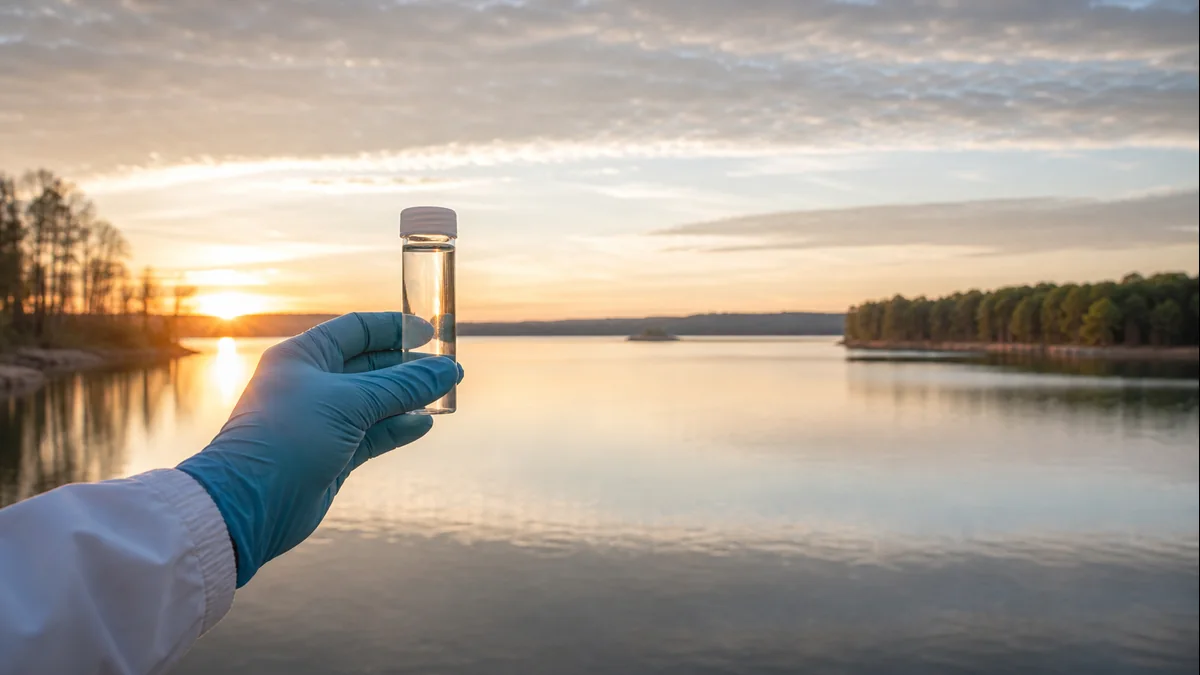
Direct answer: Triangle NC utilities test for herbicides like atrazine and simazine every year, and Cary and Apex — the towns publishing full results — currently report no detectable levels. That's a legitimate non-detect, but not the whole story: the same water still carries chlorine, chloramine byproducts, and PFAS a clean pesticide reading says nothing about. An all-in-one whole-home system handles the taste and byproducts softening alone never touches.
What are pesticides and herbicides, and how do they reach Triangle NC tap water?
Pesticides and herbicides are chemicals applied to farmland, golf courses, and lawns to control weeds, insects, and fungus, and rain carries a fraction of what's applied off the land into the rivers and reservoirs that supply drinking water. In the Triangle, Cary, Apex, and Morrisville all draw from B. Everett Jordan Lake, part of the Cape Fear River Basin.
That watershed is agricultural and urban, and the state has rated it "Higher" susceptibility to contamination sources — which is exactly why utilities are required to test for these compounds in the first place.
That susceptibility rating doesn't mean poor water quality on its own. It means the watershed has land uses — farming, stormwater runoff, developed area — that make ongoing monitoring necessary. Testing is the mechanism that turns that risk into an actual answer for your address.
How does the EPA regulate atrazine and simazine in drinking water?
The EPA sets a legal limit called a Maximum Contaminant Level (MCL) for each: 3 parts per billion for atrazine and 4 ppb for simazine. EPA's own National Primary Drinking Water Regulations table lists the potential health effect from long-term exposure above the MCL as "cardiovascular system or reproductive problems" for atrazine and "problems with blood" for simazine.
A legally compliant result is a ceiling EPA itself set using its own risk tolerance — not a guarantee of zero exposure. These are the exact compounds and effects EPA had in mind when it drew that line, which is why utilities monitor for them continuously rather than treating the limit as a one-time hurdle.
EWG, a nonprofit that publishes stricter non-regulatory health guidelines, sets its own atrazine benchmark far lower — 0.1 ppb — built around a tenfold safety margin below the 1 ppb level that studies have associated with a higher risk of preterm birth. That's a health guideline, not a legal limit, and it's useful context for how conservative a "compliant" reading really is.
Do Cary, Apex, and other Triangle utilities actually test for them?
Yes. Cary's 2025 Annual Water Quality Report and Apex's 2024 Annual Drinking Water Quality Report — the two current reports covering the shared Cary/Apex Water Treatment Facility on Jordan Lake — both state they test dozens of synthetic organic contaminants every year, and neither report lists a detected result for atrazine, simazine, or any other pesticide or herbicide.
Both reports use the same convention: "The following tables show only those substances that were detected in the water" (Cary, 2025). No atrazine or simazine row appearing in either report's contaminant tables means neither compound turned up at a reportable level in that year's testing — a genuine non-detect, not a gap in monitoring.
If you're on a different Triangle utility, check that town's own current Consumer Confidence Report rather than assuming Cary's or Apex's result applies — each system publishes its own annual results, and pesticide testing schedules and source watersheds differ by utility.
What has research found in North Carolina's surface water more broadly?
Outside these two clean local readings, independent USGS testing elsewhere in North Carolina shows these herbicides are a real regional presence, not just a checkbox category. A 1992–94 USGS study of the Tar-Pamlico River Basin — a different central/eastern NC watershed than Jordan Lake, drained mostly by the Coastal Plain — sampled 147 water samples at five stream sites.
The study found atrazine at an adjusted detection frequency of 78%, with a maximum measured concentration of 1.8 ppb. Simazine showed a 30% detection frequency and a 0.2 ppb maximum.
Both figures sit under EPA's legal MCLs (3 ppb and 4 ppb) but above EWG's 0.1 ppb atrazine guideline. That study isn't a claim about Jordan Lake specifically — it's a different basin — but it shows these are real agricultural chemicals moving through North Carolina surface water on a seasonal cycle, which is precisely why Cary and Apex test for them every year rather than assuming a clean result forever.
Does a non-detect pesticide result mean I don't need to filter my water?
No — a non-detect pesticide reading only answers one narrow question tested a handful of times a year. It says nothing about the chlorine, chloramine, disinfection byproducts, or PFAS present in Triangle tap water on an ongoing basis, which softening alone never touches.
Apex's 2024 report shows total trihalomethanes (TTHM) averaging 41 ppb and ranging up to 53, plus haloacetic acids (HAA5) at 19 ppb. Cary's 2025 report shows TTHM at 37 ppb (range 17–43) and HAA5 at 17 ppb (range 9–17). Both are legally compliant — and both are exactly the compounds EPA had in mind when it set TTHM's MCL at 80 ppb and HAA5's at 60 ppb.
EPA's regulations table lists TTHM's potential health effect from long-term exposure above the MCL as "liver, kidney or central nervous system problems; increased risk of cancer," and HAA5's as "increased risk of cancer." Compliant water isn't the same as zero-exposure water — a carbon stage removes these compounds rather than relying on staying under a legal line.
Hardness is in the same category: Triangle Waterworks measures 1.6 to 3.7 grains per gallon in homes across the service area, slightly hard to moderately hard on the WQA/Hach scale, and that buildup accumulates on fixtures and inside water heaters over years regardless of what any single pesticide test shows.
What actually removes pesticides, herbicides, and everything else that's still there?
Activated carbon is the workhorse. It adsorbs organic compounds — including atrazine and simazine when they are present, plus chlorine and chloramine taste and disinfection byproducts like TTHM and HAA5. For PFAS specifically, carbon needs to be certified for PFAS reduction (NSF/ANSI 53 or P473), or you need reverse osmosis (NSF/ANSI 58) at a drinking-water tap.
| Contaminant | Federal MCL | Stricter health guideline | What removes it |
|---|---|---|---|
| Atrazine (herbicide) | 3 ppb | EWG: 0.1 ppb | Activated carbon |
| Simazine (herbicide) | 4 ppb | — | Activated carbon |
| TTHM (disinfection byproduct) | 80 ppb | — | Activated carbon |
| HAA5 (disinfection byproduct) | 60 ppb (HAA9 unregulated) | — | Activated carbon |
| PFOA / PFOS | 4 ppt each | — | PFAS-certified carbon or RO |
| Calcium/magnesium hardness | Not health-regulated | — | Softening resin (ion exchange) |
Softening resin is ion exchange for calcium and magnesium only — it doesn't touch a single line in that table above hardness. That's the whole case for an all-in-one whole-home system: the carbon stage handles the taste, disinfection-byproduct, and pesticide side, and the softening resin handles hardness, so you're not relying on one narrow test result to decide what your water needs. For PFAS specifically, ask what the carbon is certified to — NSF/ANSI 53 or P473 is the standard that covers PFAS reduction, and a reverse-osmosis stage at the kitchen sink (NSF/ANSI 58) is the belt-and-braces option for the water you actually drink.
Ready to see what's actually in your Triangle NC water?
A clean pesticide reading is good news, and it's also just one line item. Take the 60-second water quiz to see which all-in-one system fits your address, or book a free water analysis to get a full picture — chlorine, disinfection byproducts, PFAS, and hardness — instead of one test at a time.
FAQ
I just read my town's water report and atrazine isn't even listed — does that mean it isn't being tested? No. Cary's and Apex's reports both state they only list substances actually detected during testing, so an absent line means the lab didn't find it, not that it was skipped. Both towns test dozens of synthetic organic contaminants, including atrazine and simazine, every year as part of EPA-required monitoring.
I'm on Raleigh water, not Cary or Apex — should I assume the same result applies to me? No — Raleigh is a separate utility with its own annual report, tested and published independently of Cary and Apex. Check Raleigh's current Consumer Confidence Report directly rather than assuming a neighboring town's clean pesticide result carries over, since source watersheds and testing schedules differ by system.
What's the actual difference between EPA's legal limit and EWG's health guideline for atrazine? EPA's Maximum Contaminant Level (3 ppb) is the legally enforceable ceiling utilities must stay under. EWG's 0.1 ppb figure is a stricter, non-regulatory benchmark built around a tenfold safety margin below levels studied for preterm-birth risk — useful context, but not a compliance standard any utility is required to meet.
I have well water, not city water — does any of this apply to me? Pesticides and herbicides can reach groundwater as well as surface water, and North Carolina does not regulate private well water after construction, so testing is entirely on the homeowner. A free water analysis is the way to find out what's actually in a specific well rather than guessing from a nearby utility's public report.
Is my drinking water actually being tested every year for every one of these chemicals? Most are tested annually, but EPA allows utilities to test some substances less than once a year when concentrations aren't expected to vary much — Cary's and Apex's reports both note this explicitly. That means a given year's report can include some data that's more than a year old for select contaminants, which is normal and disclosed.
I'm about to buy a home in the Triangle — how do I check a specific town's actual result before I move in? Search for that town's name plus "Consumer Confidence Report" or "Annual Drinking Water Quality Report" — most Triangle utilities publish it as a PDF on their own site every spring. Pairing that public report with a free water analysis at the actual address gives you both the town-wide picture and what's happening at your own tap.
Sources
- EPA — National Primary Drinking Water Regulations
- EWG Tap Water Database — EWG Review of Atrazine in Tap Water
- Town of Cary — 2025 Annual Water Quality Report
- Town of Apex — Annual Drinking Water Quality Report
- USGS — Water-Resources Investigations Report 01-4067: Pesticides in Streams in the Tar-Pamlico Drainage Basin, North Carolina, 1992-94
Related reading: Does Cary NC Tap Water Have Pesticides or Atrazine? | Does Apex NC Tap Water Have Pesticides? | Triangle NC PFAS & Forever Chemicals Explained | Carbon Filter vs. Reverse Osmosis | Best Whole-Home System for Cary, Apex, and Morrisville
Answer nine practical questions, then request a written quote or well-water analysis.
Start My Water Analysis