
Under-Sink vs. Whole-House Filter in Cary, NC — Which One Actually Covers Your Home?
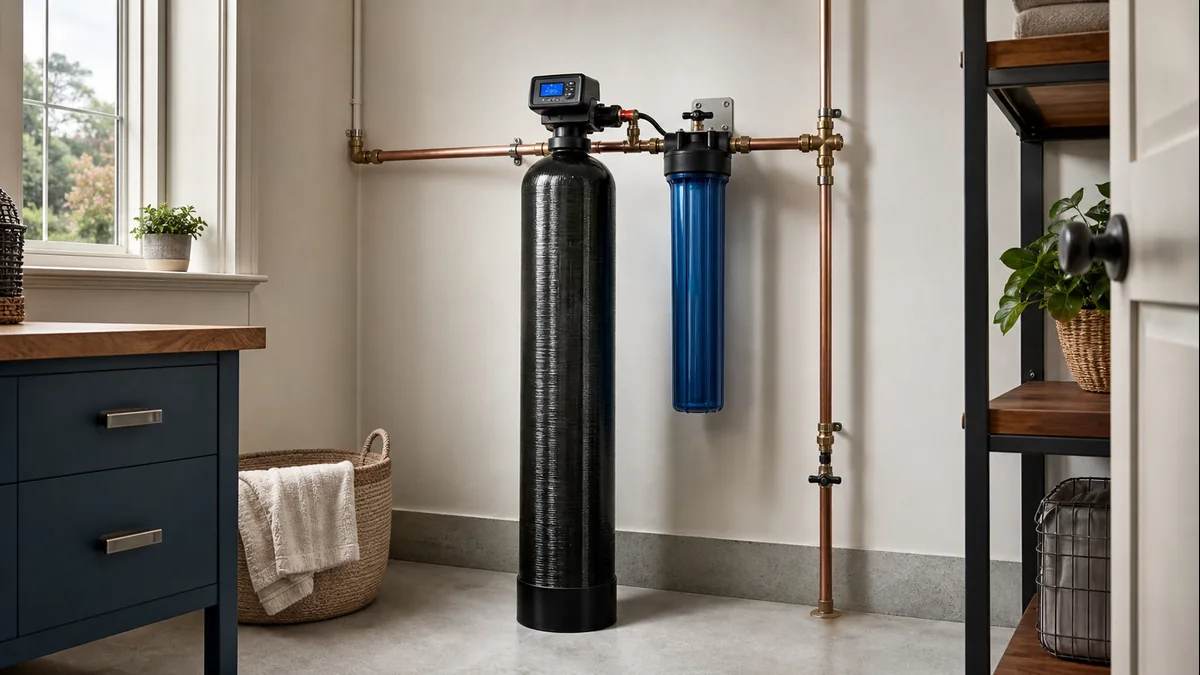
Direct answer: An under-sink filter treats one cold line at the kitchen faucet — nothing else. Our own testing measures hardness at 1.6–3.7 gpg by ZIP, moderately hard at the top, and that scale still builds inside your water heater, dishwasher, and shower even with a spotless drinking glass. A whole-home all-in-one system treats every line, with an under-sink RO unit as an add-on for the strictest drinking-water polish.
What's the real difference between an under-sink filter and a whole-house filter for a Cary home?
An under-sink filter — carbon, sometimes paired with reverse osmosis — mounts under one cabinet and taps into the cold-water line feeding that single faucet, almost always the kitchen. A whole-house system installs at the main line where water enters the home, before it splits off to every bathroom, the laundry room, the water heater, and outdoor spigots.
Location decides coverage — one faucet versus the entire plumbing system. For a Cary home, that split lines up with two separate water problems, one mineral and one dissolved, that the town's own numbers make unusually clear-cut.
Why does Cary's hardness make this a bigger deal than it is elsewhere in the Triangle?
Triangle Waterworks' own testing measures hardness across the service area at 1.6 to 3.7 grains per gallon (gpg) by ZIP code, on the Water Quality Association scale the Hach Total Hardness Test Kit, Model 5-B, reads out in. Raleigh sits near the low end of that range, at roughly 1.6 gpg — slightly hard.
The Town of Cary's own Public Works FAQ publishes finished-water hardness of 25–30 ppm, or roughly 1.5–1.75 gpg, which the Town calls very soft. Both figures are accurate and neither contradicts the other — the Town reports an average for water leaving the plant on a USGS-style scale, while we classify what we measure at the tap on the WQA scale, where 1.0–3.5 gpg is slightly hard and 3.5–7.0 is moderately hard.
That's why the number that matters is the one from your own address, not a townwide average.
Cary, Apex, and Morrisville share the Jordan Lake supply and run toward the top of that same range, up to 3.7 gpg, which crosses into moderately hard territory on the WQA/Hach scale (the moderately hard band starts at 3.5 gpg). That's the strongest measured hardness case anywhere in the service area — and it's a mineral issue, not a dissolved-chemical one, so no amount of carbon filtration under a sink changes it.
What does an under-sink filter never reach in a Cary house?
Everything past the kitchen. An under-sink unit sits on one cold line, so every gallon that reaches your water heater, dishwasher, washing machine, and shower arrives exactly as it left the meter — with whatever hardness your ZIP measures, untouched.
Over years, that calcium and magnesium plates out inside the water heater tank, works into the film on shower glass, and shows up as spotting on dishes — none of it reachable from a cartridge installed nowhere near those lines:
- Water heater — scale accumulates inside the tank whether or not your kitchen tap is filtered, since the heater draws from a separate line entirely.
- Dishwasher and washer — same untreated hard water in, same mineral spotting on glassware and stiffness in laundry.
- Shower and skin — soap and shampoo don't lather the same in hard water, and a filtered kitchen tap has zero bearing on the bathroom.
- Drinking tap — this is the one place an under-sink unit actually helps, and it does that job well.
What's actually in Cary's water that needs treating beyond hardness?
Cary, Apex, and Morrisville draw from B. Everett Jordan Lake through the jointly owned Cary/Apex Water Treatment Facility, where powdered activated carbon, ozonation, and sand-and-carbon filtration run ahead of a chlorine-and-ammonia residual added in the clearwell to form chloramines. Once a year the towns switch to free chlorine only, on NC DEQ's recommendation, to flush the distribution system, and chlorine residual runs higher system-wide during that window.
The Cary/Apex plant's own 2024 water quality report shows total trihalomethanes (TTHM) averaging 41 parts per billion and ranging as high as 53, and haloacetic acids (HAA5) at 19 ppb — both legally compliant with EPA's limits. EWG's Tap Water Database separately flags Cary's tested water on 13 contaminants above its stricter, non-regulatory health guidelines, including HAA9 at 27.5 ppb, TTHM at 38.2 ppb, PFOA at 2.86 parts per trillion, and PFOS at 3.79 ppt.
HAA9 is EWG's own broader nine-compound sum and carries no EPA limit to be compliant with — only TTHM and HAA5 are federally regulated.
EPA's National Primary Drinking Water Regulations table lists TTHM's potential health effect from long-term exposure above the MCL as "liver, kidney or central nervous system problems; increased risk of cancer," and HAA5's as "increased risk of cancer." Legally compliant is a ceiling EPA itself set based on its own risk tolerance, not a guarantee of zero exposure — a carbon stage removes these compounds at the source instead of relying on staying under a legal limit.
Jordan Lake's PFAS history is documented, not disputed. Duke University researchers found "the collection of related fluorinated compounds added up to a concentration of 100 to 200 parts per trillion in Jordan Lake" in untreated source water, with PFOA and PFOS combined at 27 ppt.
After treatment, Cary's own testing at the time found PFOA at 5.6 ppt with PFOS undetectable — Cary's water systems manager, Alexandra Jones, put it plainly: "It does seem we were able to remove some of these compounds. Others, not so much." Carbon certified for PFAS reduction (NSF/ANSI 53 or P473) or reverse osmosis (NSF/ANSI 58) are the two methods proven to work; boiling does not remove PFAS and can concentrate it as water evaporates.
Under-sink filter vs. under-sink RO vs. whole-home all-in-one — where each one actually reaches
| What it treats | Under-sink filter | Under-sink RO | Whole-home all-in-one |
|---|---|---|---|
| Hardness / scale | No | No | Yes — softening resin |
| Chlorine/chloramine taste | Kitchen tap only | Kitchen tap only | Every tap |
| DBPs (HAA9, TTHM) | Kitchen tap only | Kitchen tap only | Every tap |
| PFAS | Only if carbon is certified NSF/ANSI 53 or P473 | Yes — NSF/ANSI 58 | Yes, when the carbon stage is PFAS-certified |
| Shower & skin | Not reached | Not reached | Reached |
| Laundry | Not reached | Not reached | Reached |
| Water heater | Not reached | Not reached | Protected from scale buildup |
| Drinking tap | Yes | Yes — most thorough polish | Yes, and a dedicated drinking-water tap can still be added |
Should I add an under-sink RO unit on top of a whole-home system?
Yes — as an addition, not a substitute. A whole-home all-in-one system is the foundation for a Cary house: softening resin protects the water heater, dishwasher, and plumbing from scale, while a carbon stage handles chlorine, chloramine, and disinfection byproducts at every tap in the house.
An under-sink RO unit stacked on top adds a second, more thorough pass specifically for the water you drink and cook with, using NSF/ANSI 58-rated membrane filtration the whole-home carbon stage alone doesn't provide. Running both means the entire house is covered and the kitchen tap still gets an extra layer of polish.
National big-brand whole-home systems commonly run $6,000 to $12,000. Triangle Waterworks prices a system only after a free water analysis confirms your address's hardness and what the carbon stage needs to handle.
Ready to see what your Cary address actually needs?
Your hardness number and your contaminant profile are specific to your address, not a townwide average — Cary's own range runs from slightly hard to moderately hard depending on your ZIP. Take the 60-second water quiz to see which all-in-one system covers your Cary home end to end. The fix is a free water analysis away, not a guess.
FAQ
I just moved to Cary and my old apartment had an under-sink filter — is that enough here? It covers your drinking and cooking water at that one tap, but Cary's hardness runs 1.6–3.7 gpg by ZIP and Cary sits toward the top of that range. An under-sink filter does nothing about the scale building in your new water heater, dishwasher, or shower — a whole-home all-in-one system covers the parts of the house an under-sink unit was never installed to reach.
My glasses come out of the dishwasher spotty even though I have an RO filter under my kitchen sink — why? An RO filter only treats water at the faucet it's plumbed into, and a dishwasher draws from a completely separate line that never passes through it. The spotting is mineral residue from hard water — Cary runs up to 3.7 gpg — drying on the glass, which only a whole-home system with softening resin addresses because it treats water before it splits off to the dishwasher.
Does an under-sink filter remove PFAS from Cary's water? Only if it's specifically certified for PFAS reduction under NSF/ANSI 53 or P473, or if it's a reverse osmosis unit rated to NSF/ANSI 58 — a basic carbon cartridge without that certification isn't reliably rated for it. Cary's PFOA and PFOS levels trace back to Jordan Lake's documented PFAS history, so the certification on the box matters more than the marketing.
Do I need a whole-home system if I already have a standalone water softener? A standalone softener handles hardness through ion exchange but does nothing about chlorine, chloramine, or disinfection byproducts — that's carbon's job, not resin's. If your softener isn't paired with a carbon stage, you're still getting Cary's chloramine taste and DBPs at every tap; adding carbon filtration alongside it, or upgrading to an all-in-one unit, closes that gap.
I'm renovating my Cary kitchen and can only fit one under-sink unit — carbon or RO? If drinking-water quality at that one tap is your priority, RO is the more thorough option, since NSF/ANSI 58 membrane filtration reaches more than carbon alone, including PFAS. Either way, that single under-sink unit still won't touch your water heater, shower, or laundry — the hardness and house-wide chlorine question still needs a whole-home system regardless of which under-sink unit you pick.
Is a whole-home system overkill if drinking water is genuinely my only concern? An under-sink RO unit alone is a reasonable starting point for drinking water specifically. But Cary's hardness reaches moderately hard at the top of its range, and that scale accumulates in your water heater and on fixtures throughout the house no matter what's filtered at the kitchen tap — most Cary homeowners end up addressing both once they see what's actually building up behind the walls.
Sources
- Town of Apex — Water Quality / Annual Drinking Water Quality Report
- EPA — National Primary Drinking Water Regulations
- WRAL — Elevated levels of perfluorinated chemicals found in Cary drinking water
Related reading: Water Softener Cary, NC | Whole-House Water Filter in Cary, NC | Best Whole-House Filter for City Water | Whole-House Filter vs. Reverse Osmosis | Carbon Filter vs. Reverse Osmosis
Answer nine practical questions, then request a written quote or well-water analysis.
Start My Water Analysis