
Do Old Water Pipes in Wake County Mean I Need a Whole-House Filter?
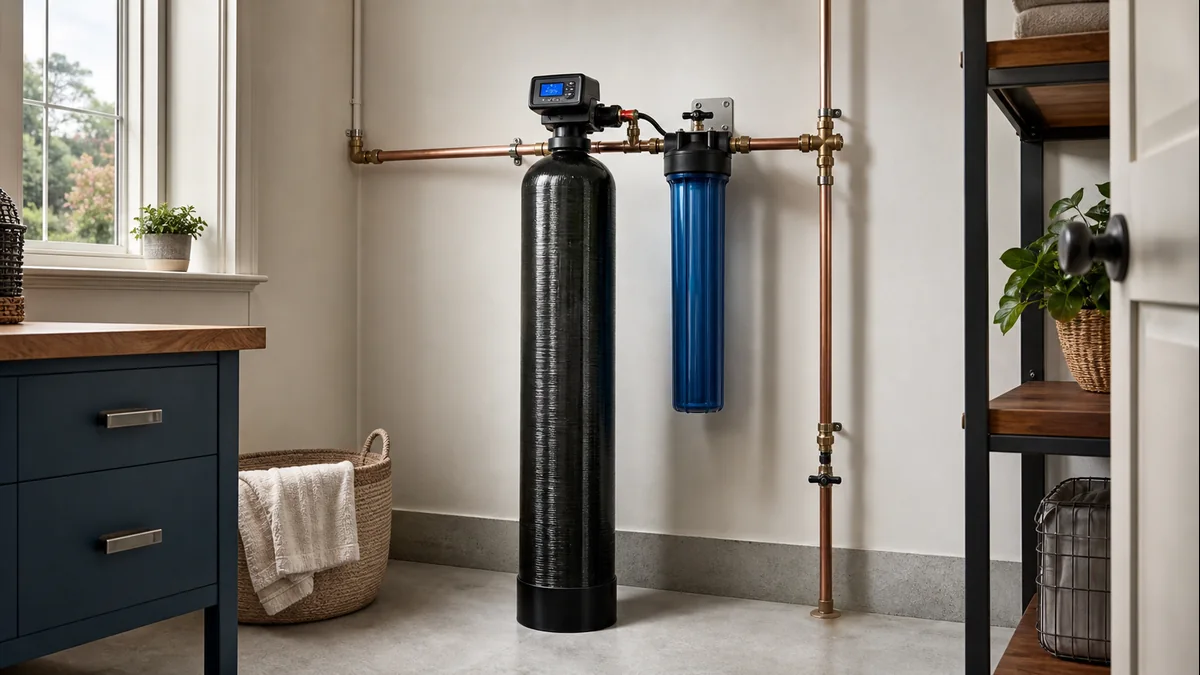
Direct answer: Every Wake County utility stops owning the pipe at your meter — past that, the service line and every pipe inside your house, whether decades-old copper inside the Beltline or brand-new PEX in a subdivision, is yours alone, untested by anyone. A whole-home system installed at that point is the only equipment sitting downstream of all of it. The fix is a free water analysis away.
Do old water pipes in Wake County actually mean I need a whole-house filter?
Age isn't really the deciding factor — ownership is. Whatever utility serves your Wake County address treats and tests the water up to a fixed point, and everything past that point is private property nobody but you maintains or checks. That's true whether your house was built in 1965 or 2025.
A whole-home filter earns its place not because your specific pipe is old, but because it's the only device installed downstream of the entire stretch of plumbing the utility doesn't touch. That's a structural fact about how water delivery works, not a claim about your particular pipes.
Where does the utility's responsibility for my water actually end?
At the meter, in most cases — sometimes at the property line or a curb stop just before it. Water utilities nationwide draw this line consistently: the utility owns and maintains the main under the street and, typically, the meter itself.
Everything from that point into the house — the service line and all interior plumbing — belongs to the property owner. Denver Water's own homeowner-responsibility page lays out this exact split, and it's the standard framework water systems operate under, Wake County's included.
That boundary isn't a technicality. It's the line between water someone is legally required to test and treat, and water nobody is required to check at all.
What's the difference between the water main, the service line, and my house's own plumbing?
Three separate segments, three separate parties responsible for them. The main is the utility's pipe running under the street, tested and maintained as part of the public system. The service line runs from that main to your house, and past the meter it's yours. Everything inside your walls — copper, galvanized steel, or PEX, depending on when the house was built — is entirely your plumbing, installed by whoever built or last repiped the house.
Delivery path: who owns it, who tests it
| Segment | Who owns it | Who tests it | Does a whole-home filter reach it? |
|---|---|---|---|
| Water main (under the street) | The utility | The utility, continuously | No — treatment already happened upstream |
| Service line (meter to house) | You | Nobody, routinely | No — sits upstream of the filter's install point |
| Point of entry (where the system installs) | You | The filter treats from here forward | Yes — this is the install point |
| Interior plumbing (inside the house) | You | Nobody, routinely | Yes — every fixture downstream of installation |
Does a newer subdivision home have the same issue as an older inside-the-Beltline house?
Yes, in the sense that matters here. A 2024 subdivision home in Wake Forest or Fuquay-Varina has the exact same ownership boundary as a 1960s house near downtown Raleigh — the utility's responsibility still stops at the meter, and the service line and interior plumbing are still entirely private, untested property regardless of how recently they were installed.
What differs is the pipe material, not who's responsible for it. Newer construction typically runs PEX rather than older copper or galvanized steel, and PEX doesn't scale or corrode the way older metal pipe can — see what a fresh subdivision build needs from a water system for how that plays out.
But "newer material" isn't the same claim as "someone is testing it" — nobody routinely checks water quality inside either kind of house, new or old. For the older side of that comparison, here's how an established Zebulon home with older pipe handles the same question.
Why can't the utility just test the water at my tap instead of the plant?
Because the utility's Consumer Confidence Report measures water at the treatment plant and at points within its own distribution system — the parts it owns and is legally required to monitor. It has no authority over, and no visibility into, what happens once water crosses into a private service line and a homeowner's own plumbing.
That's not a gap in the utility doing its job; it's outside the boundary of what a utility's job even covers. A perfectly compliant treatment report says nothing about the private stretch of pipe between the meter and your faucet, because nobody requires anyone to test it.
Where does a whole-home system actually go, and why does that placement matter?
At the point of entry — as close as practical to where the main line enters the house, before it branches off to individual fixtures. That placement is what makes a whole-home system fundamentally different from a filter at one faucet or a fridge line: it sits downstream of your entire private service line and treats everything before it reaches a single tap, appliance, or the water heater.
Because it installs at your point of entry rather than at the utility's plant, it's the only piece of equipment in the entire delivery path that's actually under your control. Everything upstream of it belongs to someone else's system; everything downstream is yours to treat — see how that compares to a point-of-use filter if you're weighing the two.
What does licensed installation have to do with any of this?
North Carolina law treats this as real plumbing work, not a DIY appliance swap. N.C. Gen. Stat. § 87-21 defines plumbing contracting to include installation and replacement of "whole-house water purification or treatment systems" — the same statute governing the pipe itself.
That's a meaningful signal: the system has to tie into your private plumbing correctly, by someone licensed to work on it, which raises the same permitting question that comes up across Wake County.
How do I find out what my own service line and plumbing are adding to the water?
A free water analysis, tested at your actual tap rather than inferred from a utility's plant-average report. That's the only way to see the combined picture — what the utility delivered plus whatever your own service line and house plumbing contributed on the way to your faucet.
Since nobody else is required to check that stretch of pipe, an address-level test is the only source for it. Take the 60-second water quiz to see how a point-of-entry system fits a home on your specific service line, or book a free water analysis directly.
FAQ
I live in an older neighborhood inside the Beltline and I'm not sure what my service line is made of — do I need to find that out before getting a filter? No — a whole-home system's case doesn't depend on knowing your exact pipe material or age. It installs at your point of entry and treats everything downstream regardless of what the service line feeding that point is made of, so it works the same way whether or not you can identify the material.
My house was built in 2023 in a new subdivision — does any of this apply to me, or is it only an old-house issue? It applies to you too. The utility's ownership still stops at your meter no matter how new the house is, so your service line and interior plumbing are just as untested and just as private as an older home's — a whole-home system covers that same gap.
If the utility's water tests perfectly clean, why would I need anything at all? Because that clean test result describes water at the plant and within the utility's own distribution system — it says nothing about your private service line or the plumbing inside your house, since neither is something the utility is required to test. A point-of-entry system treats the water at the one point you actually control.
Is a whole-house filter the same thing as a filter on my fridge or a pitcher I already use? No — a fridge or pitcher filter treats water at one point after it has already traveled through your entire private service line and house plumbing. A whole-home system sits at the point of entry, before any of that private plumbing, so it treats every fixture rather than one glass.
Can I install a whole-home filtration system myself since it's just attaching to a pipe? It's licensed plumbing work in North Carolina — N.C. Gen. Stat. § 87-21 specifically includes whole-house water purification and treatment systems in its definition of plumbing contracting. A licensed installer ties it into your service line and interior plumbing correctly rather than treating it as a simple appliance hookup.
Does a whole-home system fix problems that already exist somewhere in my house's plumbing? It treats water going forward from its install point rather than repairing the plumbing itself. Since it sits downstream of your entire private service line and house plumbing, everything reaching your fixtures from that point on is treated — but the physical condition of the pipe itself is a separate question from a licensed plumber.
Sources
Answer nine practical questions, then request a written quote or well-water analysis.
Start My Water Analysis