
New Construction Homes in Wake County: Water Treatment Guide
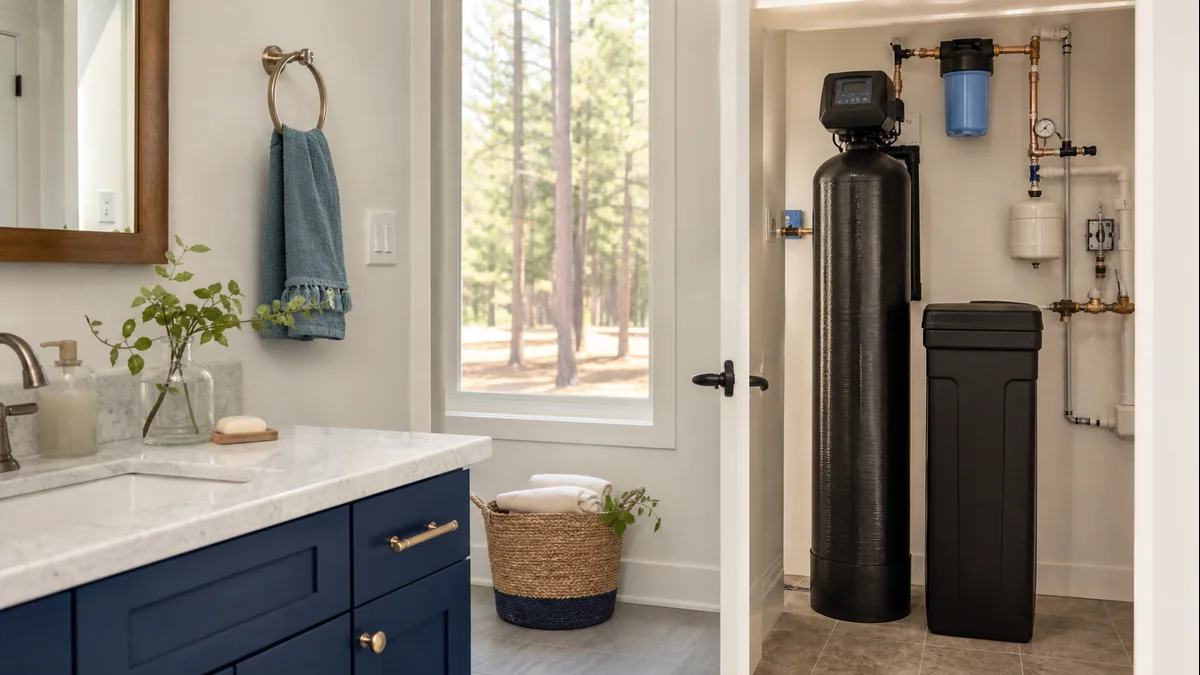
Direct answer: A new Wake County home sits on one of two very different municipal systems — Raleigh Water or the Cary/Apex system — or, outside those service boundaries, on a private well. Each delivers different water. What's constant is that mineral deposits and disinfectant residual start acting on a brand-new house from day one, and an all-in-one softening plus carbon system installed early protects the full service life of every appliance.
Which water system serves my new Wake County home?
That depends on where in the county you built, and it changes the answer to almost every other question.
| Serving system | Towns / areas | Source | What it means for treatment |
|---|---|---|---|
| Raleigh Water | Raleigh, Garner, Knightdale, Rolesville, Wake Forest, Wendell, Zebulon | Municipal supply, chloramine residual | ~1.6 gpg, slightly hard (WQA scale); TTHM 21.7 ppb, HAA9 19.9 ppb (EWG listing) |
| Cary/Apex Water Treatment Facility | Cary, Apex, Morrisville, RDU, RTP South | B. Everett Jordan Lake | Higher disinfection byproducts; Apex 2024 report TTHM 41 ppb, ranging to 53 |
| Private well | Rural Wake County outside utility boundaries | Groundwater on your property | Unregulated after construction; sizing requires a well-specific analysis |
About 15% of Wake County homes are on private wells, with the share higher in neighboring Johnston, Franklin, Chatham and Granville counties. That matters for a new build on the rural fringe: North Carolina does not regulate private well water after the well is constructed, so nobody is testing it on your behalf and no annual report will arrive in the mail.
What's actually in Wake County municipal water?
Two categories, and they call for two different pieces of equipment.
Hardness minerals. Raleigh Water runs about 1.6 grains per gallon, which is slightly hard on the WQA scale — the same one the Hach Total Hardness Test Kit (Model 5-B) uses. Our own testing across the Triangle measures 1.6 to 3.7 grains per gallon depending on the address — slightly hard at the bottom of that range, and moderately hard at the top, since 3.7 gpg is roughly 63 mg/L, just over the WQA scale's 60 mg/L line between slightly hard and moderately hard. On the Cary/Apex side, the towns publish plant averages that are lower (Cary 25–30 ppm; Apex 33.3 ppm, or 1.9 gpg), which describe finished water leaving the plant rather than what reaches an individual tap.
Disinfectant and its byproducts. Both systems carry a residual disinfectant to the tap by design. The Cary/Apex plant forms chloramine by dosing chlorine and ammonia separately in the clearwell; Raleigh Water likewise runs chloramine most of the year and converts to free chlorine annually while flushing the distribution system. Disinfection byproducts follow: HAA9 19.9 ppb and TTHM 21.7 ppb in Raleigh's EWG listing, and TTHM 41 ppb, ranging up to 53, with HAA5 at 19 ppb in Apex's own 2024 report for the shared Cary/Apex system. All of it is compliant with EPA limits. Activated carbon is what removes disinfection byproducts and disinfectant taste from the water inside your house.
Why does a brand-new home need this at all?
Because "new" describes the plumbing, not the water. Every fixture, appliance and length of pipe in a new Wake County build is at the start of its service life, and the deposits that shorten that life accumulate gradually from the first gallon:
- The water heater collects scale on the tank bottom and heating surfaces — the most expensive appliance in the house to replace early and the one that shows the least warning.
- Dishwashers and washing machines run thousands of cycles across the years you own the home, every one of them carrying dissolved minerals through the internal plumbing.
- Glass shower enclosures and glassware accumulate soap scum and mineral film, which is what forms when soap reacts with calcium and magnesium instead of lathering.
- Faucet aerators and shower heads develop deposits that visibly distort spray patterns long before anything fails.
Low-hardness water is not mineral-free water. That distinction is the entire case for treating a new home: at 1.6 to 3.7 grains per gallon nothing goes wrong in month one, and something measurable has changed by year ten.
When is the best time to install in a new build?
As early as the water service allows, for three practical reasons: the plumbing is the most accessible it will ever be, the garage or mechanical space is empty, and no appliance has yet spent part of its service life running untreated water. Many Wake County builders rough in a softener loop — worth asking about, because it simplifies the install — but a loop is only pipework. Water flows straight past it until equipment is connected.
The one thing that shouldn't be skipped even in a new build is the test. A builder's plan tells you where the loop is; it doesn't tell you your hardness, and the range across this county is wide enough that the difference matters for sizing.
What does it cost for a new Wake County home?
Locally installed all-in-one systems are sized and priced after a free water analysis, well under what national big-brand installers commonly quote ($6,000 to $12,000) for comparable whole-home coverage. For a new build on a private well, systems are configured differently — iron removal plus carbon and resin stages — and priced the same way, once a well-specific analysis establishes what's actually in the groundwater.
Running cost is a genuine local advantage on the municipal side: starting from hardness this low, a softener regenerates infrequently and uses very little salt. See water softener salt cost per year for the arithmetic.
Get your new build tested
On city water, take our 60-second water quiz to see which all-in-one system fits your new Wake County home. On a private well, book the free water analysis first — with no utility report to fall back on, the test is the only source of truth about what your groundwater actually contains.
Frequently Asked Questions
I'm building in Wake County but outside town limits — how do I know if I'll be on a well? Your builder or the county permitting record will tell you whether the lot is served by a municipal main or requires a well. It's worth confirming early, because a well changes both the treatment configuration and the fact that no one will be testing the water for you afterward.
My new home is in Wake Forest — is that Raleigh's water? Yes. Wake Forest is on the Raleigh Water system, along with Garner, Knightdale, Rolesville, Wendell and Zebulon, so the figures for Raleigh's system are the ones that describe your supply. Hardness at your specific tap still varies, which is what the analysis measures.
Do new subdivisions have better water than older parts of the county? The water arriving at the property line is the same municipal supply regardless of when the subdivision was built. What's different is your side of the meter: a new home's plumbing and appliances haven't accumulated anything yet, which is precisely why installing early captures the most protection.
Can I wait a year or two and see whether I notice a problem? You can, and the trade-off is worth naming clearly: the deposits you'd be waiting to notice are the ones already forming inside the water heater, where you can't see them. Installing while everything is new is the version of this decision that protects the most for the same price.
Does Wake County test private well water for new construction? Wells are tested at construction, but North Carolina does not regulate private well water after that point — there's no ongoing requirement and no annual report. Ongoing testing is the owner's responsibility, which is why a free water analysis is the right first step for any new well home.
Related reading: City Water vs. Well Water Treatment in NC | New Construction Water Softener in Raleigh, NC | Water Treatment in Wake Forest, NC | All-in-One Water System Cost in NC
Answer nine practical questions, then request a written quote or well-water analysis.
Start My Water Analysis