
Older Home in Wake Forest's Historic District? What to Know About Your Water
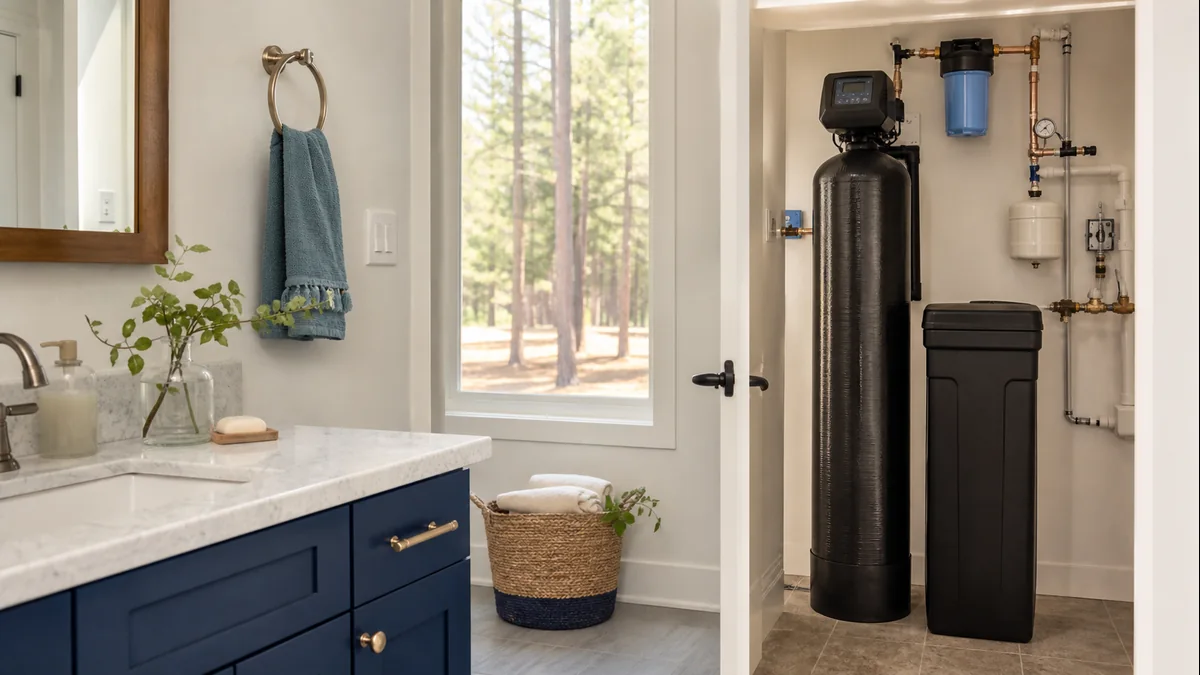
Direct answer: Your water is the same Raleigh Water supply as every other Wake Forest address — slightly hard on the Water Quality Association (WQA) scale, around 1.6 grains per gallon. What's different in the Historic District is your home's own plumbing and fixtures, which in many cases have been carrying that water for decades longer than a newer build. Mineral buildup is cumulative, so the longer a pipe or water heater has been in service, the more it's had a chance to accumulate — and low hardness alone says nothing about chlorine, chloramine, or disinfection byproducts. An all-in-one softening and carbon system protects what's left of an older home's plumbing going forward and improves the water coming out of every tap.
Is the Water in Wake Forest's Historic District Different From the Rest of Town?
No. Wake Forest doesn't operate its own water plant — the entire town, including every address in the National Register district, is supplied by Raleigh Water, which tests around 1.6 gpg. That places it in the "slightly hard" tier on the Water Quality Association (WQA) hardness scale — the same one the Hach Total Hardness Test Kit uses — and it's the identical water reaching a brand-new build on the edge of town and a 1920s home a block off North Main Street. There's no separate pipe, source, or treatment process for older neighborhoods. What actually matters isn't the water — it's how long a given home's own plumbing has been in service.
Why Would an Older Home Need Treatment If Wake Forest's Water Is Slightly Hard?
Because "slightly hard" describes a concentration, not an absence. Raleigh Water's roughly 1.6 gpg hardness means calcium and magnesium are present at a low level — not zero. Every gallon passing through a fixture, water heater, or supply line leaves behind a trace of mineral. A single day of that is negligible. Multiply it across years, and in some homes across generations, and the deposit adds up. A home whose plumbing and fixtures have been in continuous service the longest has simply had the most time for that accumulation to occur — independent of how low the hardness reading is at the tap. That's why the age of the home, not the water source, is the relevant variable here.
What Is Wake Forest's Historic District, and Why Does the Age of the Home Matter?
Wake Forest's Historic District was listed on the National Register of Historic Places on December 18, 2003, with a period of significance spanning roughly 1820 to 1953. The oldest structure in the district is the Calvin Jones House, built in 1820 and now home to the Wake Forest Historical Museum — the same Dr. Calvin Jones on whose former plantation Wake Forest College was established in 1834. North Main Street, once known as Faculty Avenue, is the town's earliest residential avenue, with homes spanning architectural styles from the 1820s through the 1950s.
That range of construction dates means the district's housing stock spans well over a century of plumbing generations, fixture types, and water heater replacements. We can't say what's inside the walls of any individual home without an inspection — that's a question for a licensed plumber, not something a water quality article can answer generically. What we can say is that a home built or plumbed decades ago has had that much more time for the same mineral process to run its course, and protecting whatever plumbing and fixtures are currently in place is a forward-looking decision, not a diagnosis of what's already there.
Does Slightly Hard Water Mean an Old Home's Plumbing Is Safe From Buildup?
Not automatically, and this is the point most homeowners miss. Slightly hard water slows the rate of mineral accumulation compared to a harder supply, but it doesn't stop it. Inside a water heater, scale layers on the heating element and tank walls year after year regardless of whether the incoming water measures 1.6 gpg or 8 gpg — it's simply a slower process at the low end of the scale. For a home whose water heater, fixtures, and supply lines have been in service for years or decades, that slower process has still had a long runway. A softening stage installed now doesn't undo prior exposure, but it does stop the clock on whatever plumbing and appliances are currently in the home — new or old.
What About Chlorine, Chloramine, and the Annual Conversion?
This is where hardness stops being the relevant measure. Raleigh Water disinfects with chloramine under normal operation, which the City describes as carrying no associated taste or odor. Once a year, on the recommendation of the N.C. Department of Environmental Quality, Raleigh Water switches to free chlorine only and flushes the distribution system to speed the changeover — a period when chlorine residual runs higher than usual and some temporary discoloration can occur during flushing. This has historically run from the last week of February through the first week of April; exact dates shift year to year, so check Raleigh Water's own announcement at raleighnc.gov for the current schedule.
Raleigh Water also carries documented disinfection byproducts — HAA9 at 19.9 ppb and TTHM at 21.7 ppb — both legally compliant with EPA limits but above the Environmental Working Group's stricter, non-regulatory health guideline. None of this has anything to do with how old a home's plumbing is or where the water falls on the hardness scale. It's a separate exposure that a softener does nothing about — softening resin is ion exchange for calcium and magnesium only. Removing chlorine taste and disinfection byproducts requires an activated carbon stage, which is why an all-in-one system pairs both rather than asking either technology to do the other's job.
Softening Alone vs. Carbon Alone vs. an All-In-One System for an Older Home
| Concern | Softening alone | Carbon filtration alone | All-in-one system |
|---|---|---|---|
| Protects remaining plumbing/fixtures from further mineral buildup | Yes | No | Yes |
| Reduces chlorine/chloramine taste and odor | No | Yes | Yes |
| Addresses documented HAA9/TTHM disinfection byproducts | No | Yes | Yes |
| Runs efficiently on Wake Forest's low-hardness ~1.6 gpg water | Yes (low salt use) | N/A | Yes |
| Relevant to any home in the district, regardless of construction decade | Yes | Yes | Yes |
| One system, one installed footprint | No | No | Yes |
An older home in the district isn't dealing with a different water supply than a newer one — it's carrying decades more history in its own plumbing while facing the exact same chlorine and byproduct profile every other Wake Forest address does. Covering only one side of that leaves a real gap either way.
What Does a Whole-Home System Cost for a Historic District Home?
Pricing for a whole-home system on Wake Forest's Raleigh Water supply is sized to household size after a free water analysis — the same approach across the Raleigh Water service area, since the water being treated is identical regardless of a home's age. National big-brand whole-home quotes commonly run $6,000–$12,000 for a comparable setup. See our full Wake Forest water treatment guide for how that pricing breaks down.
Frequently Asked Questions
I bought a 1920s home near North Main Street — is my water different from the rest of Wake Forest? No — every address in Wake Forest, including the Historic District, is on the same Raleigh Water supply, tested at roughly 1.6 gpg. What's different about a 1920s home is the plumbing and fixtures inside it, which have simply been in service far longer than a newer build's. That age is a reason to protect what's currently installed going forward, not a sign the water itself is treated any differently.
Our house is in the Historic District and dates to the 1800s — does that mean our plumbing is contaminating the water? We can't answer that generically, and any article that guessed at your home's specific pipe materials would be making it up. What's inside your walls is a question for a licensed plumber or a home inspection, not something tied to the neighborhood's historic designation. What we can say confidently is that Raleigh Water itself is legally compliant with EPA standards, and a whole-home system addresses what's coming out of the tap — mineral buildup and disinfection byproducts — regardless of what's in your specific supply lines.
I just moved into a renovated historic home in Wake Forest with all-new plumbing — do I still need a softener? Yes, and the logic doesn't change even with new pipes and fixtures. The water itself still carries roughly 1.6 gpg of calcium and magnesium, and that mineral content starts accumulating from the first day a new water heater or dishwasher goes into service. Treating it now protects a fresh investment for its full lifespan instead of letting the same slow buildup start over in brand-new equipment.
Is Raleigh Water actually hard on old pipes? Raleigh Water tests slightly hard, around 1.6 gpg on the WQA scale, which is a mild mineral load compared to many parts of the country. The concern for an older home isn't that the water is unusually hard — it's that any measurable mineral content, run through the same fixtures and appliances for years or decades, adds up. That's a cumulative-exposure argument, not a hardness-classification one.
Does the Historic District get any special treatment during Raleigh Water's annual chlorine conversion? No — the annual switch to free chlorine, which Raleigh Water runs once a year on NCDEQ's recommendation with a system-wide flush, applies uniformly across the entire service area, historic homes included. There's no separate schedule or process for any neighborhood. Check raleighnc.gov for the current year's exact dates, since they shift annually.
Will a whole-home system work with an older home's layout or a single point of entry? Yes. Whole-home systems install at the main water line entering the house, which every home has regardless of construction decade or layout. An installer confirms the specific setup during the visit, but the point-of-entry install itself isn't affected by a home's age.
See What Your Home Actually Needs
Every home in Wake Forest's Historic District draws from the same Raleigh Water supply, but the plumbing carrying it into your fixtures has its own history. Take our 60-second water quiz to see what an all-in-one softening and carbon system would look like for your specific home — protecting what's currently installed while handling the chlorine, chloramine, and disinfection byproducts that low hardness alone never addresses.
Related reading: Water Treatment in Wake Forest, NC | Water Heater Scale Buildup Prevention | Does Hard Water Really Damage Appliances and Cost You Money? | Benefits of Soft Water in the Home
Answer nine practical questions, then request a written quote or well-water analysis.
Start My Water Analysis