
Why Mineral Buildup From Hard Water Keeps Damaging Your Washing Machine in Wake County, NC
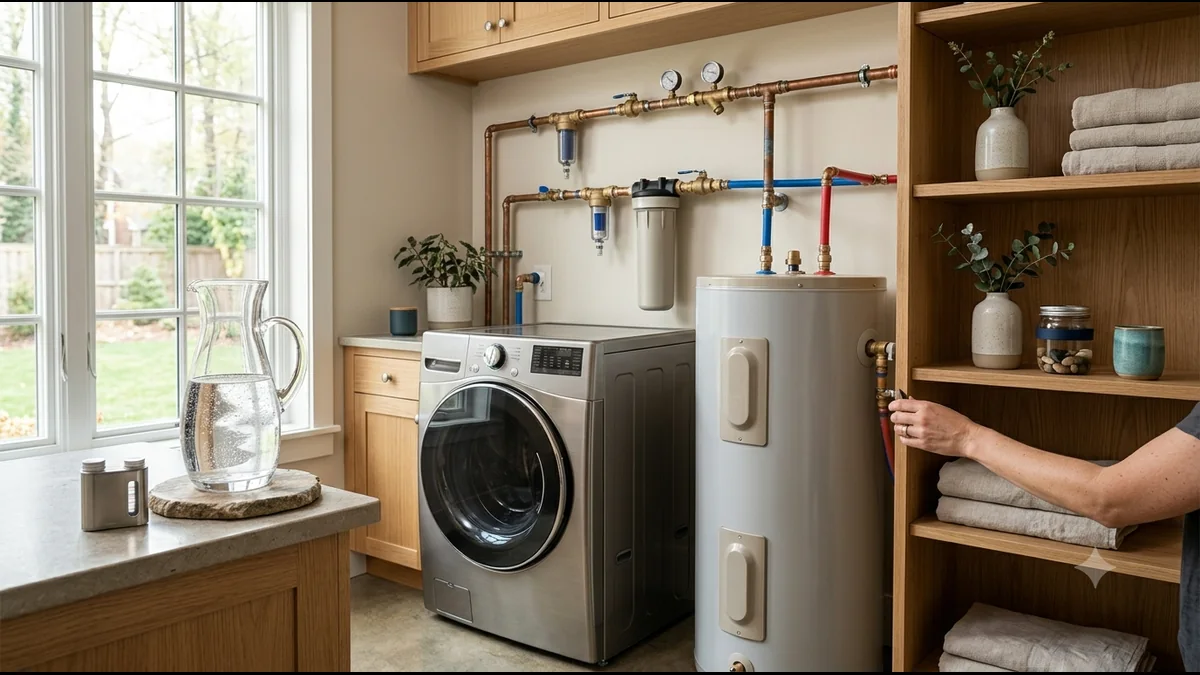
Direct answer: Dissolved calcium and magnesium leave a hardened residue inside a washing machine's detergent and fabric-softener dispenser, its internal passages, the inlet valve screens, the hoses, the drum, and — in machines that heat water — the heating element, which shows up as a dispenser that won't fully empty, crusty white deposits, longer cycle times, and reduced washing efficiency. Cleaning the dispenser and running a vinegar or machine-cleaner cycle dissolves what's already there, but only a whole-home system that softens the water before it reaches the machine, paired with a carbon stage, stops new deposits from forming in the first place.
Why Is Crusty White Residue Building Up in My Washing Machine's Detergent Dispenser?
The detergent and fabric-softener dispenser is usually the first place mineral buildup becomes visible because water sits and flows through its small compartments and channels on every load. Calcium and magnesium dissolved in the water don't wash away completely when the dispenser drains — a thin residue is left behind on the plastic, and each subsequent cycle adds another layer. Over time that residue hardens into a chalky crust that narrows the drain holes and siphon channels the dispenser relies on to empty completely. Once those passages are partly blocked, detergent or softener can sit in the compartment instead of releasing at the right point in the cycle, which is why some loads come out with a strong detergent smell but visibly less-clean results, or a softener compartment still holding liquid after the cycle ends.
Why Does My Washing Machine Take Longer to Fill, Heat, or Finish a Cycle Than It Used To?
A machine that's slowly taking longer to run is often fighting mineral scale that has narrowed the inlet valve screens, the fill hoses, or — in machines with a heating element — coated the element itself. The small mesh screens at the water inlet valves catch debris, but scale builds on that mesh the same way it builds on a faucet aerator, gradually restricting how much water reaches the drum per minute. If the machine heats its own water, calcium and magnesium behave the same way they do inside a water heater tank: they bake onto the element's surface, insulating it so the same energy input takes longer to reach temperature. Neither of these is a sign of mechanical failure by itself — it's the same mineral-carrying water passing through the same narrow points, cycle after cycle, leaving a little more behind each time.
Is This Really From Wake County's Water, or Is My Machine Just Getting Old?
It can be both, but the water is doing real work in the background regardless of the machine's age. Wake County isn't served by one water system — Raleigh Water supplies Raleigh, Garner, Knightdale, Rolesville, Wake Forest, Wendell, and Zebulon; a separate Cary/Apex system draws from Jordan Lake and serves Cary, Apex, and Morrisville; smaller town systems cover other parts of the county; and roughly 15% of Wake County homes are on private wells. Each source runs its own hardness level, so there isn't one county-wide number that applies to every address.
Our own testing across the service area measures 1.6 to 3.7 grains per gallon (gpg) depending on where the address sits. On the Water Quality Association scale the Hach test kit uses, 1.6 gpg is slightly hard and 3.7 gpg — about 63 mg/L — is moderately hard, so the measured range runs slightly hard to moderately hard by ZIP code. Raleigh Water measures about 1.6 gpg, slightly hard on that scale. Cary's own reporting puts finished water hardness at 25 to 30 ppm, roughly 1.5 to 1.75 gpg, which the town calls very soft; Apex's 2024 report shows 33.3 ppm, or 1.9 gpg, described as moderately soft. Because the county spans several systems with different plant averages, the only number that settles it for a given household is a test at that address — exactly what a free water analysis provides.
Buildup is cumulative regardless of which end of that range a home falls on. Even at the lower figures, calcium and magnesium are present in every load, and a washing machine runs water through the same narrow dispenser channels, hoses, and screens dozens of times a month for years. A machine that looked clean when installed can show visible scale a few years in — not because the water changed, but because minerals were being deposited the entire time.
Can Cleaning the Dispenser and Running a Vinegar or Machine-Cleaner Cycle Fix It?
Yes, in that it dissolves existing deposits and restores normal function for a while. Pulling the dispenser drawer out and soaking it, running an empty hot cycle with white vinegar or a citric-acid-based washing-machine cleaner, and manually clearing the inlet valve screens with a small brush are all legitimate ways to dissolve calcium and magnesium crust that's already formed. Most manufacturers recommend a cleaning cycle on a monthly or quarterly schedule for this reason, and it's a reasonable habit regardless of what treats the water upstream.
Why Does the Buildup Keep Coming Back After I Clean Everything?
Because the cleaning only removes what's already deposited — it doesn't change what's dissolved in the water feeding the next load. A vinegar cycle or descaling product treats the symptom after it has formed; the moment the next wash starts, water carrying the same calcium and magnesium runs back through the dispenser, screens, hoses, and drum, and the deposit process starts rebuilding. That's why the same maintenance keeps landing back on the calendar — it's a downstream fix for a problem that starts with the water coming into the house.
What Actually Stops Mineral Deposits From Forming Inside the Machine in the First Place?
A whole-home water softener removes calcium and magnesium through ion exchange at the point where water enters the house, so water reaching the washing machine — along with the dishwasher, water heater, and every faucet — has nothing left to deposit. Instead of a recurring cycle of dispenser soaks, cleaner packets, and manually clearing inlet screens, the machine simply isn't fed the minerals that cause the crust. That shifts the maintenance question from "keep dissolving what built up" to "nothing builds up," protecting the water heater and other appliances at the same time.
Lower hardness readings in parts of Wake County are a genuine advantage here, not a reason to hesitate. A correctly sized softener in a home toward the lower end of the range regenerates less often and uses less salt, so protecting the washing machine and every other water-using appliance costs relatively little to maintain.
Does Softening the Water Handle Everything Else My Washer's Water Touches?
No — softening addresses calcium and magnesium only, which is why it's typically paired with a carbon stage rather than installed on its own. A softener does nothing for chlorine or chloramine taste and odor, PFAS, or disinfection byproducts, since none of those are hardness minerals. Where Raleigh Water is the source, its own documented figures show HAA9 at 19.9 ppb and TTHM at 21.7 ppb, both compliant with EPA limits though above the stricter, non-regulatory EWG guideline. Where the Cary/Apex system is the source, Cary's own reporting shows HAA9 at 27.5 ppb and TTHM at 38.2 ppb, plus detectable PFOA and PFOS. Activated carbon addresses those; softening resin doesn't touch them. A whole-home all-in-one system combines both — softening resin to stop mineral buildup throughout the house, and a carbon stage for what softening alone can't remove.
Manual Machine Maintenance vs. Whole-Home Softening
| Manual maintenance (dispenser cleaning, vinegar/machine-cleaner cycles, clearing screens) | Whole-home softening | |
|---|---|---|
| What it treats | Deposits already stuck in the dispenser, hoses, screens, and drum | Minerals before they reach the machine |
| Frequency | Repeats on a recurring schedule as new deposits form | One system protects every load going forward |
| Scope | The washing machine only, one part at a time | Water heater, dishwasher, faucets, and washing machine all at once |
| Chlorine taste, PFAS, disinfection byproducts | No | Only when paired with a carbon stage |
| Best suited for | A machine that already shows crust or a slow-draining dispenser | Preventing buildup from forming in the first place |
Frequently Asked Questions
My detergent dispenser has hardened white crust in the corners even though I clean it every month — why does it keep coming back? Monthly cleaning dissolves deposits already formed, but it doesn't change what's dissolved in the water feeding every load in between. New residue starts depositing again from the very next wash unless the water itself is treated first.
Is it normal for a newer washing machine to already show mineral scale after less than two years? Yes — deposits accumulate with use, not with age alone, so a machine running several loads a week can show visible scale within its first few years. It isn't a sign of a defective machine; it reflects how much mineral-bearing water has passed through it.
I just moved to a Wake County home on the Cary/Apex system and heard the water here is very soft — so why does my washer already have buildup? Cary's and Apex's published figures are plant averages, and even the low end of that range still carries some calcium and magnesium. Our own testing across the service area measures up to 3.7 gpg depending on the address, and buildup is cumulative, so deposits can still form over time.
Does running an empty hot cycle with vinegar every month actually protect the machine long-term? It dissolves whatever crust has formed in the dispenser, hoses, and screens up to that point. It doesn't stop new minerals from depositing in the weeks between cleanings, so buildup continues at the same rate unless the incoming water is softened.
My washing machine cycles seem to run longer than they used to — could that be related to mineral buildup? It can be, especially if the machine heats its own water or scale has narrowed the inlet valve screens and reduced fill flow. Both are common effects of gradual mineral buildup rather than a single mechanical failure.
Will a water softener also get rid of the chlorine smell I notice from the washer and the tap? No — a softener only removes calcium and magnesium through ion exchange and doesn't affect chlorine, chloramine, or disinfection byproducts. That's handled by an activated carbon stage, which is why a whole-home all-in-one system pairs both rather than relying on softening alone.
Related Reading
For the bigger picture on appliances beyond the washing machine, see hard water's cost to appliances and whether soft water makes appliances last longer. The same scale that coats a dispenser also coats a water heater tank — see water heater scale buildup prevention. To find your own address's number first, how to test water hardness at home walks through the at-home GPG test, and Wake County new construction water treatment covers the county's mixed water sources in more detail.
Take the 60-second water quiz to see what a whole-home system would look like for your Wake County home, or book a free water analysis to get the exact number for your own address before deciding how to stop the buildup for good.
Answer nine practical questions, then request a written quote or well-water analysis.
Start My Water Analysis