
Does Cary's Water Cause Water Heater Scale Buildup?
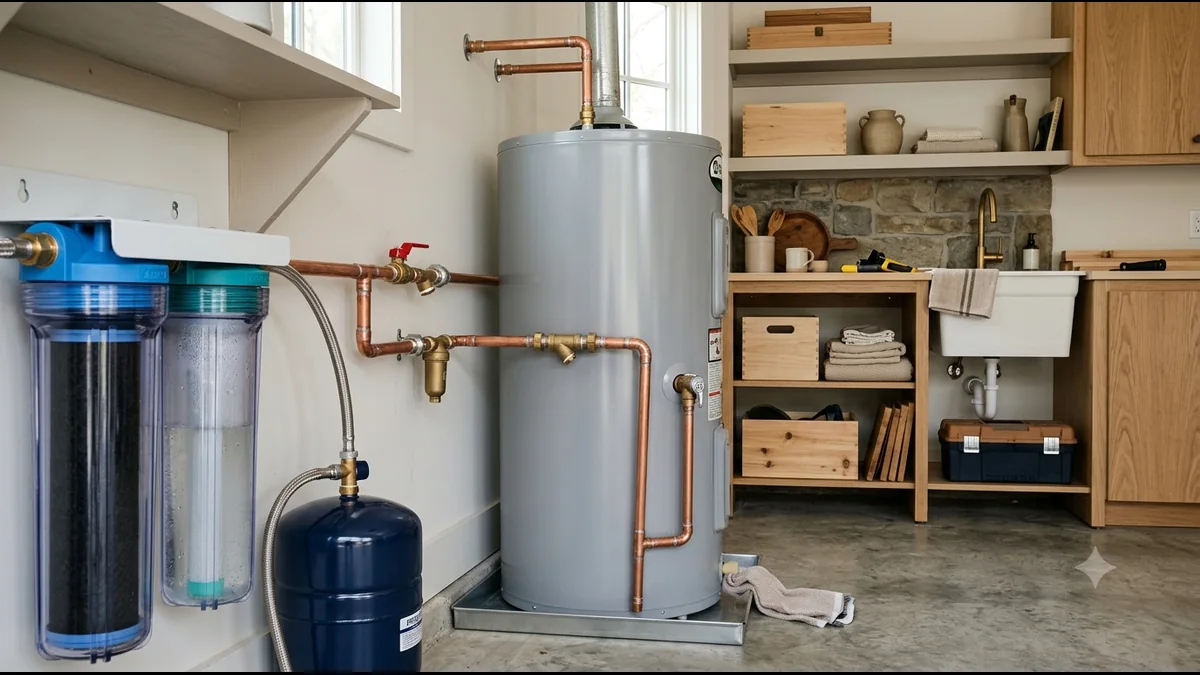
Direct answer: Yes — at the top of Cary's range, hardness runs 3.7 grains per gallon (our own testing, Cary/Apex/Morrisville system), which is "moderately hard" on the WQA scale. Heat makes dissolved calcium and magnesium drop out of solution and settle inside a water heater's tank. A whole-home all-in-one system removes that mineral load with its softening stage, while the carbon stage handles chlorine taste and disinfection byproducts softening alone can't touch.
Does Cary's Water Cause Water Heater Scale Buildup?
It contributes to it, and at the top of Cary's range, it contributes more than most Triangle homeowners realize. Cary draws from the jointly owned Cary/Apex Water Treatment Facility, sourced from B. Everett Jordan Lake, and Cary is the lead agency on that plant. Our own testing across the shared Cary/Apex/Morrisville system measures hardness running 1.6 to 3.7 grains per gallon depending on where a home sits in that service area. At 3.7 gpg — about 63 mg/L — that's "moderately hard" on the WQA/Hach scale, just over the 60 mg/L line into that tier, and it's the strongest hardness case anywhere in our service area. Cary's own Public Works FAQ states a finished-water hardness of 25 to 30 ppm (roughly 1.5 to 1.75 gpg), which the town calls "very soft" on its own scale — that's not a contradiction, it's a plant-average reading at the treatment facility compared to our tap-level testing further out in the distribution system, and a different scale (the town's own scale versus the WQA scale used industry-wide). Either way, calcium and magnesium are present in the water reaching your home, and a water heater is one of the first appliances to feel it.
How Does Scale Actually Form Inside a Water Heater?
It comes down to basic water chemistry: calcium and magnesium dissolve easily in cold water, but they become far less soluble as water heats up. Inside a water heater's tank, that means minerals precipitate out of solution and settle — most heavily on the heating element and along the bottom of the tank, where the water sits hottest and longest between draws. This isn't a one-time event. Every gallon that cycles through carries a small mineral load, and a water heater runs continuously for years, so the deposit accumulates gradually, layer by layer, for as long as the appliance is in service. Left alone, scale buildup reduces heating efficiency and can shorten tank life — the exact scale of that effect depends on your water's hardness and how long the system runs unaddressed.
How Do I Know if My Water Heater Already Has Scale?
A few common signs point to scale before you ever open the tank:
- Popping, cracking, or rumbling noises from the tank, especially during heating cycles — this is water trapped under a layer of scale sediment boiling and escaping through it.
- Longer time to get hot water, or water that doesn't get as hot as it used to, since scale insulates the heating element from the water around it.
- Rising energy bills tied to water heating, as the unit works harder to push heat through an insulating layer of mineral deposit.
- Reduced hot water capacity, if sediment has settled and taken up usable space at the bottom of the tank.
- Age relative to expected service life — an older tank in a moderately hard water area has had more years for scale to accumulate than the same tank on softened water.
If more than one of these sounds familiar, hardness at the top of Cary's range is a reasonable place to start looking.
What's the Difference Between a Water Heater With Softened Water and One Without?
| Water Heater With Softened Water | Water Heater Without Softening | |
|---|---|---|
| Scale formation | Minerals removed before reaching the tank — scale formation is prevented at the source | Calcium and magnesium precipitate onto the element and tank walls as water heats, accumulating over years |
| Heating efficiency | Element stays clear, heat transfers directly to water | Scale insulates the element, requiring more energy to heat the same water |
| Expected service life | Tends toward the longer end of the appliance's designed lifespan, since scale-related wear is minimized | Tends toward the shorter end, since scale buildup is a known contributor to premature failure |
| Maintenance needs | Standard manufacturer-recommended maintenance (e.g., periodic tank flush) | Same maintenance schedule, but scale can make flushing less effective once buildup is established |
| Noise | Normal operating sounds | Popping/rumbling as trapped water escapes through sediment |
Does Softening Fix Everything, or Do I Still Need Carbon?
Softening handles the mineral side — it doesn't touch chlorine, chloramine, or PFAS, which is why the all-in-one approach exists. A softener uses ion exchange to remove calcium and magnesium specifically, which is what stops scale from forming in the water heater in the first place. But it does nothing for disinfection byproducts or taste-and-odor compounds already in the water. Cary's water has measured HAA9 at 27.5 ppb, TTHM at 38.2 ppb, PFOA at 2.86 ppt, and PFOS at 3.79 ppt — 13 contaminants total measured above EWG's non-regulatory health guidelines, while remaining fully compliant with legal EPA limits. None of that is a softening problem; it's a carbon problem. That's the case for an all-in-one whole-home system: the softening resin protects your water heater (and dishwasher, washer, and plumbing) from scale, while the carbon stage removes chlorine and chloramine taste and smell, PFAS, and disinfection byproducts like HAA9 and TTHM — one system, both jobs, best of both worlds.
What Else Benefits From Softened Water Besides the Water Heater?
The water heater is the appliance where scale shows up most dramatically, but it's not the only place mineral buildup accumulates:
- Dishwasher and washing machine — internal components and heating elements face the same scale mechanism as a water heater, just on a smaller scale.
- Plumbing throughout the house — mineral deposits can build up inside pipes over years, the same slow accumulation as inside a tank.
- Dishes and glassware — cleaner, without the mineral film left behind when hard water evaporates.
- Showers and skin/hair — softer water lathers better and rinses more completely, which many households notice as softer skin and hair and less soap residue.
- Laundry — fabrics stay in better condition without cumulative mineral buildup working against detergent.
Softening one point of entry protects all of it at once, which is the appeal of a whole-home system over trying to treat each fixture separately — see how it plays out for appliance longevity specifically.
What Does It Cost to Fix This?
There's no single number that applies to every home — a whole-home system is sized to household size, water usage, and the specific hardness at your address, and the only accurate way to know is a free water analysis. For context, national big-brand whole-home systems commonly run $6,000–$12,000, though that figure reflects broad national competitor pricing, not a Triangle Waterworks quote. The fastest way to see what applies to your home specifically is our 60-second water quiz.
Frequently Asked Questions
I have a tankless water heater in Cary — does hardness still matter for that? Yes. Tankless units heat water on demand through narrow internal passages and a heat exchanger, and scale can build up inside those passages the same way it builds inside a tank, just in a more concentrated space. Softened water protects a tankless unit's heat exchanger the same way it protects a traditional tank.
I've noticed my water heater making popping sounds — is that scale? Popping or rumbling during heating cycles is a common sign of sediment buildup at the bottom of the tank — water trapped under the scale layer boils and escapes through it, which is what creates the sound. It's worth having your water tested to confirm hardness levels at your specific address.
Is my new build in Cary already protected against this? Not automatically — a new water heater starts scale-free, but the same hardness in the water supply applies to a new home as an existing one, and scale accumulation begins from the first fill. If you're moving into new construction, it's worth checking out what new-construction homeowners in Cary should know about water treatment before scale has a chance to start.
Does this only matter for water heaters, or does it affect my whole plumbing system? It affects the whole system — a water heater just shows the effects first and most visibly because heat accelerates mineral precipitation. The same hardness that scales your tank is also working, more slowly, on pipes, fixtures, and other water-using appliances throughout the house.
My glasses have white spots too — is that related to the same hardness issue? Yes, same underlying cause. Mineral content left behind as water evaporates is what causes white spots on glasses, and it's driven by the same calcium and magnesium that scale a water heater — just showing up on a different surface.
How do I find out exactly how hard my water is before deciding what to do? The most reliable at-home option is the Hach Total Hardness Test Kit, Model 5-B, which uses drop-count titration to give you a real gpg reading at your own tap. From there, a free water analysis confirms it and shows what a properly sized all-in-one system looks like for your household — or start with water heater scale prevention for the broader picture.
Ready to see what's happening in your own water? Take our 60-second water quiz and get matched with the right whole-home system for your home.
Answer nine practical questions, then request a written quote or well-water analysis.
Start My Water Analysis