
How Do You Prevent Water Heater Scale Buildup?
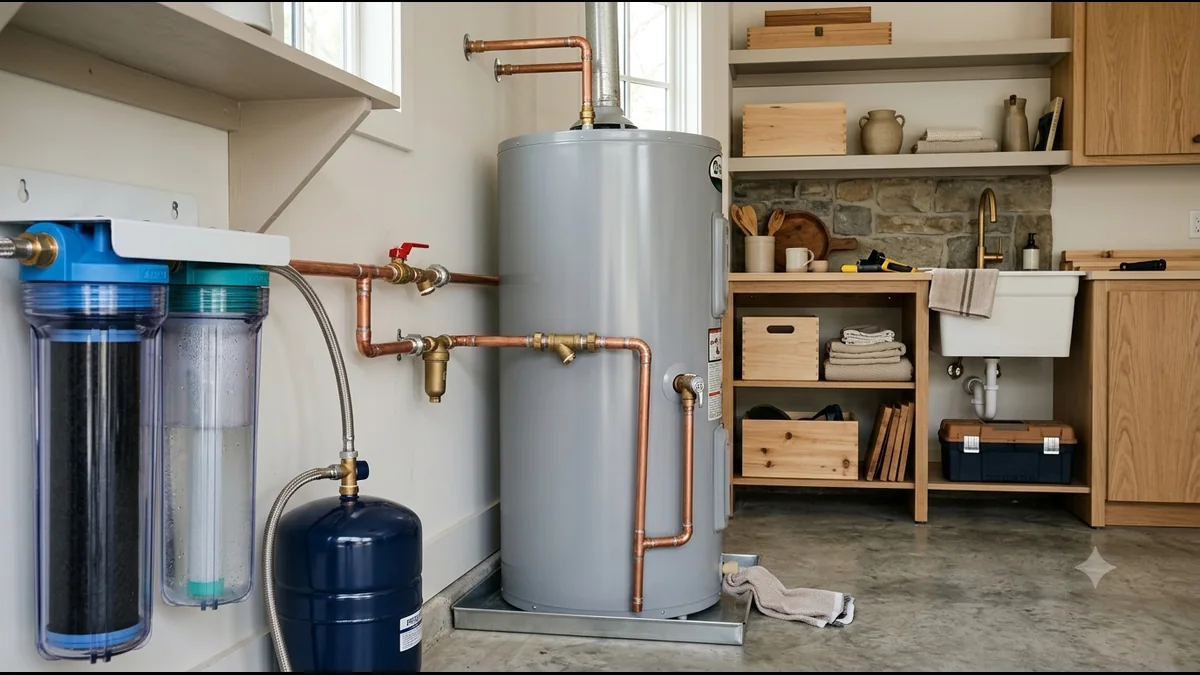
Direct answer: The most effective way to prevent water heater scale buildup is removing calcium and magnesium before they reach the tank — which is what a softener does. Annual flushing controls sediment that has already settled, but the Department of Energy notes that doesn't fully restore efficiency on gas units. Preventing the minerals from arriving in the first place, through a whole-home softening and carbon system, stops the problem at its source.
What is water heater scale, and how does it form?
Water heater scale is the layer of calcium and magnesium minerals that separates out of the water and settles inside the tank as the water heats. The U.S. Geological Survey identifies calcium and magnesium as the two minerals responsible for water hardness, and heat accelerates the process by which they come out of solution and deposit on surfaces. Inside a water heater, that means the tank walls, the heating element on electric units, and the bottom of the tank near the burner on gas units are where scale accumulates first.
What does scale do to a gas water heater?
Scale acts as an insulating layer between the burner and the water, according to the Department of Energy's Building America Solution Center. Because the burner has to push heat through that extra layer to reach the water, the heating surface itself runs hotter than it would on a clean tank. Those elevated surface temperatures can reduce the unit's thermal efficiency and accelerate oxidation of the heat-transfer surfaces — in plain terms, scale buildup both makes the heater work harder and wears it out faster from the inside.
Battelle Columbus Laboratories, researching water heater efficiency for the Gas Research Institute, put the mechanism directly: "Scale deposits on the heat transfer surfaces act as a barrier to the flow of heat into the water, resulting in higher heating surface temperatures. The elevated surface temperatures can reduce the thermal efficiency of the unit, and can also accelerate the gas-side oxidation of the heat transfer surfaces, shortening heater life." In that same research, water heaters run on untreated hard water accumulated up to 5.8 pounds of scale in the equivalent of one year of typical residential use, while heaters running on softened water accumulated an insignificant amount.
What does scale do to an electric water heater?
On an electric unit, sediment collects directly on the heating element, according to the Department of Energy, reducing the element's effectiveness at transferring heat into the water. The heater compensates by running the element longer to reach the same temperature. Electric units have an advantage here: DOE notes that for electric storage water heaters, regularly flushing to prevent sediment buildup maintains efficiency for the lifetime of the equipment — a maintenance response that works better on electric units than on gas units, for reasons covered below.
Can scale actually damage the tank itself, not just efficiency?
Yes. The Department of Energy's Building America program describes how the added insulation from scale causes heat to build up in the steel tank and glass lining, which can cause the glass to dissolve, degrade the steel, and expose the tank shell to corrosion. Scale buildup can also clog hot water pipes, the drain valve, and the temperature and pressure relief valve. That last part matters beyond convenience — the T&P valve is a safety device that releases pressure if the tank overheats, so a valve clogged with scale isn't just an inconvenience, it's a safety component not working the way it's supposed to.
Does flushing the tank fix scale buildup?
Partially, and the honest answer depends on whether the heater is gas or electric. Annual flushing removes loose sediment before it hardens into scale, which is worthwhile maintenance either way. But the Department of Energy is specific about the limits: for gas heaters, cleaning sediment out after it has built up does not restore full efficiency, because the burner surface at the bottom of the tank cannot be completely cleaned. Flushing still significantly limits the decrease compared to skipping it entirely — it just doesn't reset the unit to like-new condition once scale has formed. For electric heaters, regular flushing does maintain efficiency for the equipment's lifetime, since the heating element is more accessible to clean thoroughly. Either way, the Department of Energy's own framing is the useful takeaway: prevention beats remediation.
Does a tankless water heater avoid this problem?
Not entirely — a tankless unit still heats water carrying the same dissolved calcium and magnesium, so scale can still form on its heat exchanger wherever hard water passes through and heats rapidly. What changes is where the scale forms, not whether it forms. We don't have verified specifications for any single tankless model to compare directly, so the fair statement is a general one: the underlying chemistry — hardness minerals coming out of solution as water heats — is the same whether the water passes through a tank or a heat exchanger.
Gas vs. electric: how scale compares
| Gas water heater | Electric water heater | |
|---|---|---|
| Where scale forms first | Bottom of the tank, near the burner | On the heating element |
| Effect of scale | Insulates the burner, raises surface temperature, can accelerate oxidation of heat-transfer surfaces | Reduces the heating element's effectiveness at transferring heat |
| Does flushing restore full efficiency? | No — the burner surface can't be completely cleaned once scale has formed | Yes — regular flushing maintains efficiency for the lifetime of the equipment |
| What stops it at the source | A softener removing calcium and magnesium before water reaches the tank | Same — a softener removing the minerals upstream |
What actually prevents water heater scale for good?
Removing the calcium and magnesium before the water ever reaches the tank. A water softener does this through ion exchange, swapping the hardness minerals out of the water supply at the point it enters the house, so there's nothing left in the water to deposit as scale on the tank walls, the burner area, or the heating element. That's a structurally different approach than flushing, which manages scale after minerals have already been delivered to the appliance. Triangle Waterworks builds that softening stage into an all-in-one system alongside carbon filtration, so the same installation that stops scale from reaching the water heater also handles chlorine taste and disinfection byproducts that softening alone doesn't touch. For a well, the equivalent starting point is an iron removal plus carbon/resin system, sized after a free water analysis, since well water often carries iron and other minerals beyond calcium and magnesium.
Frequently Asked Questions
Do I need to prevent water heater scale if I have a newer tank? Yes — scale accumulation starts as soon as untreated water begins heating in the tank, and the Department of Energy describes it as a cumulative process, not something that only affects older units. Addressing it while the tank is new, before scale has had years to build, is when prevention does the most good.
I have a gas water heater — does annual flushing fully protect it? Not fully. The Department of Energy notes that for gas heaters, flushing out sediment after it has accumulated doesn't restore full efficiency, since the burner surface at the bottom of the tank can't be completely cleaned. Flushing still significantly limits the decrease compared to skipping it, but it's a maintenance step, not full prevention.
My water pressure has dropped and I'm wondering if scale is the cause — could it be? It's possible. The Department of Energy notes that lime scale buildup can clog hot water pipes, the drain valve, and the temperature and pressure relief valve, any of which could affect flow or pressure. It's worth having the water heater and lines checked if you notice a drop, since the T&P valve in particular is a safety device worth confirming is clear.
How much scale can actually build up in a year on untreated water? Research from Battelle Columbus Laboratories, conducted for the Gas Research Institute, found that water heaters run on untreated hard water accumulated up to 5.8 pounds of scale in the equivalent of one year of typical residential use, while heaters on softened water accumulated an insignificant amount over the same period.
Is the temperature and pressure relief valve really a safety issue, or just maintenance? Both. It's a maintenance item in the sense that scale can clog it over time, but functionally it's a safety device — it releases pressure if the tank overheats. A valve that isn't functioning because of scale buildup is a safety component not working as intended, which is why the Department of Energy lists it specifically among the things scale can affect.
Does a water softener really stop scale, or does it just slow it down? It stops it at the source. A softener removes calcium and magnesium from the water supply itself, so there's nothing left in the water to deposit as scale by the time it reaches the tank. That's different from flushing, which manages sediment after the minerals have already arrived — softening prevents the minerals from arriving in the first place.
Ready to stop scale before it starts?
Take our 60-second water quiz to see what system fits your home if you're on city water, or request a free water analysis if you're on a well. Either way, treating the water before it reaches the tank is the only step that stops scale at the source rather than managing it after the fact.
Related reading: Hard Water's Cost to Appliances | Is a Water Softener Worth It in NC? | Water Softener Installation in Raleigh | All-In-One Water System Cost in NC | Raleigh Water Hardness
Answer nine practical questions, then request a written quote or well-water analysis.
Start My Water Analysis