
Does Wake Forest Water Cause Water Heater Scale Buildup?
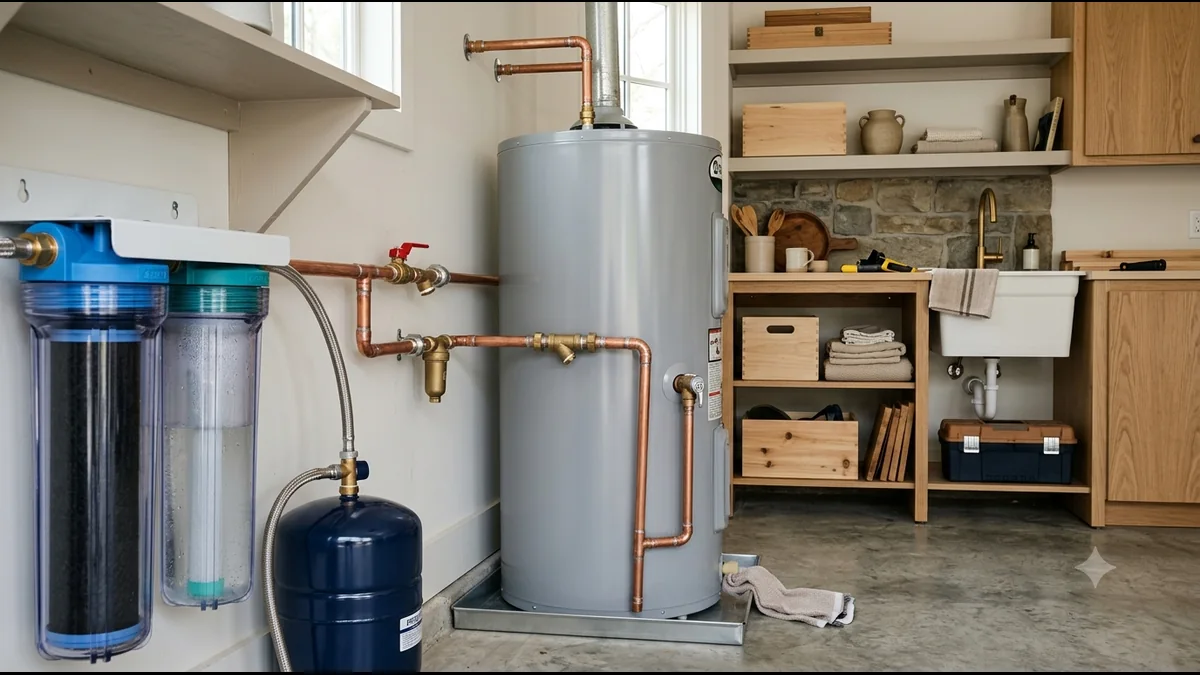
Direct answer: Yes — Raleigh Water serves Wake Forest at about 1.6 grains per gallon on average, slightly hard on the WQA scale, and our own testing measures up to 3.7 gpg depending on address. Heat pulls dissolved calcium and magnesium out of solution and onto the hottest surfaces inside a water heater. An all-in-one whole-home system stops it with a softening stage, plus carbon for what softening alone can't touch.
Does Wake Forest Water Cause Water Heater Scale Buildup?
Yes, gradually, and the mineral is present in every gallon that runs through the tank. Wake Forest is served by Raleigh Water, which also serves Raleigh, Garner, Knightdale, Rolesville, Wendell, and Zebulon. That system runs about 1.6 grains per gallon on average — slightly hard on the Water Quality Association (WQA) scale, the same one the Hach Total Hardness Test Kit (Model 5-B) uses. That's genuinely low, but it isn't mineral-free. Our own testing across the service area measures hardness running 1.6 to 3.7 grains per gallon depending on ZIP code, so a specific Wake Forest address can sit above the system average. At 3.7 gpg — about 63 mg/L — that crosses into "moderately hard" on the WQA scale. Either way, calcium and magnesium are dissolved in the water reaching your house, and a water heater is one of the first places that shows up.
How Does Scale Actually Form Inside a Water Heater?
It comes down to solubility: calcium carbonate dissolves easily in cold water but becomes far less soluble as water heats up, so it precipitates out of solution and settles onto the hottest surfaces it touches. In an electric water heater, that's the heating element. In a gas tank, it's the tank bottom directly above the burner. In a tankless unit, it's the heat exchanger the water passes through on its way to your fixtures. Because scale is a poor conductor of heat, it acts as a thermal insulator — the burner or element has to run longer to deliver the same hot water once a layer builds up. Loose scale settled at the bottom of a tank is also what causes the popping or rumbling sound many homeowners hear during a heating cycle: water trapped underneath the sediment boils and escapes through it. None of this happens in one event — it's a slow, cumulative process, a little more mineral settling out with every cycle, for as long as the appliance runs unprotected.
Is My Water Heater at Risk If My Home Is Brand New?
Yes, the clock starts the same day the water is turned on, new subdivision or not. Wake Forest has plenty of fast-growing new construction alongside its older neighborhoods, and a brand-new water heater in a brand-new subdivision home is scale-free on day one — but the water feeding it carries the same dissolved calcium and magnesium as anywhere else on Raleigh Water. That's actually the best moment to install whole-home protection: the appliance has its full service life ahead of it, and nothing has accumulated yet. A softening stage installed before the heater has run its first thousand cycles never has to work against scale at all.
What About Older Homes in Wake Forest's Historic District?
Here, decades of accumulation may already be sitting inside the plumbing and any water heater that hasn't been replaced recently. Wake Forest's National Register historic district includes homes dating back to the 1820s, and legacy plumbing in older houses has simply had more years for mineral deposits to build up, layer by layer, than a heater installed last year. Replacing an aging water heater in one of these homes alongside a softening system resets that clock the same way new construction does — it just starts from a different baseline.
How Do I Know if My Water Heater Already Has Scale?
A handful of signs tend to show up together:
- Popping, cracking, or rumbling noises during heating cycles
- Longer wait times for hot water, or water that doesn't get as hot as it used to
- Rising energy use as the unit works harder through an insulating layer
- Reduced hot water capacity, if sediment has taken up space at the tank bottom
- A tankless unit losing output, since scale narrows the heat exchanger's passages
If a couple of these sound familiar, it's worth having your address tested rather than guessing.
Tank Flush, Anode Rod, Descaling, or Softening — What Actually Fixes This?
| Maintenance approach | Effort | How often | Addresses the root cause? |
|---|---|---|---|
| Annual tank flushing | Moderate — drain and refill the tank | Every year, for the life of the heater | No — clears loose sediment but doesn't stop new mineral from settling |
| Anode-rod service | Low to moderate — inspect and replace a rod | Every few years | No — protects against corrosion, not scale |
| Descaling a tankless unit | Moderate to high — circulate a descaling solution through the heat exchanger | Per manufacturer guidance, ongoing | No — clears existing scale, but the same minerals return with the next gallon |
| Whole-home softening | One-time install, then automatic | Continuous, ongoing protection | Yes — removes calcium and magnesium by ion exchange before they ever reach the heater |
Flushing, anode-rod service, and descaling are worth keeping up regardless of what treatment you have — but they manage symptoms after the fact. Softening is the only approach here that stops new mineral from ever reaching the tank.
Does Softening Fix Everything, or Do I Still Need Carbon?
Softening handles the mineral side — it doesn't touch chlorine, chloramine, or disinfection byproducts, which is why an all-in-one system pairs both. Softening resin removes calcium and magnesium through ion exchange, which is exactly what stops scale from forming in the first place. Raleigh Water normally disinfects with chloramine, which the City describes as having no taste or odor associated with it. Once a year, on the N.C. Department of Environmental Quality's recommendation, the system converts to free chlorine only and flushes the distribution lines — historically from the last week of February through the first week of April, though exact dates shift year to year and flushing can cause temporary discoloration. That's when many Wake Forest households first notice a stronger chlorine smell. Disinfection byproducts are the other half: the EWG Tap Water Database lists Raleigh's system at HAA9 19.9 ppb and TTHM 21.7 ppb — legally compliant with EPA limits, and above EWG's stricter, non-regulatory guidelines. Activated carbon removes disinfection byproducts and the seasonal chlorine taste, a job softening was never built to do.
That's the case for an all-in-one system: softening resin plus a carbon stage in one whole-home unit. The softening half protects the water heater, dishwasher, washer, and plumbing from scale; the carbon half handles taste, odor, and disinfection byproducts — best of both worlds. Wake Forest's relatively low hardness also works in the system's favor: a softener regenerates less often and uses less salt starting from 1.6 gpg, which keeps it inexpensive to run for as long as you own the house.
What Does It Cost to Fix This?
There's no single number that applies to every home — a system is sized to household size, water usage, and the hardness measured at your address, and the only accurate way to know is a free water analysis. For context, national big-brand whole-home installers commonly quote $6,000–$12,000 for comparable coverage, though that reflects broad national competitor pricing, not a Triangle Waterworks quote. Wake Forest's lower starting hardness also means lower ongoing operating cost once a system is in — a reason to protect the house now, not to wait.
See What's in Your Water
Take our 60-second water quiz to see which all-in-one system fits your Wake Forest home, or book a free water analysis and find out exactly what your address is delivering before more scale has a chance to accumulate.
Frequently Asked Questions
I just moved into a new subdivision in Wake Forest — is it too early to worry about scale in my water heater? It's actually the ideal time. The heater is brand new and nothing has accumulated yet, so a softening system installed now protects its entire service life. A free water analysis can confirm your address's hardness first.
I live in a historic Wake Forest home built in the 1800s — has decades of buildup already ruined my water heater? Not necessarily, but older homes with legacy plumbing have had more years for deposits to accumulate. If your current heater is aging, replacing it alongside a softening system resets the clock and protects the new unit going forward.
My water heater has started making popping noises — is that scale? Popping or rumbling during a heating cycle is a common sign of sediment at the bottom of the tank — trapped water boiling and escaping through the layer above it. It's worth having your address tested to confirm.
Does a tankless water heater in Wake Forest face the same scale risk? Yes. Tankless units heat water on demand through a heat exchanger, and scale builds up inside those narrow passages the same way it builds inside a tank, just in a more concentrated space.
How do I know exactly how hard my water is before deciding what to do? The most reliable at-home option is the Hach Total Hardness Test Kit, Model 5-B, which uses drop-count titration to give a real gpg reading at your own tap. From there, a free water analysis confirms it and sizes the right system.
Will installing a softener stop the annual chlorine smell too? No — that's the carbon stage's job, not the softener's. An all-in-one system pairs the two, so the same install that protects your water heater from scale also handles the chlorine taste and odor many homes notice during the yearly free-chlorine conversion.
Related reading: Water Heater Scale Buildup Prevention | Is Wake Forest, NC Water Hard? | Water Treatment in Wake Forest, NC | New Construction Water Softener in Wake Forest, NC
Answer nine practical questions, then request a written quote or well-water analysis.
Start My Water Analysis