
Can Hard Water Void Your Water Heater's Warranty in Clayton, NC?
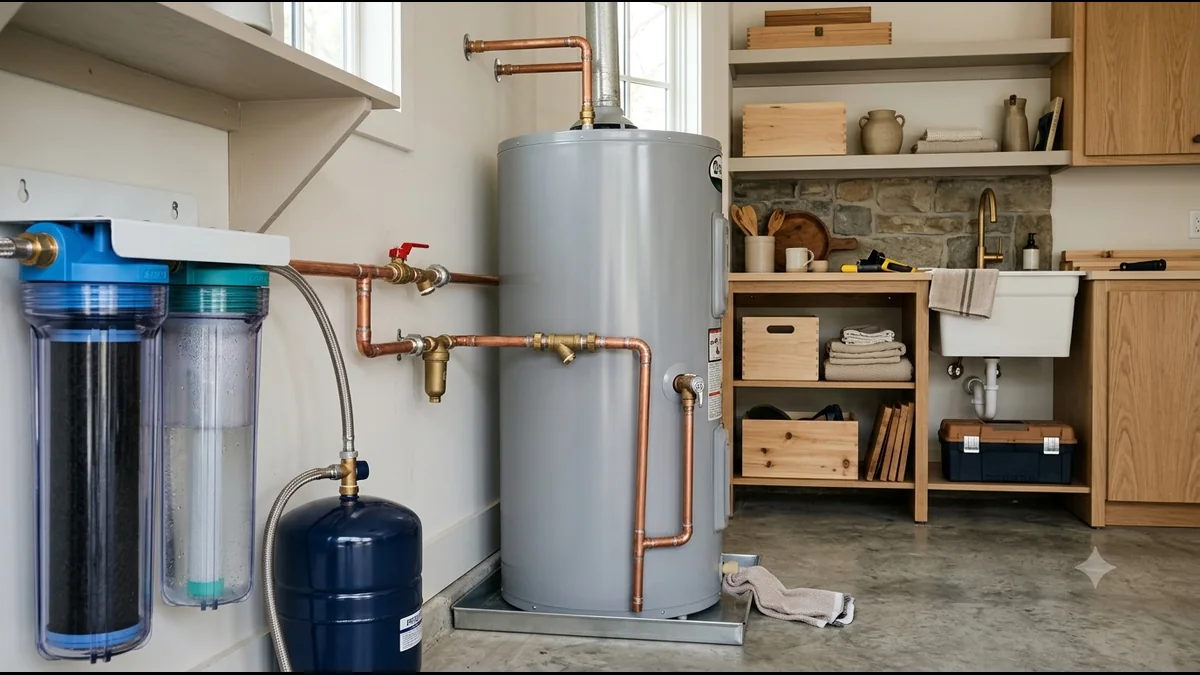
Direct answer: Many manufacturers' written limited warranties exclude damage tied to scale, lime, mineral buildup, or sediment, regardless of how hard the water actually is. A Clayton water heater failure traced to mineral deposits is commonly a cost the homeowner carries, not the manufacturer. Softening water where it enters the home removes the calcium and magnesium that form those deposits in the first place, which protects the appliance and the coverage sitting behind it. A carbon stage handles what softening never touches.
Can Hard Water Really Void My Water Heater's Warranty in Clayton, NC?
It can, depending on the manufacturer and the model, because a meaningful number of written limited warranties carry a clause excluding damage connected to scale, lime, or mineral buildup. These are not obscure fine-print items — they show up in current warranty documents from several major water heater brands, tank-type and tankless alike. The exclusion isn't framed as "if your water crosses a hardness number," either; it's usually written as a flat exclusion for damage traced to mineral deposits, sediment, or poor water quality, independent of how hard or soft the water measured. That distinction matters: a homeowner doesn't need unusually hard water for this clause to apply, only a failure the manufacturer can attribute to mineral buildup.
What Do Water Heater Warranty Documents Actually Say About Scale?
They vary by brand, but the pattern across several current manufacturer documents is a specific exclusion for mineral-related damage rather than general wear and tear. Bradford White's residential limited warranty (form 238-39699-00) excludes coverage for adverse local water conditions, naming sediment or lime precipitate in the tank specifically. A.O. Smith's residential limited warranty states plainly that coverage does not apply where "component parts fail due to sediment build-up." State Water Heaters, an A.O. Smith brand, carries the same language. On the tankless side, Rheem's certificate of limited warranty for its residential gas tankless units excludes damage, malfunction, or failure caused by lime, mineral buildup, or scale, and Navien's NPE-series tankless limited warranty excludes damage from local adverse conditions, naming hard water deposits and mineral buildup among them. Rinnai's SENSEI residential tankless limited warranty (form 100000655(04)) excludes damage caused by poor water quality. None of these clauses set a hardness threshold before they apply — they're written as unconditional exclusions for that category of damage.
Does Every Manufacturer Handle This the Same Way?
No — terms vary by manufacturer and by model within the same manufacturer's lineup. A tank-type warranty and a tankless warranty from the same brand aren't necessarily worded the same way; an exclusion in one product line's document doesn't automatically carry over to another. Scale damage isn't universally excluded everywhere — the exclusion is common enough, especially on tankless units, that a homeowner should read the warranty document for their own unit rather than assume either way. Whatever that document says is what governs a claim.
Why Does a Water Heater Take the Brunt of Mineral Buildup Before Almost Anything Else?
Because a water heater holds and reheats the same water continuously, day after day, for years — exactly the condition that concentrates mineral deposits fastest. Every gallon carries dissolved calcium and magnesium, and heating water accelerates how quickly those minerals come out of solution and settle onto the tank wall, heating element, or heat exchanger. A dishwasher or faucet sees water pass through in seconds; a water heater holds and reheats it repeatedly. Buildup is cumulative — a small amount of scale after each cycle keeps adding to what's already there, and a tank that looked clean at install can carry years of accumulated deposit by the time a technician opens it for a warranty inspection.
How Hard Is Clayton's Water, Really?
There's no verified, published hardness figure for water in the Clayton area specifically, so it isn't accurate to state one — and that's actually the most useful thing to understand here. Our own testing across the Triangle Waterworks service area measures 1.6 to 3.7 grains per gallon depending on the exact address, spanning slightly hard to moderately hard on the Water Quality Association scale the Hach Total Hardness Test Kit, Model 5-B uses. That's a real range, not a single number, and it moves address by address depending on the local water system and the plumbing between the meter and the tank. The only way to know what's actually feeding a specific Clayton water heater is a test at that address, and that test is free — which makes it the natural first step before worrying about warranty language at all.
What Actually Protects Both the Water Heater and the Warranty?
Removing calcium and magnesium before they reach the water heater is what stops the deposits these warranty exclusions are written about. A whole-home softener uses ion exchange at the point where water enters the house, so water reaching the tank or heat exchanger has essentially nothing left to leave behind. That's a different approach from anything done at the water heater itself — there's no scale accumulating in the first place, so there's nothing for an adjuster to point to when a failure is being evaluated. An all-in-one system pairs that softening resin with a carbon filtration stage in a single unit, protecting the water heater's mineral exposure and covering ground softening alone never touches.
| Untreated water | Whole-home softening (all-in-one system) | |
|---|---|---|
| Mineral deposits in the tank/heat exchanger | Accumulate continuously with every heating cycle | Calcium and magnesium removed before reaching the water heater |
| Exposure to scale-related warranty exclusions | Ongoing, cumulative over years of use | Removed at the source rather than treated after the fact |
| Chlorine/chloramine taste, PFAS, disinfection byproducts | Untouched by softening either way | Addressed by the carbon stage, not the softening resin |
| Salt use and regeneration frequency | Not applicable | Low at Clayton-area hardness levels — a correctly sized system regenerates rarely |
Does Softening Handle Everything Else in the Water, Too?
No — softening only addresses calcium and magnesium, so it's typically paired with a carbon stage rather than installed by itself. Ion exchange resin has no effect on chlorine or chloramine taste and odor, PFAS, or disinfection byproducts, since none of those are hardness minerals. That's the other half of an all-in-one system: a carbon stage sits alongside the softening resin in the same unit, addressing what softening was never designed to remove. Between the two, a household gets protection against mineral scale in the water heater and the appliances downstream from it, plus filtration for what softening alone leaves untouched.
Frequently Asked Questions
My water heater failed and the technician mentioned sediment — could that affect my warranty claim? It can, if the manufacturer's warranty document contains a sediment or scale exclusion and the failure is attributed to that cause. Read the specific warranty document that came with your unit rather than assuming — terms vary by manufacturer and even by model, so the wording in your paperwork is what actually applies to your claim.
I just moved to Clayton and I'm not sure how hard the water is at my new house — where do I even start? Start with a test at your own address, since there's no single published hardness figure that applies across the Clayton area. Our testing across the service area runs 1.6 to 3.7 grains per gallon by address, and a free water analysis will tell you exactly where your home falls.
Does a water softener come with any kind of guarantee that it will protect my warranty? A softener removes the calcium and magnesium that scale-related exclusions are written about, which addresses the underlying cause rather than promising a specific outcome on any manufacturer's claims process. What it does reliably is reduce the mineral buildup those clauses describe, since there's little left in the water to deposit once it's been softened.
I've had my water heater for years without a softener — has damage already happened? Possibly some degree of scale has already accumulated, since buildup is cumulative and adds up with every heating cycle over time. Softening going forward stops new deposits from forming; it won't reverse what's already inside an existing tank, but it protects the unit — and any replacement — from here on.
Why would a manufacturer exclude scale damage instead of just covering it like anything else? Manufacturers generally treat water quality as outside their control once a unit is installed, since it depends on the local supply and the specific address rather than anything about how the appliance was built. That's why several current warranty documents draw a line around damage tied to mineral buildup or sediment specifically, separate from defects in materials or workmanship.
My glasses and fixtures already show mineral spots — should I assume my water heater has the same issue? Visible spotting on glassware and fixtures is a reasonable sign that calcium and magnesium are present in the water supplying the whole house, including the water heater. It's still worth confirming with an actual test, since the concentration that matters for scale buildup is the grains-per-gallon reading at your address, not just what's visible on a glass.
Related Reading
For a closer look at how deposits form specifically inside a water heater, see water heater scale buildup and how to prevent it. The warranty question is really one piece of a bigger cost picture — what hard water buildup costs in appliance damage and whether soft water makes appliances last longer both cover related ground. If you're weighing an install at a Clayton HOA property, HOA rules on water softener installation in Clayton, NC is worth reading first. And before any of this matters for your own address, how to test water hardness at home walks through the at-home GPG check.
Take the 60-second water quiz to see what an all-in-one system would look like for your Clayton home, or book a free water analysis to get the actual number for your address before your next water heater decision.
Answer nine practical questions, then request a written quote or well-water analysis.
Start My Water Analysis