
Water Softener Cary NC: What Cary's Water Actually Needs
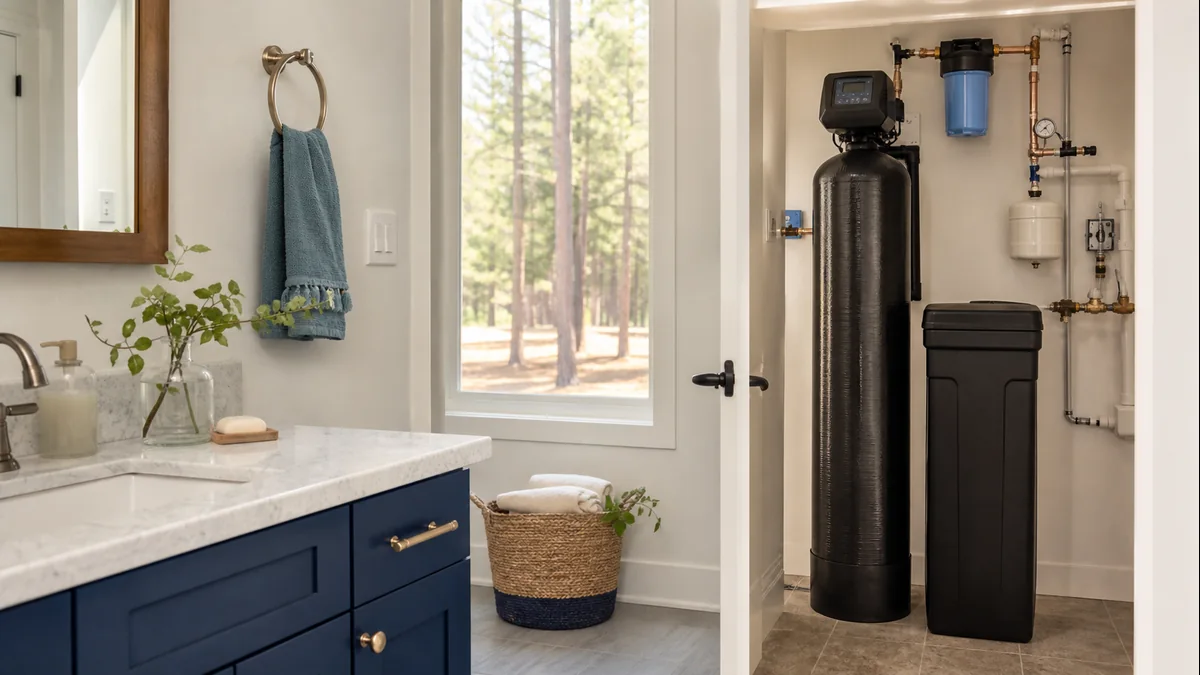
Direct answer: Cary water runs 1.6–3.7 grains per gallon (gpg), and the top of that range crosses into moderately hard on the WQA scale — hard enough that scale buildup on fixtures and appliances is a real, ongoing issue for Cary homes. Cary's water also carries 13 contaminants above EWG health guidelines, including PFAS traced back to Jordan Lake. A softener alone fixes the hardness; it does nothing for the rest. That's why the right system for a Cary home is an all-in-one unit — softening resin plus carbon filtration — that handles scale and water quality together.
How Hard Is Cary Water, Really?
Cary is supplied by the Cary/Apex Water Treatment Facility, which draws from B. Everett Jordan Lake, and tests 1.6–3.7 gpg. On the WQA hardness scale — the same one the Hach Total Hardness Test Kit (Model 5-B) uses — that range starts in the slightly hard band and climbs into moderately hard territory as it approaches the top:
| Classification | ppm (mg/L) | Hardness (gpg) |
|---|---|---|
| Soft | <17 | <1.0 |
| Slightly hard | 17 – 60 | 1.0 – 3.5 |
| Moderately hard | 60 – 120 | 3.5 – 7.0 |
| Hard | 120 – 180 | 7 – 10.5 |
| Very hard | 180+ | 10.5+ |
Because Cary's range spans 1.6–3.7 gpg, a lot of Cary homes are living at or above the WQA's 3.5 gpg line into moderately hard water for at least part of the year — the exact zone where a softener starts paying for itself in fewer water spots, less scale in the water heater, and appliances that don't have to fight mineral buildup to do their job. Compare that to Raleigh, whose water tests at a much lower 1.6 gpg — see our full breakdown in Raleigh water hardness for how the two systems differ.
What Else Is in Cary's Water Besides Minerals?
Hardness is only part of the picture. According to the EWG Tap Water Database, Cary's water tests at HAA9 27.5 ppb — roughly 458 times the EWG's stricter 0.06 ppb health guideline — along with TTHM at 38.2 ppb, PFOA at 2.86 ppt, and PFOS at 3.79 ppt. In total, 13 contaminants in Cary's water exceed EWG guidelines. It's important to be precise about what that means: Cary's water is fully compliant with EPA's legal limits — the EWG numbers are a separate, non-regulatory health benchmark that's simply stricter than the federal standard. Both bars are real; they're just not the same bar. For the full contaminant breakdown, see is Cary, NC water safe to drink.
None of that has anything to do with hardness. A softener's resin bed exchanges calcium and magnesium for sodium — it isn't designed to touch chlorine byproducts or PFAS. Removing those requires activated carbon, and for PFAS specifically, carbon certified to NSF/ANSI 53 or P473 (or reverse osmosis certified to NSF/ANSI 58).
Where Did Cary's PFAS Come From?
Cary's PFAS reading traces back to its source, not a treatment failure at the plant. Jordan Lake — the reservoir that feeds the Cary/Apex Water Treatment Facility — has an established PFAS history: Duke University researchers measured combined PFAS above 200 ppt in the lake's raw source water back in 2017. That's a watershed-level contamination story upstream of the plant, not evidence the utility is doing anything wrong; Cary is still meeting every federal requirement. It does mean that whatever comes out of the tap started with a PFAS load in the source, and boiling water does nothing to remove PFAS — the only way to get it out at the tap is carbon media rated for PFAS removal or RO. See whole-house water filtration for Cary homes for how the carbon stage handles PFAS at the tap.
Why an All-In-One System Is the Right Fit for Cary Homes
Cary's water profile is a two-problem situation, so the efficient fix is a two-part system running as one unit:
- Softening side: removes calcium and magnesium before they scale up your water heater, dishwasher, and washing machine — and before they leave spots on glassware and film on skin and hair.
- Carbon filtration side: removes chlorine taste and smell, PFAS, and disinfection byproducts like HAA9 and TTHM — the contaminants a softener was never built to handle.
Running both stages in one whole-home system means one installation, one maintenance routine, and full coverage instead of stacking separate boxes for separate problems. Pricing is set only after a free water analysis confirms your home's actual numbers — and it's typically well under the $6,000–$12,000 that national big-brand installers commonly quote for comparable coverage. For more on what drives that pricing locally, see water softener cost in Raleigh and is a whole-house filter worth it.
Cary Water vs. Raleigh and National Averages
| Hardness (gpg) | WQA classification | Notable contaminants | |
|---|---|---|---|
| Cary, NC | 1.6–3.7 | Slightly hard to moderately hard | HAA9 27.5 ppb, TTHM 38.2 ppb, PFOA 2.86 ppt, PFOS 3.79 ppt |
| Raleigh, NC | 1.6 | Slightly hard | HAA9 19.9 ppb, TTHM 21.7 ppb |
| Very hard water (national reference) | 10.5+ | Very hard | Varies by region |
Cary isn't in the "very hard" territory that drives the worst scale problems nationally, but it's meaningfully harder than Raleigh and does cross into moderately hard at the top of its range — enough that Cary homeowners notice the difference in spotting, buildup, and appliance wear that Raleigh homeowners typically don't.
Frequently Asked Questions
Do I actually need a water softener in Cary? Cary's 1.6–3.7 gpg range puts many homes at or above the moderately hard line, so a softener is doing real, ongoing work here — protecting your water heater, dishwasher, and washing machine from scale while stopping the spotting and film that come with moderately hard water. Because Cary's water also carries 13 contaminants above EWG guidelines that a softener can't touch, most homeowners get the most complete protection from an all-in-one system that pairs softening with carbon filtration.
I just moved to Cary and my dishwasher is leaving white spots on glasses — is that hardness? Very likely, yes — white film and spotting on glassware is a classic sign of calcium and magnesium in moderately hard water, and Cary's range runs right up to that line. A correctly sized softener resolves it, and pairing it with carbon filtration in one system also addresses the chlorine taste some new-to-Cary residents notice in the same breath.
My neighbor in Raleigh isn't on a softener — why would I want one in Cary? Raleigh water tests at 1.6 gpg — slightly hard on the WQA scale — while Cary runs 1.6–3.7 gpg — different source, different water treatment facility, different result. The two cities aren't on the same system, so what's true for a Raleigh home doesn't automatically apply in Cary, where the top of the hardness range crosses into moderately hard — high enough that a softener does real, ongoing work protecting your appliances and glassware.
Is Cary tap water safe to drink even with those EWG numbers? Yes — Cary's water meets every EPA legal requirement. The EWG guideline is a separate, stricter, non-regulatory health benchmark, and Cary's numbers exceed that stricter bar on 13 contaminants. That's exactly why many Cary households add carbon filtration alongside softening: to close the gap between "legally compliant" and "filtered to a stricter standard."
Does a water softener remove the PFAS from Jordan Lake? No. A softener's resin is built to exchange calcium and magnesium — it has no effect on PFAS. Removing PFAS requires activated carbon certified for PFAS removal (NSF/ANSI 53 or P473) or reverse osmosis (NSF/ANSI 58), which is why an all-in-one system pairs a carbon stage with the softening resin rather than relying on softening alone.
How much does a whole-home system cost for a Cary house? A free water analysis sizes the system to your home first, then pricing follows — typically well under the $6,000–$12,000 commonly quoted by national big-brand installers for similar coverage. Exact pricing depends on household size and your water analysis results.
Ready to See What Your Cary Home Needs?
Take our 60-second water quiz to find out what your Cary home's water actually needs. For most city-water homes here, that means an all-in-one softening + carbon filtration system built to handle Cary's water — slightly hard to moderately hard depending on your ZIP — and its Jordan Lake contaminant profile in a single install.
Answer nine practical questions, then request a written quote or well-water analysis.
Start My Water Analysis