
How Much Does a Water Softener Cost in Cary, NC?
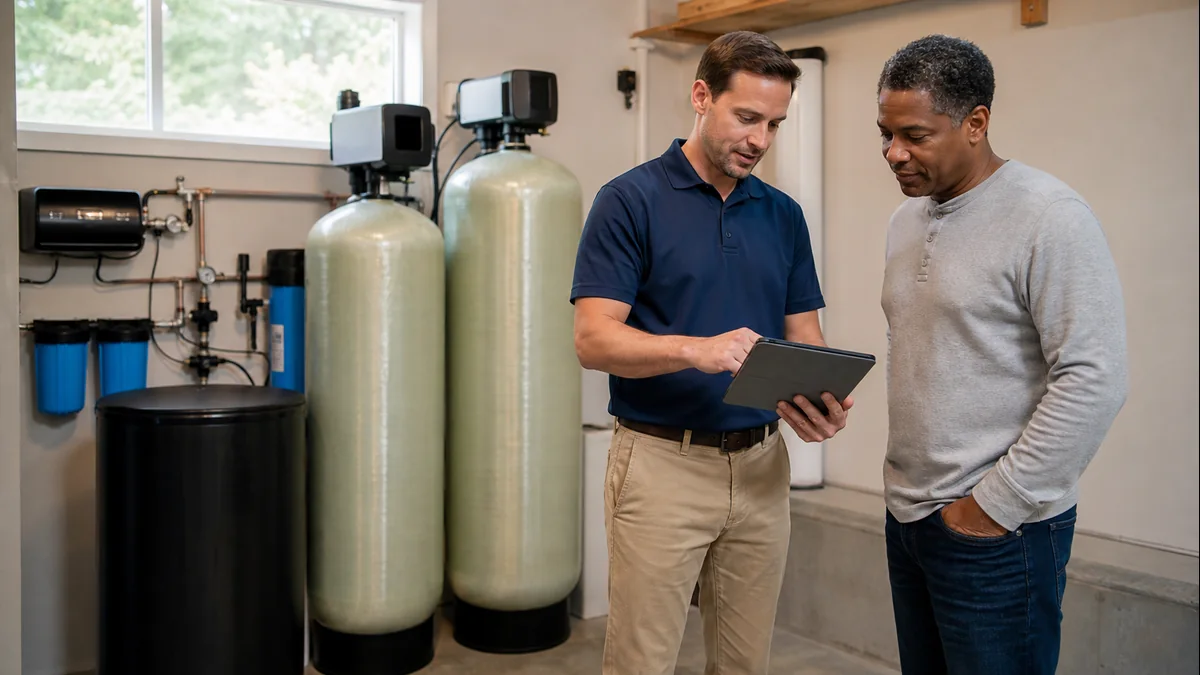
Direct answer: In Cary, a whole-home water softener system is priced and sized after a free water analysis — well under what many national big-brand dealers quote (commonly $6,000 to $12,000) for a comparable whole-home setup. Hardness here runs 1.6 to 3.7 grains per gallon by ZIP (our own testing) — slightly hard at the low end, moderately hard at the top. That range, paired with the carbon filtration stage, is why the all-in-one system — not a softener alone — is the right call for most Cary homes.
What does a water softener cost in Cary, NC?
A properly sized whole-home system in Cary is priced only after a free water analysis sets the exact number. There's no single flat price because no two Cary homes have identical water, plumbing, or usage — the equipment, the installation labor, and the sizing work all flow from that test. For comparison, national big-brand dealers commonly quote $6,000 to $12,000 for a similar whole-home job, which is why a local quote after a real water test is worth getting before you sign anything.
What's actually included in that price?
The installed price covers a complete system, not just a tank. That means the softening resin stage, the professional installation (tie-in to your main line, bypass valve, drain connection), and the sizing analysis that determines the right equipment for your specific household. If you choose the all-in-one configuration, carbon filtration is built into the same install — one footprint, one visit, one price — rather than being sold as a separate add-on project later.
What the price does not include, because we don't publish figures we haven't verified for your specific system: financing terms, monthly payment plans, rental rates, or service-plan pricing. Those numbers vary by configuration and by your free water analysis, so ask about them directly rather than trusting a number you saw online.
What moves the price up or down?
Five things determine where a Cary quote lands:
- Household size. More people means more daily water use, which affects the size and capacity of the equipment needed.
- Number of bathrooms. More fixtures and more simultaneous demand call for a system sized to keep up without a pressure drop.
- What the water analysis finds. This is the biggest variable. A free water test measures what's actually in your water — hardness minerals, chlorine/chloramine levels, and other findings — and the system is sized to that result, not a guess.
- Where the equipment can physically go. Garage, basement, crawlspace, or utility closet access all affect installation complexity and labor time.
- Softening alone versus the all-in-one. Adding the carbon filtration stage to the softening resin changes the price, but it's a single combined install rather than two separate jobs down the road.
| What drives the quote | Pushes the price lower | Pushes the price higher |
|---|---|---|
| Household size | Smaller household, lower daily use | Larger household, higher daily use |
| Bathrooms | Fewer fixtures | More fixtures, higher simultaneous demand |
| Water analysis findings | Fewer treatment needs identified | More treatment needs identified |
| Install location | Easy access (garage, basement) | Tight or hard-to-reach space |
| System type | Softening only | All-in-one (softening + carbon) |
What does Cary's hardness actually mean for the cost of running a softener?
It depends on where in Cary you are. The Town of Cary's own Public Works FAQ reports a finished-water hardness average of 25 to 30 ppm (roughly 1.5 to 1.75 grains per gallon) — that's a plant-wide average for water leaving the treatment facility. What actually reaches a given tap depends on where that address sits in the distribution system: our own testing across Cary measures hardness running 1.6 to 3.7 grains per gallon by ZIP code — slightly hard at the low end, moderately hard at the top (3.7 gpg works out to about 63 mg/L, just over the WQA line for moderately hard water at 60 mg/L). The number that actually determines your softener's running cost is the one at your own address, and that test is free.
At the low end of that range, the softening stage regenerates rarely and uses very little salt — it's cheap to own. At the top of the range, a household has a straightforward hardness case: calcium and magnesium are heavy enough to matter on their own, not just as a slow cumulative buildup. Either way, minerals are present across the whole range, and buildup on fixtures, glassware, and inside your water heater is cumulative over years of daily use. The softening stage earns its place at every level — it's just less expensive to run at the low end than at the top.
So where does the money actually go in a Cary system?
Into the carbon filtration stage — and that's where the real value is. Cary, along with Apex and Morrisville, draws from the jointly owned Cary/Apex Water Treatment Facility, sourced from B. Everett Jordan Lake. The treatment train that keeps that water safe leaves some things behind that softening alone does nothing about:
- Disinfection byproducts. Cary's own reported figures (EWG Tap Water Database) show HAA9 at 27.5 ppb and TTHM at 38.2 ppb. Both are legally compliant with EPA's limits — but the numbers are real, and they're the kind of thing activated carbon is specifically good at removing. The shared Cary/Apex facility's own 2024 report (filed by Apex, since Cary does not publish a separate figure) recorded TTHM as high as 41 ppb, ranging to 53 — roughly double what Raleigh reports.
- A chloramine residual, with an annual switch to free chlorine. The plant disinfects with chloramine (chlorine plus ammonia) most of the year, then temporarily switches to free chlorine once a year to flush the distribution system — a normal, planned maintenance step. That's exactly when Cary households are most likely to notice a chlorine taste or smell at the tap. (The timing shifts year to year — check the Town's own announcement for current dates rather than a fixed calendar.)
- Detectable PFAS compounds. The shared facility's 2024 report found PFBA at 3.8 ppt and PFHxA at 3.65 ppt — both low, both legally unregulated individually, and neither a plant failure. Duke researchers measured combined PFAS above 200 ppt in raw Jordan Lake source water back in 2017, which points to the watershed as the source, not the treatment process. Carbon filtration certified for PFAS reduction is built to address exactly this.
None of that is a softening problem. It's a filtration problem, and it's the actual reason the all-in-one system is worth the money in Cary — you're paying once to solve the taste, byproduct, and PFAS questions at every tap in the house, not just the mineral-buildup question.
Cary system cost versus a national big-brand quote
| Local all-in-one (Cary) | National big-brand | |
|---|---|---|
| Typical installed price | Set after a free water analysis | $6,000–$12,000 |
| Pricing basis | Free water analysis | Often a generic or remote estimate |
| What's addressed | Softening + carbon (chlorine/chloramine, byproducts, PFAS) in one install | Varies by package, often softening-only unless upgraded |
| Sizing | Matched to your household, bathrooms, and test results | Often templated to a standard household size |
The gap between the two isn't just brand markup — it's often what's actually included. A quote that only covers softening resin, sized to a generic household rather than your test results, can look cheap on paper and still leave the chlorine, chloramine, and byproduct questions completely unaddressed.
Getting an accurate number for your Cary home
The only way to know your exact number is a free water analysis. It tells you what's actually in your water, how many bathrooms and how much daily demand the system needs to handle, and where the equipment can go — the three biggest cost variables, all answered before you commit to anything.
Frequently Asked Questions
I just got a quote from a national company that's near the top of their range — is that normal? National big-brand dealers commonly quote $6,000–$12,000 for a whole-home system, so a quote near the top of that range isn't unusual. Compare what's included, though — if that price covers softening only, ask what it would cost to add carbon filtration for chlorine, chloramine, and disinfection byproducts. A local all-in-one quote covering both stages can come in lower than a national softening-only price.
My water in Cary doesn't feel hard — do I still need to spend money on this? Cary's hardness runs 1.6 to 3.7 grains per gallon depending on your ZIP — slightly hard at the low end, moderately hard at the top — so how your water feels depends on where you are in town. At the low end, the softening side is cheap to own; at the top, it's carrying real mineral load. Either way, the carbon stage is the other half of the value here, handling chlorine/chloramine taste, disinfection byproducts, and detectable PFAS compounds.
What's the cheapest way to get an accurate price instead of guessing from a website? A free water analysis. It measures your actual water and matches equipment to your household size, bathroom count, and installation space, which are the three things that move your quote up or down.
I've read that Cary's water is soft — does that mean the price should be lower than in other NC towns? Not necessarily. The town's published average (about 1.5–1.75 gpg) falls in the soft range on some hardness scales, but on the WQA scale the Hach test kit uses — which is what we classify by — that same figure is slightly hard, not soft. Our own testing across Cary shows hardness running up to 3.7 gpg depending on ZIP, so some homes reach moderately hard at the top of that range. Either way, most of the value in a Cary system comes from the carbon filtration stage addressing chlorine, chloramine, and disinfection byproducts — those costs are similar regardless of local hardness.
Does the price include financing or a monthly payment option? That depends on the specific arrangement, and we don't publish a financing figure here because it varies by system and household. Ask directly when you get your free water analysis and quote.
Is it worth paying more for the all-in-one system instead of just a softener in Cary? Given what the carbon stage addresses here — TTHM, chloramine taste, and detectable PFAS that a softener alone does nothing about — the all-in-one is the system that actually matches what's in Cary's water, all in one installed price rather than two separate projects.
Ready to get your number?
Take our 60-second water quiz to see which all-in-one system fits your Cary home, or request a free water analysis to get an exact quote based on your actual water, household, and install space.
Related reading: All-in-One Water System Cost in NC | Water Softener in Cary, NC | Whole House Water Filter in Cary | Water Softener Salt Cost Per Year | Water Softener vs. All-in-One System
Answer nine practical questions, then request a written quote or well-water analysis.
Start My Water Analysis