
What Determines Water Softener Cost in Clayton, NC?
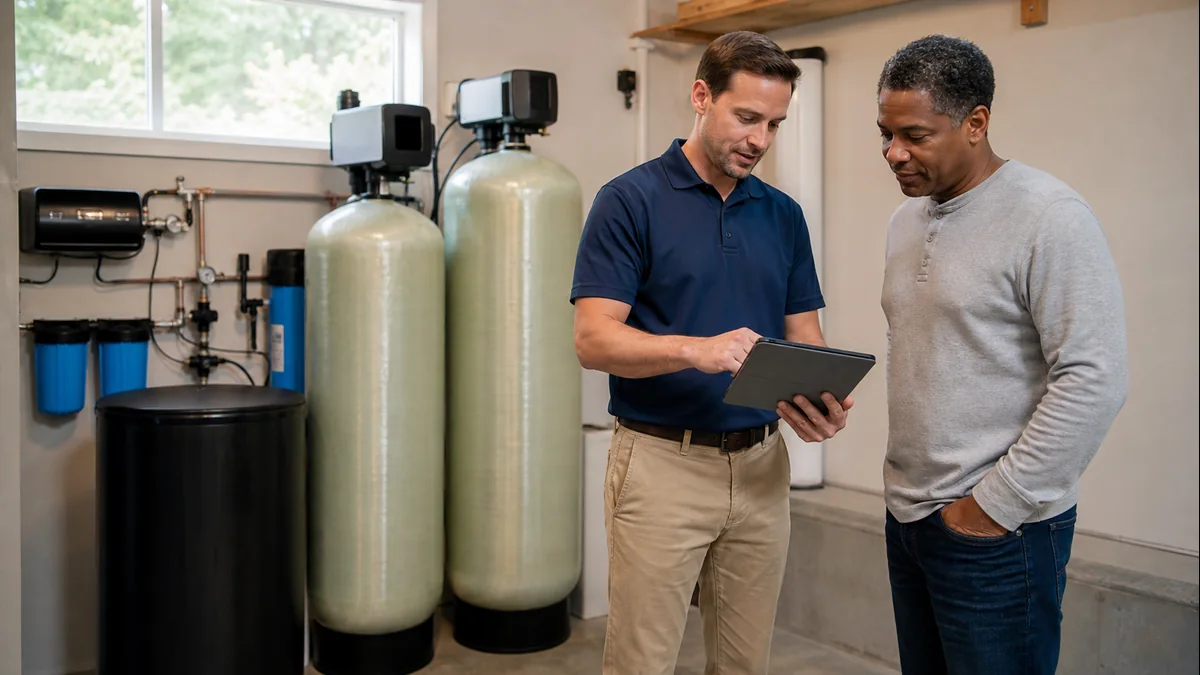
Direct answer: In Clayton, NC, a water softener's price comes down to four things: municipal water vs. private well, your address's hardness reading, household capacity, and whether the system also strips out chlorine, chloramine, and disinfection byproducts — not just calcium and magnesium. Clayton has no published town-wide hardness number, so guessing at a price is guessing at your health risk. A free water analysis replaces both guesses with real numbers.
What Determines the Cost of a Water Softener in Clayton?
Four factors do almost all the work in shaping the final number:
- Water source. Town of Clayton municipal customers and private-well homeowners in the surrounding unincorporated area face different cost pictures — a well can carry iron, sulfur, or low pH on top of hardness, each of which changes what the system needs to handle.
- Hardness reading at your address. There's no published countywide hardness figure for Clayton, so this comes from an actual test rather than a chart.
- Household size and water usage. More bathrooms and higher daily usage mean a system needs more capacity to keep up without running dry between regeneration cycles.
- Softening-only vs. all-in-one. A softener that only touches calcium and magnesium is a different (and narrower) purchase than one that also filters chlorine, chloramine, and disinfection byproducts.
None of these get guessed at from a spreadsheet — they're the reason a real quote follows a real water test instead of preceding it.
Is Clayton's Water Hard Enough to Need a Softener?
There's no single answer, because Clayton draws from two different water systems and neither publishes a town-wide hardness figure. The Town of Clayton itself notes that Riverwood and the rest of town are served by two separate Johnston County systems, each with its own annual water quality report.
That split is exactly why a generic "Clayton is hard" or "Clayton is soft" claim isn't reliable. The honest move is a hardness test at your own address — it's free, and it replaces a guess with a real number before you spend a dollar on the wrong system.
Minerals in water are cumulative regardless of which system serves your street — calcium and magnesium build up gradually on fixtures, glassware, and inside a water heater over years of daily use. A softener sized to your actual reading is what keeps that buildup from accumulating going forward.
Town Water vs. Well Water: How Your Source Changes the Cost Picture
Clayton sits inside a part of Johnston County where both municipal and well-served homes are common, and the cost conversation splits along that line:
| Water Source | What Drives Cost | Typical Add-On Needs |
|---|---|---|
| Town of Clayton / Johnston County municipal | Hardness reading, household size, chlorine/chloramine handling | Usually softening + carbon in one system |
| Private well (unincorporated Johnston County) | Hardness, plus iron, sulfur, and pH from a full water panel | Iron filtration, pH correction, or sediment stages as needed |
If you're not sure which one applies to your home, check whether you receive a water bill from the Town of Clayton or a Johnston County utility. If you don't — and you have a pressure tank or well pump — you're on a private well.
North Carolina does not regulate private well water quality after the well passes its original construction inspection. Ongoing testing is on the homeowner either way, which is exactly why a full water panel — not just a hardness strip — is worth doing before a well-home quote, not after a problem shows up.
All-In-One System vs. Standalone Softener: Why the Cost Difference Matters
A bare softener and an all-in-one system aren't the same purchase, and the price difference reflects that:
- A standalone softener is ion exchange only — it swaps out calcium and magnesium and stops there. It has no effect on chlorine or chloramine taste, or on disinfection byproducts.
- An all-in-one system pairs that same softening resin with a carbon filtration stage in one unit, one install, and one appointment — covering hardness and water-quality taste/odor issues together instead of as two separate purchases.
The "best of both worlds" framing matters for cost because it changes what you're comparing: a cheaper standalone softener quote and an all-in-one quote aren't apples to apples if only one of them actually addresses chlorine and disinfection byproducts.
That gap isn't cosmetic. EPA's National Primary Drinking Water Regulations list real long-term health effects tied to exposure above the legal limit: for total trihalomethanes (TTHMs), "liver, kidney or central nervous system problems; increased risk of cancer"; for haloacetic acids (HAA5), "increased risk of cancer." Clayton's public water systems are legally compliant — but compliant is a ceiling set by EPA's own risk tolerance, not a guarantee of zero risk.
A carbon stage removes those compounds directly instead of relying on staying under a legal limit. That's the real case for an all-in-one system over a standalone softener — it's not about taste, it's about not carrying that exposure at all.
What Does Licensed Installation Add to the Cost (and Why It's Required)?
Installation cost isn't optional overhead — it's state law. Under North Carolina General Statute 87-21, installing or replacing a whole-house water purification or treatment system is licensed plumbing contracting work — the same category that covers water heaters and gas furnaces. A DIY box kit skips that requirement; a professional install doesn't.
That's why a legitimate quote includes labor by a licensed contractor, not just equipment cost. Verify it before you sign anything — the NC State Board's public lookup confirms whether a given installer actually holds that license.
How Much Do National Big-Brand Systems Cost Compared to a Local Quote?
National big-brand water treatment dealers commonly quote $6,000–$12,000 for a comparable whole-home softening-and-filtration setup, frequently after an in-home sales visit where the number gets built around the household rather than off a standardized process. That range is a useful anchor for what "whole-home" pricing looks like nationally — it's also why an address-specific, water-test-first quote is worth comparing against a big-brand number rather than accepting either sight-unseen.
Triangle Waterworks doesn't publish a fixed price for the same reason a single Clayton hardness number doesn't exist: every home's water, plumbing, and usage are different enough that a real number only means something once it's built off your actual water analysis.
Cost Comparison: All-In-One vs. Standalone vs. National Big-Brand
| All-In-One System | Standalone Softener Only | National Big-Brand Whole-Home | |
|---|---|---|---|
| Pricing model | Quoted after a free water analysis | Varies by installer, often lower up front | $6,000–$12,000, typically after an in-home sales visit |
| Softening (hardness) | Yes | Yes | Yes |
| Carbon (chlorine/chloramine + TTHM/HAA5 exposure) | Yes | No | Varies by model/add-on |
| Well-water add-ons (iron, pH, sediment) | Sized after a full water panel | Not typically included | Varies, often a separate line item |
| Installation | Licensed NC plumbing contractor (NCGS 87-21) | Varies | Varies |
What Affects Ongoing Cost After Installation?
The purchase price isn't the only number that matters — how the system runs afterward depends on the same hardness reading that shaped the initial quote:
- Lower hardness means fewer regeneration cycles and less salt used per year, which is a real ongoing-cost advantage if your Clayton address tests toward the lower end.
- Higher hardness or added iron/sulfur treatment on a well means more frequent regeneration and more media working at once, which shows up as somewhat higher salt and maintenance cost over time.
- Salt cost itself is a small, predictable annual line item regardless of where your reading falls — see the salt-cost breakdown for what that actually looks like year to year.
None of this is a reason to wait on a test — it's the opposite. A test is what tells you which side of that ledger your home falls on, and it's free either way.
FAQ
I just moved to Clayton and don't know if I'm on town water or a well — how does that change my cost? Start by checking whether you get a water bill from the Town of Clayton or a Johnston County utility. If you do, you're on municipal water and pricing centers on hardness and household size. If you don't — and you have a pressure tank or well pump — you're on a private well, and a full water panel (hardness, iron, pH, sulfur) determines what add-ons, if any, your quote needs.
Does Clayton, NC have hard water? There's no single town-wide answer — Clayton is served by two different Johnston County water systems, and neither publishes one combined hardness figure. A test at your specific address is the only way to know your actual reading, and it's free.
Why doesn't Triangle Waterworks list a price online? Because a fixed number wouldn't be accurate for most homes. Hardness, household size, plumbing layout, and whether you're on town water or a well all change what a system needs to do, so every quote follows a free water analysis rather than preceding it.
I got a quote from a national brand for around $9,000 — why would a local quote be different? National big-brand dealers commonly price a comparable whole-home setup between $6,000 and $12,000, often after an in-home sales visit that shapes the final number. A local, water-test-first quote is built off your actual hardness reading and household needs rather than a sales-visit estimate, so the two numbers can land in different places even for similar equipment.
Does the quote include carbon filtration, or is that a separate add-on? For an all-in-one system, softening and carbon filtration are quoted together as one system, one install — not as a base price plus a carbon upcharge. That's the distinction to check for when comparing any two quotes side by side.
Do I need a permit to install a water softener in Clayton? Whole-house water treatment installation is licensed plumbing contracting work under North Carolina General Statute 87-21, the same category that covers water heaters and furnaces. Verifying that your installer holds a valid NC plumbing license — rather than assuming a permit isn't needed — is worth doing before you sign a contract.
Chlorine, chloramine, and hardness don't fix themselves, and every day on untreated water is another day of buildup and exposure you don't have to accept. Take the free quiz now to get a sizing direction for your specific Clayton address — the actual fix is one free water analysis away, not a decision to put off.
Related reading: What does an all-in-one water system cost across NC? · How to choose a water treatment company in Johnston County, NC · HOA rules and water softener installation in Clayton, NC · Can hard water void your water heater's warranty in Clayton, NC? · How to clean hard water stains off stainless steel appliances in Clayton, NC
Sources
- Town of Clayton, NC — Water Quality and Wastewater Reports
- North Carolina General Statute § 87-21 — Definitions; contractors licensed by Board
- EPA — National Primary Drinking Water Regulations
Answer nine practical questions, then request a written quote or well-water analysis.
Start My Water Analysis