
How Much Does a Water Softener Cost in Durham, NC?
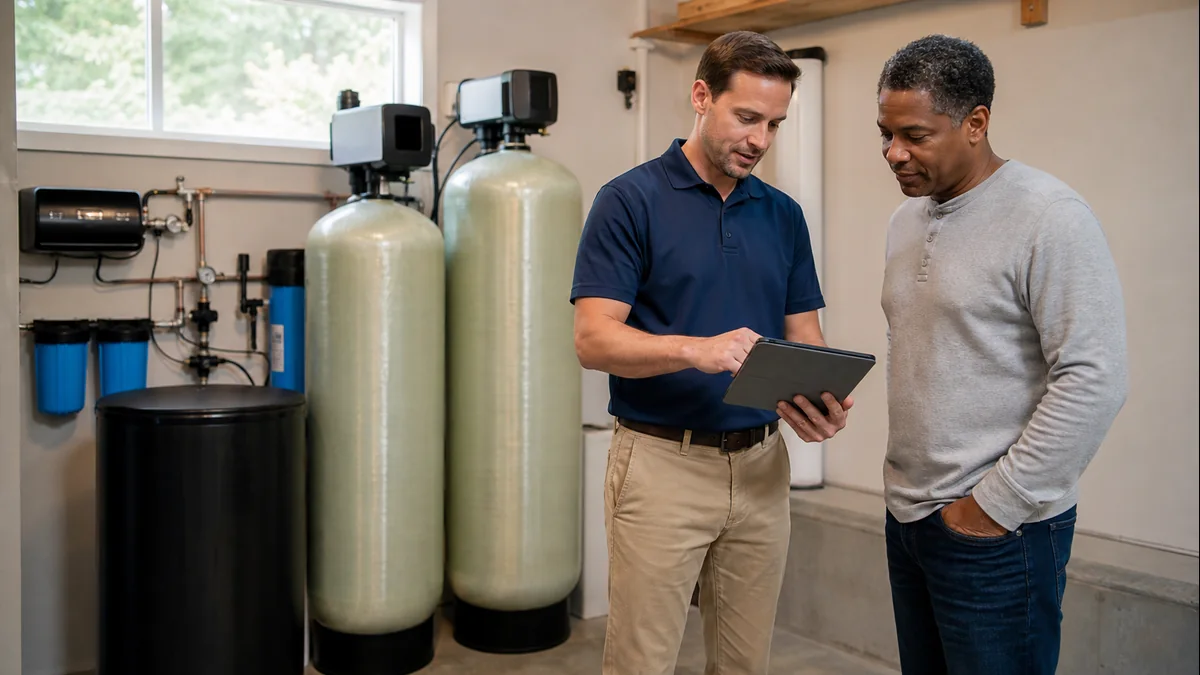
Direct answer: In Durham, a whole-home water softener system is priced and sized only after a free water analysis — well under what many national big-brand dealers quote (commonly $6,000 to $12,000) for a comparable whole-home setup. Durham runs its own water utility and doesn't publish a hardness figure at all, so the test is the only way to know what a specific house actually needs. That's also why the all-in-one system — softening plus carbon filtration — fits most Durham homes better than a softener alone.
What determines the cost of a water softener in Durham, NC?
The price comes from what a free water test finds at your address, not from a generic package. Six things move a Durham quote: tested hardness (sets the resin sizing), household size and daily water use, the number of bathrooms and fixtures drawing on the system, whether carbon filtration is added alongside softening, how complicated the install is at that house, and what it costs to run day to day. Every one of those is specific to your home, which is why an honest number can only come after someone measures your water and looks at your plumbing.
Why does Durham's water need a hardness test before pricing?
Because Durham doesn't publish a hardness number for its customers to compare against. The City of Durham runs its own municipal water utility, with its own treatment plant and its own annual water quality report. Durham Water reports 100% compliance with all drinking water quality standards in 2025 and says it routinely monitors more than 150 contaminants. That's a real, verified compliance record — but compliance is a legal safety floor. It confirms the water meets EPA standards; it says nothing about how hard the water is at a given tap, whether it carries a chlorine taste, or what disinfection byproducts are present. A free water test is the only way to know the actual hardness at your address, and it's the number the whole quote is built on.
How does household size affect the price?
More people in the house means more water moving through the system every day, and the equipment has to be sized to keep up without running out of capacity between cycles. A single-person household and a family of five put very different daily demand on a softener, even on the same water. This is one of the first things a water analysis captures, alongside the hardness reading.
How much do bathrooms and fixtures change the quote?
More bathrooms and fixtures mean more simultaneous demand, and the system has to be sized so pressure and softening capacity don't drop when multiple fixtures run at once. A two-bathroom house with one shower running is a different sizing problem than a four-bathroom house running two showers, a dishwasher, and a washer at once. That fixture count is part of what the visit checks before a number gets attached to the job.
Do I need the carbon filtration stage too, or just a softener?
On Durham's city water, the carbon stage is almost always part of the right answer, not an optional upgrade. Softening resin only addresses calcium and magnesium — the minerals that cause scale. It does nothing about chlorine or chloramine taste and smell, or disinfection byproducts, which is why the all-in-one configuration (softening plus carbon) is what most Durham homes end up with. Buying it as one combined install is simpler than treating softening and filtration as two separate projects later.
What makes installation more or less complex at a specific Durham house?
Three physical things at your house drive install labor: where the main water line enters the home, how accessible a drain is for the system's discharge, and whether the electrical setup near the install location is straightforward or needs extra work. A garage or basement install with an easy drain tie-in and a nearby outlet is simpler than a crawlspace install with a long drain run or limited electrical access. North Carolina law (N.C. Gen. Stat. § 87-21) treats installing a whole-house water treatment system as plumbing-contracting work done by a licensed plumbing contractor — one more reason installation is scoped at your house, not priced as a flat line item.
What does it cost to run a softener after it's installed?
Mostly salt, and how much salt depends on your tested hardness. Lower hardness means the softener regenerates less often and uses less salt, so it's inexpensive to run — and because Durham's hardness varies by address rather than following one town-wide number, running cost is one more reason the test matters. For a full breakdown of what softener salt actually costs to keep stocked, see our water softener salt cost guide.
What does it cost if I don't treat the water at all?
The cost shows up in your appliances, not on a monthly bill. Scale from untreated hard water builds gradually inside a water heater, a dishwasher, and a washing machine, and that buildup is cumulative — it doesn't reverse itself once it starts. A water heater working around scale on its heating element has to work harder to do the same job, and appliances carrying mineral deposits show it in spotting, film, and reduced efficiency over time. Treating the water up front protects that equipment; not treating it just moves the cost from a one-time install to a slow appliance replacement cycle instead. See hard water's cost to appliances for more.
What drives a Durham quote, and which direction it moves
| Cost driver | What it depends on | Pushes price lower | Pushes price higher |
|---|---|---|---|
| Tested hardness | Your free water test | Lower measured hardness | Higher measured hardness |
| Household size | Daily water use | Smaller household | Larger household |
| Bathrooms/fixtures | Simultaneous demand | Fewer fixtures | More fixtures |
| Carbon filtration | Whether it's added to softening | Softening only | All-in-one (softening + carbon) |
| Install complexity | Main line, drain access, electrical | Easy access | Tight or hard-to-reach space |
| Running cost | Tested hardness (salt use) | Lower hardness | Higher hardness |
Durham system cost versus a national big-brand quote
| Local all-in-one (Durham) | National big-brand | |
|---|---|---|
| Typical installed price | Set after a free water analysis | $6,000–$12,000 |
| Pricing basis | Free water test at your address | Often a generic or remote estimate |
| Hardness basis | Your actual tested reading | Often a regional average or none at all |
| What's addressed | Softening + carbon in one install | Varies by package, often softening-only unless upgraded |
A quote that only covers softening resin, sized to a generic household instead of a real test, can look competitive on paper and still leave chlorine taste and disinfection byproducts completely unaddressed. That's a different scope, not just a different price.
Getting an accurate number for your Durham home
The only way to know your real number is a free water analysis. It measures your actual tested hardness, checks your bathroom and fixture count, and looks at where the equipment can physically go — the variables that decide the quote, all answered before you commit to anything.
Frequently Asked Questions
I just moved to Durham and have no idea if my water is hard — where do I even start? Start with a free water test, since Durham doesn't publish a hardness figure the way some nearby towns do. The test gives you your actual reading, and that — plus your household size and fixture count — is what a real quote gets built from.
My neighbor in another town got a hardness number from their utility — why can't Durham tell me mine? Durham reports compliance with drinking water standards and how many contaminants it monitors, but it doesn't publish a hardness figure for customers to look up. That's exactly why a test matters more here — it's the only way to get a real number for your address.
I got a quote from a national company that only mentions a softener — is that the same as what I'd get locally? Not necessarily. A softening-only quote addresses scale and mineral buildup but does nothing about chlorine taste or disinfection byproducts, which the carbon stage handles. Compare scope, not just price.
How much does the size of my house actually change the price? Household size and bathroom count both factor into sizing, since more people and more fixtures mean more daily demand. A water analysis captures both alongside your hardness reading, and all three together determine where your quote lands.
Is it worth paying for the carbon stage if I only care about scale and spotting? The carbon stage handles chlorine and chloramine taste and disinfection byproducts — issues softening resin doesn't touch — so most Durham homes end up better served by the combined all-in-one system rather than softening alone.
What's the fastest way to get a real number instead of guessing from a website? A free water analysis. It measures your actual tested hardness and matches equipment to your household size, fixture count, and installation space.
Ready to get your number?
Take our 60-second water quiz to see which all-in-one system fits your Durham home, or request a free water analysis to get an exact quote based on your actual tested water, household, and install space.
Related reading: Water Softener in Durham, NC | Tankless Water Heater Scale in Durham, NC | All-in-One Water System Cost in NC | Water Softener Salt Cost Per Year | Hard Water's Cost to Appliances
Answer nine practical questions, then request a written quote or well-water analysis.
Start My Water Analysis