
What Determines Water Softener Cost in Fuquay-Varina, NC?
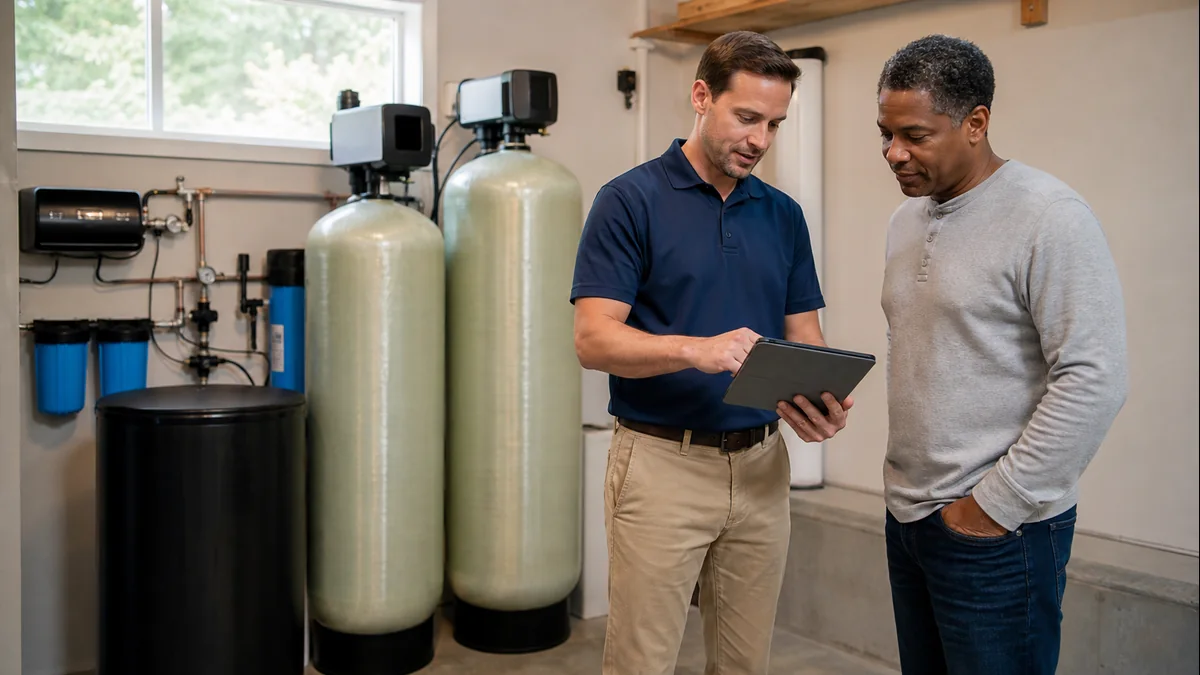
Direct answer: In Fuquay-Varina, a water softener's price is driven by six things: your address-level hardness reading, household water demand, whether a carbon stage is included alongside softening, plumbing access at your main line, licensed-plumber labor, and warranty coverage. Because Fuquay-Varina blends water from three different systems, no townwide number applies — a free water analysis is what actually sets an accurate quote.
What Determines the Cost of a Water Softener in Fuquay-Varina?
Six factors do almost all the work in shaping the final number:
- Hardness reading at your address. Fuquay-Varina blends treated water from three separate wholesale suppliers, so hardness isn't fixed the way it is in a single-source town — it depends on your street and which blend is dominant that week.
- Household water demand. More bathrooms, more people, and higher daily usage all mean a system needs more capacity to keep up without running dry between regeneration cycles.
- Carbon stage included or not. A softener that only handles calcium and magnesium is a narrower purchase than an all-in-one unit that also filters chlorine, chloramine, and disinfection byproducts.
- Plumbing access. Crawl space vs. slab, main-line location, and how far the unit sits from an electrical outlet and drain all affect labor time.
- Licensed-plumber labor. Installation is plumbing contracting work under state law, not a plug-in appliance swap — see below.
- Warranty coverage. What's covered on resin, tank, valve, and labor changes what a quote actually buys, not just what it costs upfront.
None of these get guessed at from a chart — they're the reason a real quote follows a real water test instead of preceding it.
Is Fuquay-Varina's Water Hard Enough to Need a Softener?
There's no single published hardness figure for Fuquay-Varina, and that's not a data gap — it's a feature of how the town gets its water. Fuquay-Varina buys treated water wholesale from three different systems (Raleigh Water, Harnett Regional, and Johnston County) and blends it across the distribution network, so a single townwide number wouldn't accurately describe any one address.
What we do know, from our own testing across the wider service area, is a measured range of 1.6 to 3.7 grains per gallon (gpg). On the WQA/Hach scale — the same scale the Hach Total Hardness Test Kit (Model 5-B) reads out on — that spans slightly hard (1.0–3.5 gpg) to moderately hard (3.5–7.0 gpg) depending on where in that range a given tap lands.
That's a real, address-dependent range, not a townwide guess borrowed from a single source utility. Minerals are cumulative regardless of which of the three blends is reaching your tap — calcium and magnesium build up gradually on fixtures, glassware, and inside a water heater over years of daily use.
Why Does a Blended Supply Change the Cost Conversation?
In a town with one treatment plant and one source, a plant-average hardness figure is at least a reasonable starting point for a rough quote. Fuquay-Varina doesn't have that — three source systems means a "townwide average" barely applies to any specific address, let alone yours.
That uncertainty is exactly why an address-level test matters more here than in most Triangle towns, and why plumbing access matters just as much as hardness in shaping the final cost. A technician who tests at your home also sees your actual main-line location, crawl space or slab layout, and drain access — the same visit that gives you a real hardness number also gives the installer the real labor picture.
| Approach to pricing | What it tells you | Reliable for Fuquay-Varina? |
|---|---|---|
| Using Raleigh's published hardness figure | Raleigh's own reservoir source only | No — only one of three blends reaching town |
| Using a national "average" hardness estimate | Nationwide well/municipal averages | No — doesn't reflect any local blend |
| Free water analysis | Your home's actual current water and plumbing access | Yes — the only inputs a real quote should use |
Should I Pay for an All-In-One System or Just a Standalone Softener?
A bare softener and an all-in-one system aren't the same purchase, and the price difference reflects that. A standalone softener is ion exchange only — it swaps out calcium and magnesium and stops there, with no effect on chlorine, chloramine taste, or disinfection byproducts.
An all-in-one system pairs that same softening resin with a carbon filtration stage in one unit and one appointment, covering hardness and taste/quality issues together. That distinction matters in Fuquay-Varina specifically: all three source systems feeding the town are surface-water sources, meaning each requires disinfection that can leave behind chlorine taste and disinfection byproducts like HAA9 and TTHM.
That gap isn't cosmetic. EPA's National Primary Drinking Water Regulations table lists real long-term health effects tied to exposure above the legal limit: for total trihalomethanes (TTHMs), "liver, kidney or central nervous system problems; increased risk of cancer"; for haloacetic acids (HAA5), "increased risk of cancer." Fuquay-Varina's public water systems are legally compliant — but compliant is a ceiling set by EPA's own risk tolerance, not a guarantee of zero risk. A carbon stage removes those compounds directly instead of relying on staying under a legal limit, regardless of which of the three blends is dominant in your area that month.
What Does Licensed Installation Add to the Cost (and Why It's Required)?
Installation cost isn't optional overhead — it's state law. Under North Carolina General Statute 87-21, installing or replacing a whole-house water purification or treatment system is licensed plumbing contracting work, the same category that covers water heaters and gas furnaces. A DIY box kit skips that requirement; a professional main-line tie-in doesn't.
That's why a legitimate quote includes labor by a licensed contractor, not just equipment cost — and why plumbing access (crawl space, slab, distance to a drain and outlet) is part of what a real quote is priced on. Verify a contractor's license before you sign anything.
How Much Do National Big-Brand Systems Cost Compared to a Local Quote?
National big-brand water treatment dealers commonly quote $6,000–$12,000 for a comparable whole-home softening-and-filtration setup, frequently after an in-home sales visit where the number gets built around the household rather than off a standardized test. That range is a useful anchor for what "whole-home" pricing looks like nationally.
Triangle Waterworks doesn't publish a fixed price for the same reason a single Fuquay-Varina hardness number doesn't exist: every home's blend, plumbing, and usage are different enough that a real number only means something once it's built off your actual water analysis and a look at your main line.
| All-In-One System | Standalone Softener Only | National Big-Brand Whole-Home | |
|---|---|---|---|
| Pricing model | Quoted after a free water analysis and plumbing check | Varies by installer, often lower up front | $6,000–$12,000, typically after an in-home sales visit |
| Softening (hardness) | Yes | Yes | Yes |
| Carbon (chlorine/chloramine + TTHM/HAA5 exposure) | Yes | No | Varies by model/add-on |
| Installation | Licensed NC plumbing contractor (NCGS 87-21) | Varies | Varies |
| Warranty terms | Spelled out in writing before install | Varies | Often summarized verbally at a sales visit |
What Affects Ongoing Cost After Installation?
The purchase price isn't the only number that matters — how the system runs afterward depends on the same hardness reading that shaped the initial quote. Lower hardness means fewer regeneration cycles and less salt used per year, a real ongoing advantage if your Fuquay-Varina address tests toward the lower end of the 1.6–3.7 gpg range.
Salt cost itself is a small, predictable annual line item regardless of where your reading falls — see our salt-cost breakdown for what that actually looks like year to year. None of this is a reason to wait on a test; it's the opposite. A test is what tells you which side of that ledger your home falls on, and it's free either way.
FAQ
I just moved to Fuquay-Varina and got two very different softener quotes — why the gap? Usually because they're quoting different things: one may only cover softening while the other includes a carbon stage, or they're sizing off different assumptions about your household demand and plumbing access. Ask each company what the system treats and what the price is sized from, and the gap usually explains itself.
Does Fuquay-Varina have hard water, or is it slightly hard like Raleigh? There's no single answer, because Fuquay-Varina blends water from three different systems and no townwide figure applies evenly across every address. Raleigh Water runs about 1.6 gpg, which is "slightly hard" on the WQA/Hach scale rather than soft. Our own testing across the service area measures 1.6–3.7 gpg, spanning slightly hard to moderately hard depending on the tap — the only way to know your own number is a free test at your address.
Why doesn't Triangle Waterworks list a price online? Because a fixed number wouldn't be accurate for most homes. Hardness, household demand, plumbing access, and whether you want carbon filtration alongside softening all change what a system needs to do, so every quote follows a free water analysis rather than preceding it.
I got a national-brand quote around $8,500 — why would a local quote look different? National big-brand dealers commonly price a comparable whole-home setup between $6,000 and $12,000, often after an in-home sales visit that shapes the final number. A local, water-test-first quote is built off your actual hardness reading and your home's plumbing access rather than a sales-visit estimate, so the two numbers can land in different places even for similar equipment.
Does the quote include carbon filtration, or is that a separate add-on? For an all-in-one system, softening and carbon filtration are quoted together as one system and one install, not as a base price plus a carbon upcharge. That's the distinction worth checking for when comparing any two quotes side by side.
Do I need a permit to install a water softener in Fuquay-Varina? Whole-house water treatment installation is licensed plumbing contracting work under North Carolina General Statute 87-21, the same category that covers water heaters and furnaces. Verifying that your installer holds a valid NC plumbing license — rather than assuming it isn't needed — is worth doing before you sign anything.
Chlorine, disinfection byproducts, and mineral buildup don't pause while you compare quotes, and every day on untreated water is another day of exposure and buildup you don't have to accept. Take the free quiz to get a sizing direction for your specific Fuquay-Varina address, or book a free water analysis — the real number is one visit away, not a decision to put off.
Related reading: Water Treatment in Fuquay-Varina, NC · All-in-One Water System Cost in North Carolina · Water Softener vs. All-in-One System · How to Choose a Water Treatment Company in Fuquay-Varina, NC
Sources
- North Carolina General Assembly — General Statute § 87-21, Definitions; contractors licensed by Board
- EPA — National Primary Drinking Water Regulations
Answer nine practical questions, then request a written quote or well-water analysis.
Start My Water Analysis