
What Drives Water Softener Cost in Garner, NC?
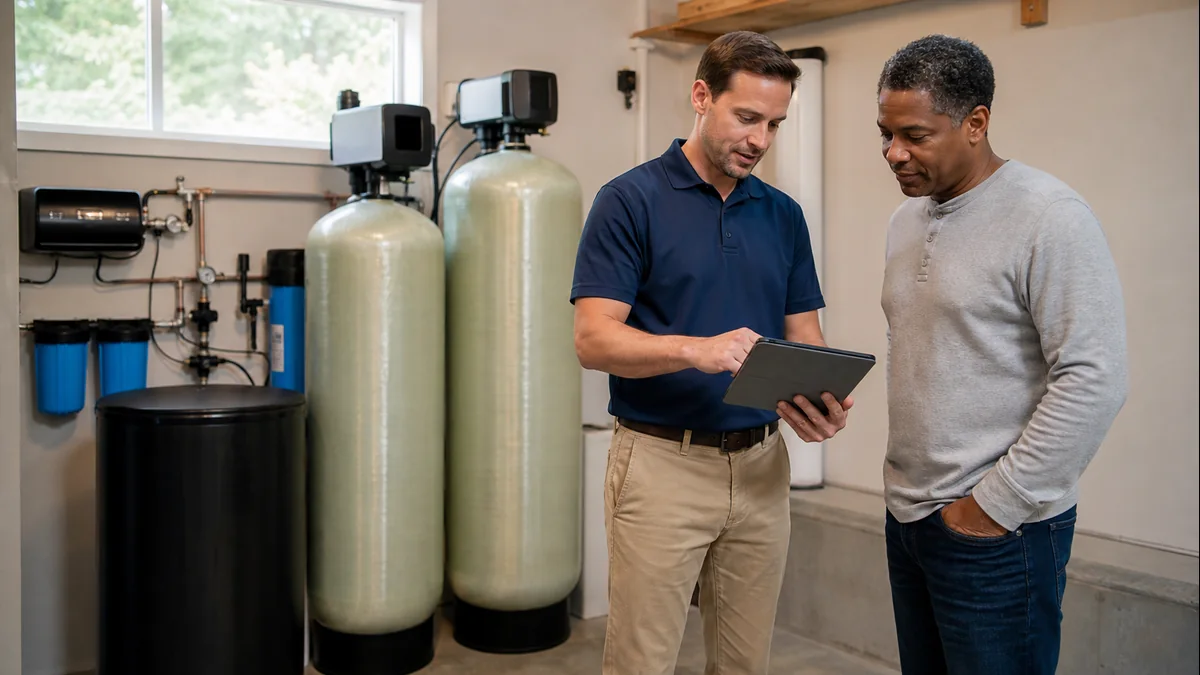
Direct answer: Water softener cost in Garner depends on six factors: your address's measured hardness, household size and peak water flow, whether carbon filtration is bundled in, how accessible your plumbing tie-in is, the licensed-plumber labor installation requires under North Carolina law, and your warranty terms. National big-brand whole-home systems commonly run $6,000–$12,000 — the only way to get an exact number for your own home is a free water analysis.
What determines water softener cost in Garner, NC?
No two Garner homes get priced the same, because the price follows what's actually true about that specific house rather than a flat catalog number. Garner is on Raleigh Water, the same utility that supplies Raleigh, Knightdale, Rolesville, Wake Forest, Wendell, and Zebulon — but hardness still varies by ZIP within that system, and so does the household's own water demand.
The six factors below are the real levers. A company that quotes a number before checking any of them is guessing, not pricing.
| Cost driver | Why it moves the price |
|---|---|
| Hardness measured at your address | Sets resin volume and regeneration frequency |
| Household size / peak water flow | Sets the softener's grain capacity and flow rate |
| Carbon filtration included or not | Adds a treatment stage for chlorine, chloramine, and disinfection byproducts |
| Plumbing tie-in accessibility | Crawl space, slab, or finished basement all change labor time |
| Licensed-plumber labor | Required by NC law for the main-line tie-in |
| Warranty terms | Parts, labor, and tank coverage differ by term length |
Does Garner's water hardness affect the price?
Yes — hardness is the single biggest driver of resin volume and how often the system needs to regenerate. Raleigh Water, which serves Garner, tests at roughly 1.6 grains per gallon (gpg), which lands in the "slightly hard" band on the Water Quality Association (WQA) scale — the same scale the Hach Total Hardness Test Kit, Model 5-B, reads out in grains per gallon.
Our own testing across the wider service area measures 1.6 to 3.7 gpg depending on ZIP code, and 3.7 gpg (about 63 mg/L) crosses into "moderately hard" territory. A townwide average doesn't tell you which end of that range your own tap falls on, and a company that skips testing your address is sizing — and pricing — blind.
Why does household size change the cost?
A bigger household runs more water through the system at once, and the softener has to be sized to keep up without running out of capacity during peak use — a shower, the dishwasher, and a laundry load all running together. Undersizing saves money up front but leaves the system short during exactly the moments it matters most; oversizing spends more without adding benefit. Getting this number right depends on your home's actual usage pattern, not a guess based on square footage or bedroom count.
Does the price change if carbon filtration is included?
Yes, and this is the split that matters most for Garner specifically. A softener alone only handles calcium and magnesium — the minerals behind spotty glasses and gradual scale buildup. It does nothing about chlorine, chloramine, or disinfection byproducts, because ion exchange isn't built to touch any of them.
Raleigh Water's own data in the EWG Tap Water Database shows TTHM at 21.7 ppb, legally compliant with EPA's 80 ppb limit, alongside HAA9 at 19.9 ppb — a nine-compound total EWG tracks that EPA does not separately regulate (its enforceable limit covers the five-compound HAA5 group at 60 ppb). "Legally compliant" is a ceiling set by EPA's own risk tolerance, not a guarantee of zero risk. EPA's National Primary Drinking Water Regulations table lists the potential health effects of long-term exposure to TTHMs above the MCL as "liver, kidney or central nervous system problems; increased risk of cancer," and HAA5's listed effect as "increased risk of cancer." Those are the exact compounds EPA had in mind when it set that legal ceiling — a carbon stage removes them rather than relying on staying under the limit.
That's why an all-in-one system — softening resin plus a carbon stage in one unit — costs more than softening alone, but covers both halves of what's actually in Garner's water instead of just one. Our all-in-one system cost breakdown walks through how that pricing works statewide.
Does my plumbing access affect the installation cost?
Yes — where the softener ties into your main line changes how much labor the job takes. A crawl space with easy access, a slab foundation, and a finished basement each require different work to route the tie-in and drain line, and that labor time is part of what a quote reflects. This is one more reason a phone estimate can't be accurate: the only way to know your home's access situation is to look at it.
Why does licensed-plumber labor matter for the price?
Under North Carolina law, installing or replacing a whole-house water purification or treatment system is plumbing contracting (N.C. Gen. Stat. § 87-21) — the tie-in to your main supply line is licensed work, not a plug-in appliance swap. That labor is priced into any legitimate quote. A price that looks unusually low is worth asking about directly: who is doing the tie-in, and are they licensed for it?
What should be covered in the warranty I'm paying for?
Warranty length and what it actually covers — resin, tank, valve, and labor, each spelled out separately — is part of the price you're comparing, not a detail to skip past. Get it in writing rather than a verbal summary, and compare coverage line by line against any competing quote. Our guide on what to look for in a water system warranty breaks down what a real warranty should include.
How much do national big-brand chains charge in Garner?
National big-brand whole-home systems commonly run $6,000–$12,000, largely reflecting franchise overhead and national ad spend layered on top of the equipment itself — not a difference in the softening resin. A locally installed all-in-one system is priced after a free water analysis sizes it to your specific home, with a licensed plumber doing the tie-in and servicing it afterward. Our breakdown of what an all-in-one system costs across NC and our comparison of a standalone softener versus an all-in-one system go deeper on how that comparison plays out.
What actually keeps ongoing costs down after installation?
Salt is the main recurring cost for the softening side, and Garner's relatively low measured hardness works in your favor here — a system sized correctly for 1.6–3.7 gpg regenerates less often and uses less salt than one sized for genuinely hard water elsewhere in the state. Our breakdown of water softener salt cost per year shows what that actually looks like across a typical Triangle household.
Get the number that actually applies to your home
Every driver above — hardness, household size, carbon inclusion, plumbing access, labor, and warranty — depends on facts specific to your address, not a townwide average. That's worth pinning down now, not guessing at while you compare quotes. Book a free water analysis and get the exact hardness reading and a price built around your own home, or take our 60-second water quiz to see which all-in-one system fits first.
FAQ
I just moved to Garner and got two very different quotes — why the gap? Usually because the quotes are pricing different things: one may cover softening only while the other bundles in carbon filtration, or they're using different sizing assumptions for your household. Ask each company exactly what's included and what the price is sized from — the gap almost always traces back to one of the factors above.
Does a bigger house always mean a more expensive system? Not directly — square footage isn't the driver, peak water flow and household size are. A smaller household with several bathrooms running at once can need more capacity than a larger house with lower simultaneous demand, which is why sizing comes from a real usage assessment rather than a floor-plan guess.
My crawl space is tight — will that raise my installation cost? It can, because tie-in labor time depends on how easily a licensed plumber can access your main line and route the drain connection. It's worth mentioning your home's layout when you book your free analysis so the visit accounts for it up front rather than surprising you later.
Is it worth paying more for carbon filtration if my water is only slightly hard? Yes — carbon addresses something hardness has nothing to do with. Chlorine, chloramine taste, and documented disinfection byproducts like HAA9 and TTHM are present in Raleigh Water's supply regardless of how hard or soft the water tests, so the carbon stage is solving a separate problem than the softening resin.
What's the fastest way to get an accurate number instead of an estimate? A free water analysis, which tests your actual hardness and reviews your plumbing access and household usage on site — that's the only input set that produces a real number instead of a townwide guess.
Does the warranty length change the total price much? It can, since longer coverage on parts and labor is worth more and should be reflected honestly in what you're quoted. Ask to see warranty terms in writing before comparing prices, not just hear them summarized verbally.
Sources
- EWG Tap Water Database — City of Raleigh (PWS NC0392010)
- EPA — National Primary Drinking Water Regulations
- North Carolina General Assembly — General Statute § 87-21, Definitions; contractors licensed by Board
Related reading: Water Treatment in Garner, NC | How to Read Your Water Quality Report in Garner, NC | Water Softener vs. All-in-One System
Answer nine practical questions, then request a written quote or well-water analysis.
Start My Water Analysis