
Water Softener in Durham, NC: What Compliance Doesn't Tell You
Direct answer: Durham runs its own municipal water utility, City of Durham Water, which publishes its own annual water quality report and monitors more than 150 contaminants — its 2025 report showed 100% compliance with federal standards. That's a real, meaningful floor, but compliance is a legal safety bar, not a promise of soft, mineral-free, or great-tasting water. No verified hardness figure has been published for Durham, so a free water analysis is the right first step, followed by an all-in-one softening and carbon system sized to your home's actual numbers.
Does Durham Have Its Own Water System?
Yes — unlike towns that purchase treated water wholesale from a neighboring utility, Durham operates its own water utility, City of Durham Water, with its own treatment plants and its own annual water quality reporting. That's worth knowing because it means Durham's water isn't a blend of someone else's system reports — Durham publishes its own numbers, on its own testing schedule, for its own customers.
The utility's 2025 annual report showed 100% compliance with federal drinking water standards and stated that Durham monitors more than 150 different contaminants. That's a genuinely strong compliance record, and it means Durham water meets every legal safety requirement the EPA sets.
Does 100% Compliance Mean Durham Water Is Hard or Soft?
Compliance and hardness are two entirely different measurements, and Durham's compliance report doesn't answer the hardness question either way. No verified grains-per-gallon (gpg) figure for Durham's municipal supply has been published in a form we can confidently point to, so we won't guess at one — a "compliant" reading and a "soft" reading aren't the same test, and conflating them would do Durham homeowners a disservice.
What that means practically: the only way to know your Durham home's actual hardness is to test it directly. Once you have that number, sizing a softener is simple math — household size × daily water use × your tested gpg. Our softener sizing guide walks through that formula step by step once your home has a real reading.
What Does "100% Compliant" Actually Mean — and What Doesn't It Cover?
Federal compliance is a legal floor: it means the levels of regulated contaminants in Durham's water stay under the limits the EPA sets to protect public health. It's an important standard, and Durham meeting it across 150+ monitored contaminants is a real credential for the utility.
What compliance doesn't measure is comfort, taste, or mineral content:
- Hardness (calcium and magnesium buildup) isn't a compliance metric at all — the EPA doesn't regulate hardness because it isn't a health hazard, just a household nuisance that scales water heaters, dulls dish and glassware shine, and leaves mineral buildup in pipes and fixtures over time.
- Chlorine taste and smell are a byproduct of disinfection, which every municipal utility uses to keep water safe — being "compliant" doesn't mean chlorine taste is absent, just that disinfectant levels stay within legal limits.
- Disinfection byproducts (compounds like HAA9 and TTHM that form when disinfectant reacts with organic matter) are regulated and tracked as part of compliance, but "under the legal limit" and "not present" are different things — a compliant reading can still carry a measurable DBP load.
| Question | Does compliance answer it? |
|---|---|
| Is the water legally safe under EPA rules? | Yes — that's what compliance measures |
| Is the water hard or soft (mineral content)? | No — hardness isn't a compliance metric |
| Does the water have a chlorine taste or smell? | No — disinfection is required regardless of taste |
| Are disinfection byproducts fully absent? | No — compliance means under the legal limit, not zero |
So What Should a Durham Homeowner Actually Test For?
Since Durham's compliance report doesn't include a hardness figure, and hardness genuinely does vary from home to home based on plumbing age and local conditions, a free water analysis is the step that actually answers the question a compliance report can't: what is my water doing in my house, at my tap, right now?
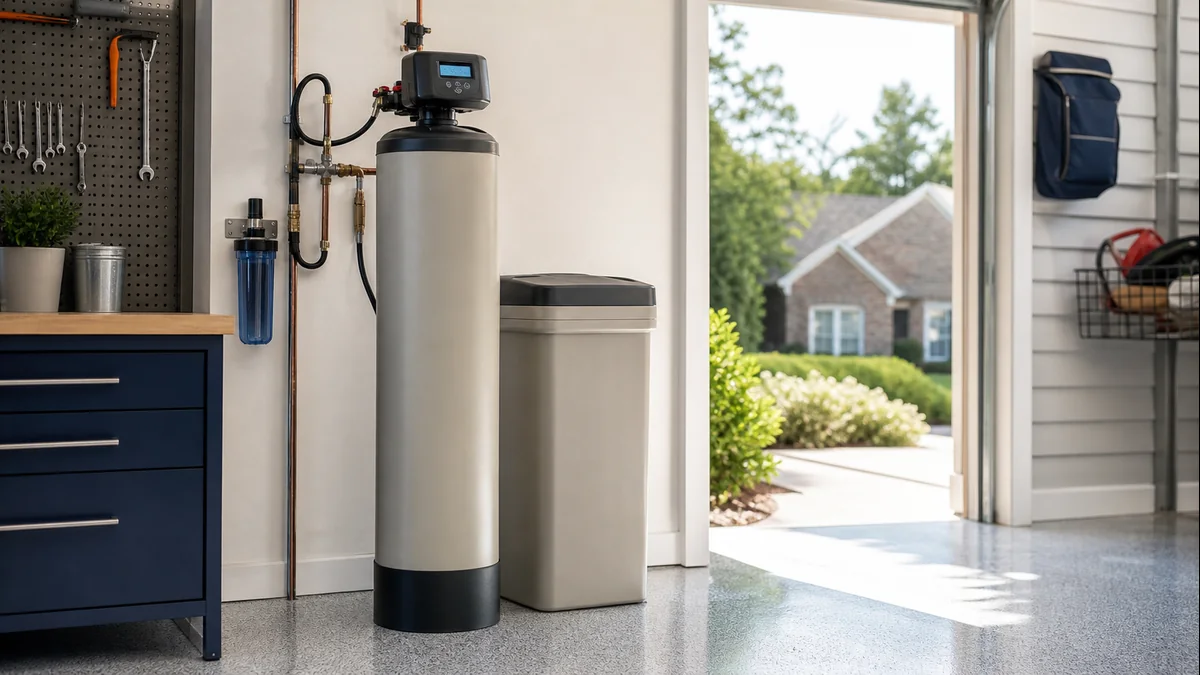
That test gives you a real hardness reading (for sizing a softener correctly) plus a read on chlorine levels and taste — the two things that determine whether your household benefits more from softening, carbon filtration, or both. For the large majority of Durham homes, the answer is both, which is why Triangle Waterworks builds every recommended system as a single all-in-one unit: softening resin sized to your tested hardness, paired with a carbon filtration stage that handles chlorine taste, smell, and disinfection byproducts in the same footprint.
Why Pair a Softener With Carbon Filtration in Durham?
A softener is an ion-exchange system, full stop — it swaps calcium and magnesium ions for sodium ions, which is exactly what stops scale from building up in your water heater, dishwasher, washing machine, and pipes. It does nothing for taste, smell, or chemical byproducts, because that was never its job.
Carbon filtration is the other half: activated carbon adsorbs chlorine, removes the taste and smell it leaves behind, and reduces disinfection byproducts like HAA9 and TTHM. Since Durham's utility (like every municipal system) disinfects to stay compliant, some level of chlorine taste is a normal part of city water here — carbon is what addresses it.
Putting both in one system means a Durham home gets full coverage — appliance protection on the hardness side, better-tasting water on the carbon side — without stacking two separate units or maintenance schedules. See our comparison of whole-house filters and water softeners for how the two technologies divide the work, and what a strong whole-house filter for city water looks like for the filtration side specifically.
Pricing is set after a free water analysis, and it typically lands well under the $6,000–$12,000 commonly quoted for comparable national big-brand whole-home installs.
Frequently Asked Questions
Is Durham water hard or soft? There's no verified hardness figure published for City of Durham Water at this time, so we won't state one. The utility's 2025 report confirms 100% federal compliance and monitoring of 150+ contaminants, but compliance doesn't measure hardness — a free water analysis is the only way to get your home's actual reading.
I just moved into an older home in Durham and my glassware comes out spotty — what's going on? Spotting is a classic sign of hard water minerals, and it's common in older Durham homes regardless of exactly where the neighborhood falls on the hardness scale, since mineral buildup compounds over years of use. A water analysis will confirm your home's actual hardness so a softener can be sized correctly instead of guessed at.
Does Durham's 100% compliance rating mean I don't need to treat my water? Compliance means Durham's water meets every federal safety standard — it's a real credential, and it says nothing about hardness, chlorine taste, or how the water feels in your home. Most Durham households still get real, tangible benefits from an all-in-one softening and carbon system: less scale on fixtures and appliances, and better-tasting, better-smelling water at the tap.
What's the difference between "compliant" and "safe to drink" versus "good tasting"? Compliant and safe to drink describe meeting the EPA's legal health standards, which Durham's water does. Good tasting is a separate, subjective quality that depends on chlorine levels and disinfection byproducts — carbon filtration is what improves that side, independent of the legal compliance picture.
How do I find out my actual water hardness in Durham since the utility doesn't publish one? A free water analysis is the way to get a real number for your specific address — testing at your tap accounts for local plumbing and conditions that a citywide average wouldn't capture even if one existed. From there, softener sizing is a straightforward formula based on your household's daily usage and that tested gpg reading.
Are there local companies that do water treatment work in the Durham area? Yes — see our roundup of water filtration companies serving the Raleigh area for how the regional options compare, several of which also serve Durham. Whichever company you choose, insist on a real test of your water before agreeing to any system size.
See What Your Durham Home Actually Needs
Durham's compliance report is a good sign for the utility, but it isn't a substitute for knowing your own water. Take our 60-second water quiz or book a free water analysis to get your home's real hardness and chlorine readings, and get matched with an all-in-one softening + carbon filtration system sized to what your tap actually delivers.
Answer nine practical questions, then request a written quote or well-water analysis.
Start My Water Analysis