
Does a Water Softener Lower Your Water Heater Energy Bill in Cary, NC?
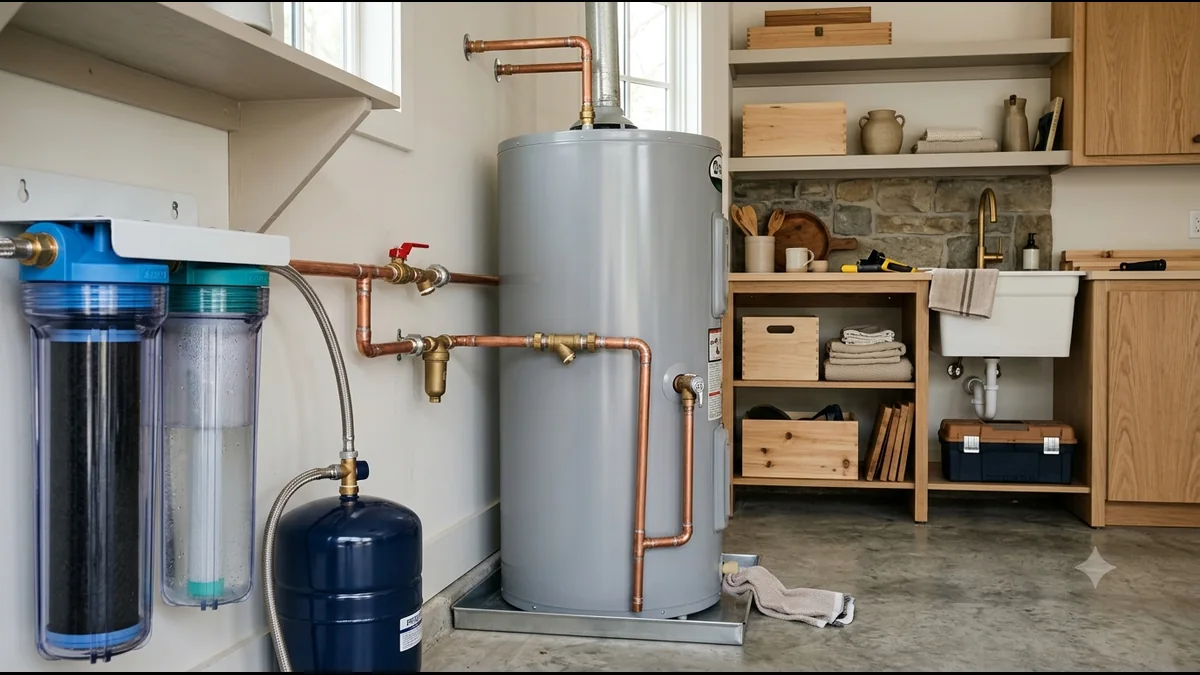
Direct answer: A 2009 lab study (Battelle Memorial Institute, funded by the Water Quality Research Foundation) found scale from unsoftened water measurably hurt gas water heater efficiency — but the test used an accelerated protocol on water far harder than Cary's, so there's no verified dollar or percentage savings figure for a Cary bill. What's real and local: mineral buildup on a heater's tank or elements is cumulative over the appliance's life, and an all-in-one softening-and-carbon system protects against it while running cheaply on the Triangle's own hardness range.
Does a Water Softener Lower a Water Heater's Energy Bill?
There's no verified number for what that means on a Cary utility bill — but the mechanism behind the question is real. The most detailed test is a 2009 study by Battelle Memorial Institute, funded by the Water Quality Research Foundation (WQRF), which tracked 30 water heaters over 90 days on an accelerated laboratory scaling protocol designed to build scale far faster than a normal home would. That study measured real efficiency and scale differences between softened and unsoftened water — the figures below are pulled straight from it. What it didn't produce is a dollar figure or a percentage off anyone's actual bill, because the test water was harder and the exposure was accelerated in ways a real Cary home doesn't experience. We don't translate lab scale numbers into a monthly savings estimate, because the study doesn't support one.
What Did the Battelle/WQRF Study Actually Find?
It found that scale buildup measurably reduced gas water heater efficiency and clogged the outlet piping on every unsoftened unit tested before the 90-day period finished. By heater type:
- Tankless (instantaneous) gas water heaters on unsoftened water: average thermal efficiency fell from 80% to 72% by the point equivalent to 1.6 years of field service, at which point the units had to be delimed. After deliming, efficiency recovered only to about 77%, still below the starting point. On softened water, tankless units held 80% throughout.
- Gas storage water heaters on unsoftened water: thermal efficiency dropped from 70.4% to 67.4% at the equivalent of two years of field service. On softened water, gas storage units held steady at 70.4%.
- Electric storage water heaters: thermal efficiency did not drop in a measurable way (99.5% unsoftened vs. 99.3% softened). The honest story for electric heaters isn't an efficiency loss — it's scale accumulating directly on the heating element, a durability and service-life issue rather than a measured efficiency one.
- None of the unsoftened units completed the 90-day test. Scale built up in the outlet piping until flow couldn't be maintained, and the units had to be pulled.
How Much Scale Actually Built Up in the Study?
Scale accumulation was tracked separately by heater type. On gas storage units, unsoftened water produced roughly 528 grams of scale per year versus about 7 grams per year softened. On electric storage units, unsoftened water produced roughly 907 grams per year versus about 14 grams per year softened. Carbon footprint for gas storage units ran 0.066 kg CO₂ per gallon of hot water unsoftened versus 0.056 kg CO₂ per gallon softened. These figures are real and verified, but specific to the study's own accelerated lab conditions — not to any particular home's actual water use.
Why Doesn't This Translate Into a Cary Bill Estimate?
Because the study ran on water much harder than Cary's, using an accelerated protocol built to produce scale fast rather than mimic a real Triangle home's pace of buildup. The Town of Cary's Public Works FAQ publishes a plant-average finished hardness of 25–30 ppm (about 1.5–1.75 gpg), which Cary calls very soft. Triangle Waterworks' own testing across Cary, Apex, and Morrisville measures a wider range — 1.6 to 3.7 gpg, varying by ZIP code — spanning slightly hard to moderately hard on the Water Quality Association (WQA) scale used by the Hach Total Hardness Test Kit, Model 5-B. Both figures are accurate at once: one is a plant average, the other address-level, and only a test at your own tap settles where your house falls.
Even at the top of that range, Cary's water is nowhere near the harder test water Battelle used to force scale formation inside 90 days. So: scale accumulates far more slowly here than in the study, there's no verified way to scale the lab results down to a real Cary figure, and the underlying chemistry — minerals depositing on heating surfaces — still applies, just at a slower pace.
Does That Mean Scale Isn't Worth Worrying About in Cary?
No — it means the timeline is longer, not that buildup doesn't happen. Buildup on a heater's tank walls or elements is cumulative: it doesn't reset, and every year of unsoftened water use adds more scale on top of what's already there. An all-in-one whole-home system (softening resin paired with carbon filtration) intercepts that mineral load before it reaches the heater, so the appliance keeps running closer to the efficiency it left the factory with, for longer. For a closer look at how that buildup shows up on a tank over time, see water heater scale buildup in Cary, NC and preventing water heater scale buildup. Tankless units have their own version of the same story — see tankless water heater scale in Durham, NC.
Unsoftened vs. Softened Water Heater Impact (Battelle/WQRF Lab Conditions)
| Unsoftened water | Softened water | |
|---|---|---|
| Tankless gas thermal efficiency | Fell 80% → 72%, recovered only to ~77% after deliming | Held at 80% |
| Gas storage thermal efficiency | Fell 70.4% → 67.4% at 2-year equivalent service | Held at 70.4% |
| Electric storage thermal efficiency | No measured drop (99.5%) — scale hit the element instead | No measured drop (99.3%) |
| Scale, gas storage | ~528 g/yr | ~7 g/yr |
| Scale, electric storage | ~907 g/yr | ~14 g/yr |
| Test completion | None finished — outlet piping clogged | Completed the full test |
This table reflects Battelle's accelerated lab protocol on harder-than-Cary water — it shows the mechanism, not a projected Cary bill.
What's the Honest Reason to Care About This in Cary?
Two things, and both are genuine advantages, not a hedge. First, buildup is cumulative over a water heater's life — softening resin keeps calcium and magnesium out of the tank and off the elements for as long as the system runs, protecting the appliance and the efficiency it left the factory with. Second, because Cary's measured hardness tops out well below the water Battelle used to force scale formation, a system sized for this area regenerates rarely and uses comparatively little salt — it's inexpensive to run here. That's a reason to buy, never a reason to hesitate. Hardness also isn't the whole story with Cary's water: it carries a chloramine residual, disinfection byproducts, and detectable PFAS from its Jordan Lake source, all legally compliant with EPA limits but still measurable — which is why the recommended system pairs softening resin with carbon filtration in one install, covering heater protection and taste/contaminant reduction together. National big-brand installers commonly quote $6,000 to $12,000 for comparable whole-home coverage; Triangle Waterworks prices each system after a free water analysis. See water softener Cary, NC for the fuller picture, and water softener salt cost per year for why the system stays cheap to operate at local hardness levels.
See What Your Cary Address Actually Measures
The only way to know where your home falls in the 1.6–3.7 gpg range — and what that means for your water heater over time — is a test at your own tap. Take the 60-second water quiz to see which all-in-one system fits your home, or book a free water analysis with Triangle Waterworks.
Frequently Asked Questions
I just bought a house in Cary with an older gas water heater — should I worry about scale inside the tank? It's worth knowing about, even though Cary's measured hardness is well below the accelerated lab conditions behind the Battelle/WQRF study's biggest numbers. Scale buildup is cumulative, so an older unsoftened heater has had more years to accumulate deposits. A free water analysis can tell you where your address falls in the local 1.6–3.7 gpg range.
My water heater in Cary is only a few years old — is a softener even going to make a measurable difference? No verified study translates that into a specific number for a home at Cary's hardness level. What the Battelle/WQRF research does establish is the mechanism: unsoftened water deposits scale continuously, and that buildup compounds the longer a heater runs unsoftened. Starting sooner means less cumulative buildup over the appliance's life.
Does a water softener really save money on my water heating bill, or is that just marketing? There's no verified dollar or percentage figure for what softened water saves on a hot water bill, in Cary or anywhere else, so we won't quote one. What is verified is that unsoftened water produced measurably faster scale buildup and lower thermal efficiency in the Battelle/WQRF lab study.
Why did none of the water heaters in the study finish the test on unsoftened water? Scale built up inside the outlet piping until flow couldn't be maintained, forcing those units out of the 90-day test. That happened under an accelerated protocol using water much harder than Cary's, so it's not a timeline to expect at home — it's evidence of how far unaddressed scale buildup can go.
Does an electric water heater need a softener less than a gas one, since its efficiency didn't drop in the study? Not necessarily. Electric storage heaters didn't show a measured efficiency drop, but scale still accumulated on the heating element itself (about 907 g/yr unsoftened versus about 14 g/yr softened) — a durability and service-life concern rather than an efficiency one. Softening resin addresses that buildup on gas or electric units either way.
How do I find out my actual water hardness in Cary before deciding whether this matters for my home? A free water analysis from Triangle Waterworks measures your address directly rather than relying on the Town's plant-average figure. For an at-home check between visits, the Hach Total Hardness Test Kit, Model 5-B, reports results in grains per gallon on the same WQA scale Triangle Waterworks uses across the service area.
Answer nine practical questions, then request a written quote or well-water analysis.
Start My Water Analysis