
What to Expect From Water Softener Installation in Cary, NC
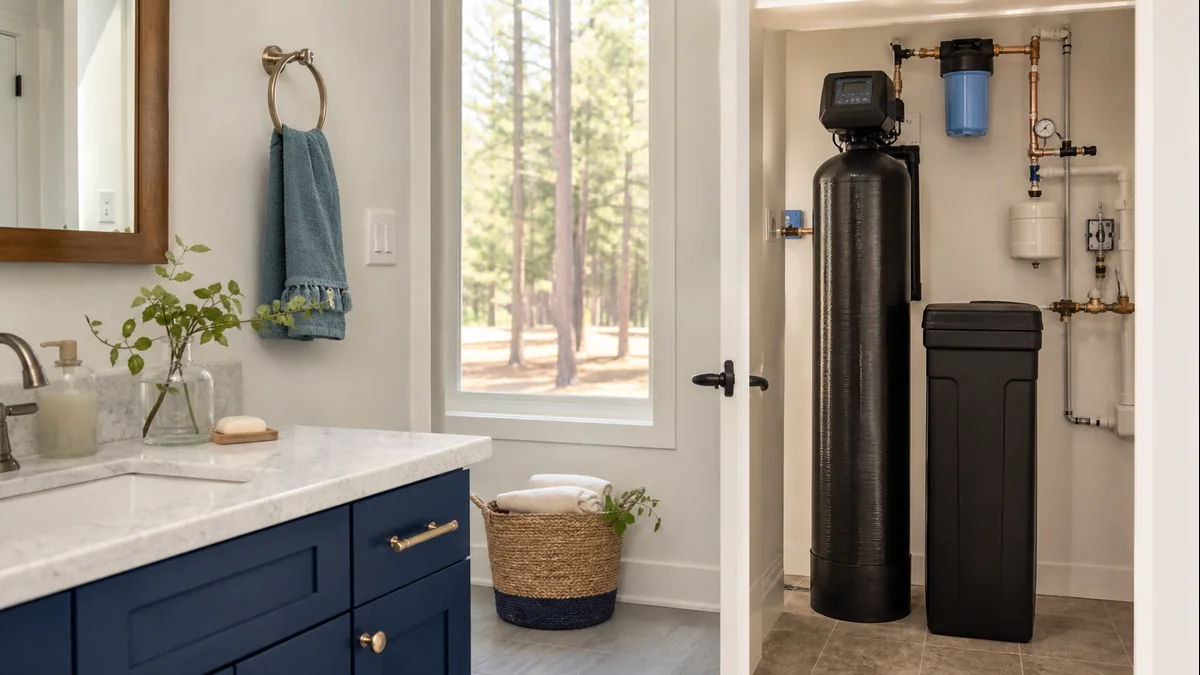
Direct answer: Water softener installation in Cary starts with a free water analysis that tests your tap's actual hardness, then a licensed plumbing contractor ties an all-in-one softening-and-carbon system into your main line so the whole house runs downstream of it. The unit is programmed to what your test shows — not a citywide average — which matters in Cary, where hardness varies by ZIP and the water also carries chlorine, chloramine, and PFAS that softening alone never touches.
What happens before installation day in Cary?
Before anything gets installed, a free water analysis tests your water directly at your address. Cary's finished water comes from the Cary/Apex Water Treatment Facility, drawing from B. Everett Jordan Lake in the Cape Fear River Basin, and treated water leaving that plant isn't necessarily what comes out of your particular tap — hardness in the homes Triangle Waterworks has tested runs 1.6 to 3.7 gpg, slightly hard to moderately hard on the Water Quality Association scale the Hach test kit uses, and where a given address falls in that range depends on the ZIP and the plumbing between the main and the faucet.
That test also drives the sizing conversation: how much water your household moves, how many fixtures are downstream, and whether the carbon stage needs anything specific for what your water shows. This happens before a crew touches your plumbing, and it's also when pricing gets set — every system is configured to the home it's going into, with no fixed number quoted before the analysis happens.
Where does the installer put the system in a Cary home?
The installer places the unit at the point where the main water line enters the house — typically a garage, basement, or utility area — so every fixture in the home sits downstream of it. That placement is what makes it a whole-home system rather than a point-of-use one: water gets treated once, at the entry point, and every faucet, shower, and appliance draws from water that's already passed through it.
Finding the right spot also means confirming there's a place for the drain line the system needs for regeneration. A licensed plumber walks this with you before cutting into anything, especially in homes with an unusual point of entry — better to flag that during the analysis than discover it mid-install.
What actually happens on install day?
Install day follows a set order, and most of it is plumbing and electrical work the homeowner isn't doing hands-on:
| Step | What the installer does | What you do |
|---|---|---|
| Water shut-off | Shuts off the main supply at the entry point | Clear access to the install area |
| Tie-in to the main | Connects the all-in-one unit into the main line so the whole house is downstream | Confirm the location works for your household |
| Drain line | Runs the drain line connection the system needs for regeneration | Point out the nearest suitable drain, if you know it |
| Control valve | Wires in and plugs in the control valve that runs the system | Nothing — this is licensed plumbing and electrical work |
| Bypass valve | Installs a bypass valve so the house can run on untreated water if the unit ever needs servicing | Ask where it's located so you know it later |
| Commissioning | Programs the unit to your tested hardness number | Share your analysis results if you tested separately |
| Walkthrough | Explains salt, regeneration, and basic upkeep | Ask questions before the crew leaves |
Every home's plumbing differs slightly, so the exact order can shift depending on your setup — but this is the general shape of it everywhere in Cary.
How does the installer program the system to my water?
The control valve gets programmed using the hardness number from your analysis, not a generic average. That distinction matters here: the Town of Cary's own Public Works FAQ publishes finished-water hardness of 25–30 ppm (roughly 1.5–1.75 gpg), classified as very soft. Triangle Waterworks measures a wider range — 1.6 to 3.7 gpg across homes in the service area — because the two figures describe different things. The Town's number is a plant average on a different classification scale; what reaches your fixtures depends on your ZIP and your home's own plumbing, and can run higher by the time it gets to you. Programming the unit to your own tested number is why the analysis happens before commissioning instead of being skipped.
What does the carbon side of the system actually do?
Softening resin only handles calcium and magnesium — it does nothing about chlorine, chloramine, or the other things documented in Cary's finished water. Cary's system disinfects with chloramines, formed by adding chlorine and ammonia separately in the clearwell at the end of treatment, and switches to free chlorine once a year to flush the distribution system (the Town posts the timing each year, since it shifts). EWG's Tap Water Database lists Cary's HAA9 at 27.5 ppb and TTHM at 38.2 ppb, plus detectable PFOA (2.86 ppt) and PFOS (3.79 ppt) — all within EPA's legal limits, and also above EWG's stricter, non-regulatory guidelines, a different and higher bar. An activated carbon stage addresses that side of the water, which is why carbon and softening resin get installed together as one all-in-one system.
What do I need to know about salt and maintenance afterward?
Before the crew leaves, the walkthrough covers where to add salt, roughly how to keep an eye on the level, how the regeneration cycle works day to day, and where the bypass valve is if you ever need it. This is the point to ask questions rather than figure it out later. Because pricing and sizing are set from your own tested water rather than a generic number, the maintenance rhythm your installer describes is specific to your system, not a one-size answer for every Cary home.
What will I actually notice after installation?
Most homeowners notice less spotting on glasses and shower doors, an easier time getting soap and shampoo to lather, and less visible buildup on fixtures over time — the softening side working as intended. On the carbon side, chlorine or chloramine taste and odor at the tap typically drops off noticeably. None of this happens the moment the crew leaves; it builds in as the system runs through its first regeneration cycles.
Who is legally allowed to install a water softener in Cary?
A licensed plumbing contractor, not a handyman or an unlicensed installer — North Carolina law is specific about this. N.C. Gen. Stat. § 87-21 defines plumbing contracting to include installing or replacing "whole-house water purification or treatment systems," which puts a softener tie-in squarely in licensed-plumber territory rather than a DIY project. That's because the work involves cutting into your home's main water line, the same line every fixture in the house depends on.
Before hiring anyone in Cary, ask directly whether the person doing the tie-in holds an NC plumbing license. A company that installs water treatment systems regularly should answer without hesitation.
Frequently Asked Questions
Is water softener installation in Cary something I can handle myself? No — North Carolina classifies installing a whole-house water treatment system as licensed plumbing-contracting work under N.C. Gen. Stat. § 87-21. The tie-in point is your home's main water line, the same line every fixture depends on, so it's handled by a licensed plumbing contractor rather than as a DIY project.
I just moved into an older Cary home — does that change how installation works? It can affect where the installer places the unit and how the tie-in gets run, especially if the point of entry or the mechanical space is unusual. That's exactly what the pre-install walkthrough and the free water analysis are for — flagging anything home-specific before install day rather than during it.
My glasses and shower doors already show spotting even though Cary's water is supposed to be soft — will installation fix that? Cary's own published figure is a plant average on a different classification scale than the one Triangle Waterworks uses; measured at the tap across the service area, hardness runs 1.6 to 3.7 gpg, which spans slightly hard to moderately hard depending on your address. An all-in-one system programmed to your own tested number addresses that mineral buildup directly, on top of handling chlorine and chloramine taste through its carbon stage.
What is the bypass valve for, and do I need to do anything with it myself? It lets your home run on untreated water without disconnecting the system, which matters if the unit ever needs servicing. Your installer shows you where it is during the walkthrough; day to day, you don't need to touch it.
How does the installer know what hardness number to program my system to? From the free water analysis performed before installation, which tests your water directly rather than relying on a citywide figure. That number, not a town average, is what the control valve gets commissioned to on install day.
Will the whole house be affected after installation, or just certain faucets? The whole house, because the system is tied into the main line at the point it enters your home — every fixture downstream draws from water that's already passed through the unit. That's the difference between a whole-home system and a point-of-use filter installed under one sink.
The most useful next step is a free water analysis, since pricing and sizing in Cary depend on what your own water tests at rather than a town average. If you'd rather start online first, the 60-second water quiz gives you a read on your household before anyone visits. For what drives cost, see water softener cost in Cary; for moving into the area, what new Cary homeowners should know about water quality; for how softening and filtration compare, whole house filter vs. water softener; and for sizing once your hardness number is known, water softener sizing by grains. If spotting on glassware brought you here, white spots on glasses in Cary goes deeper on that symptom.
Answer nine practical questions, then request a written quote or well-water analysis.
Start My Water Analysis